
charliemathilde
Well-Known Member

Porsche’s marquee product is the Cayenne. They know how to do brakes and chassis for 5000#+ vehicles
Sponsored

track use…and historical design/engineering patterns. and the 90% figure is misleading - it's 90% of normal stops - but if you are constantly doing heavy braking you're using the friction brakes. It's only for normal street driving with light/medium braking that regen handles most of the load.I have mixed feelings about this. If it can get by without a larger brake system then why offer PCCBs? Also, Taycan is one of the few vehicles that have rear brake air ducts to assist cooling (why if the majority of braking is done by the motors?). Is this more of a marketing material or can someone explain how these two co-exist. Cheers

Exactly what I thought, these numbers ("90%") are used in an isolated manner (in this case - street use). For me PCCBs are for looks (and a bit of confidence when driving the Porsche like a Porsche)track use…and historical design/engineering patterns. and the 90% figure is misleading - it's 90% of normal stops - but if you are constantly doing heavy braking you're using the friction brakes. It's only for normal street driving with light/medium braking that regen handles most of the load.
but yeah PCCB's are not necessary on this vehicle - you'll run out of battery-thermal-capacity/battery-power/tires before you'll overheat the brakes.
PCCB's have always been questionable (they have no purpose for street use other than lower brake dust - and you need endurance level duration on track to overwhelm Porsche's cast iron brakes [hint: most track days are not endurance level sessions])

having tracked a Taycan (twice) you can not drive it hard enough and long enough to thermally overwhelm Porsche's brakes…PCCB's are 100% un-necessary on Taycan (and proably most EV's) until you can drive them "hard" for 30+ minutes at a track say like Laguna Seca or Sonoma - based on my experience Taycan is good for about 12-15 minutes of full pace driving before you lose to battery thermals and Taycan's computers reduce power to prevent the battery from overheating (at which point you are at 50% or less battery capacity).Exactly what I thought, these numbers ("90%") are used in an isolated manner (in this case - street use). For me PCCBs are for looks (and a bit of confidence when driving the Porsche like a Porsche)

Good post and total sense. Anyone who's done a PEC day or really braked their Taycan from *cough* very fast to stop: will know that Taycan brakes are immense.having tracked a Taycan (twice) you can not drive it hard enough and long enough to thermally overwhelm Porsche's brakes…PCCB's are 100% un-necessary on Taycan (and proably most EV's) until you can drive them "hard" for 30+ minutes at a track say like Laguna Seca or Sonoma - based on my experience Taycan is good for about 12-15 minutes of full pace driving before you lose to battery thermals and Taycan's computers reduce power to prevent the battery from overheating (at which point you are at 50% or less battery capacity).
you'll need great battery capacity (thermal load & total kWh's) before Taycan will run long enough to need high-endurance brakes like PCCB's
You really can't overwhelm cast-iron brakes in the 12-15 minutes you can run Taycan at full pace limits. And if you're not on track spirited street driving has more than enough "cooling" breaks to bring any thermals back in line for "normal" brakes - and Porsche's normal brakes are excellent - industry leading…
PCCB"s are primarily profit centers on an regen EV
I've ordered my next Taycan (GTS or Turbo CT/ST) and did not specify PCCB's - they are 100% unnecessary - even on track.
My dealer once told me that they denied their customer's request to replace PSCBs under warranty. He managed to melt them on the track and uploaded it all to YouTube. So even though you can't push PCCBs to the limit, you can definitely do it with PSCBs.Good post and total sense. Anyone who's done a PEC day or really braked their Taycan from *cough* very fast to stop: will know that Taycan brakes are immense.

this be truePCCBs are worth the $10K option (from standard brakes), considering they cost you'll 30k in parts plus labor if you want to get them after the fact....
Ask me how I know.
this could be for many reasons - I'm guessing pads were worn - no brakes including PCCB's are any good once the pads are below 40% or more…My dealer once told me that they denied their customer's request to replace PSCBs under warranty. He managed to melt them on the track and uploaded it all to YouTube. So even though you can't push PCCBs to the limit, you can definitely do it with PSCBs.
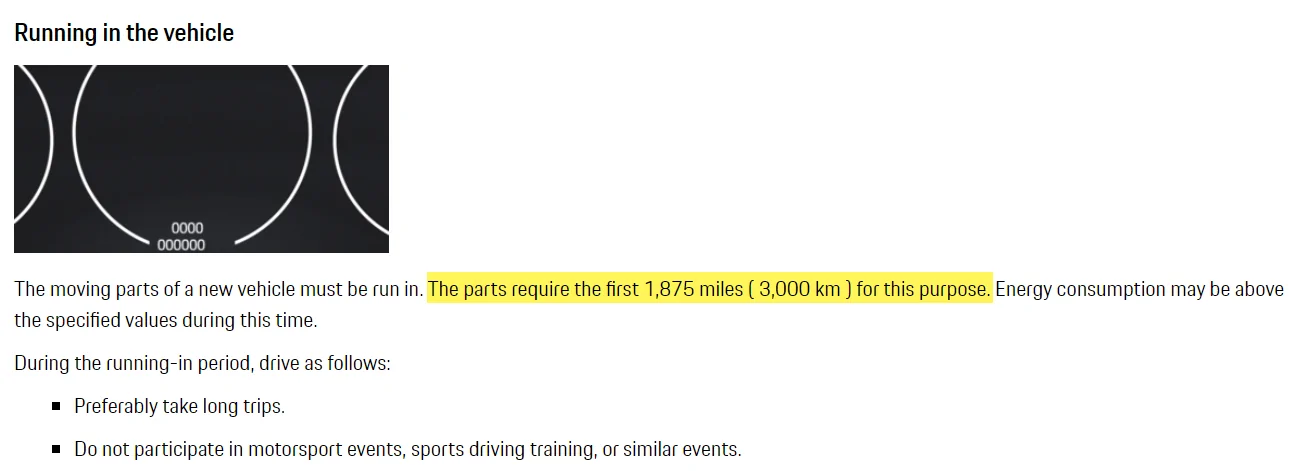
I hadn't read the manual, nor tried the Sport mode until about ~1700 miles of driving. By this point coasting almost became a second nature (as in modulating the 'throttle' not to carry too much speed into the back of that truck), and so the first time I activated 'Sport' mode I thought something broke. The motor braking effect is very pronounced (to me, at least) - much more so than I'd experience, on the same road and in the same driving manner, with my lowly 996. Color me the odd one out - and that's reason #2 I regret not getting the Sport Chrono package (for its Individual mode).? The contradiction I was trying to articulate was that Porsche make a point of saying that the car coasts by default, but they are overlooking the fact that many Porsche owners seem to default to Sport or Sport+. I suppose it's all part of the game of presenting the best WLTP numbers.
I've not noticed those characteristics (I wonder if due in part to different motors in Turbo and 4S from those in 4?). Can you elaborate on the SoC-dependent one?...the brake feel (pedal and deceleration) has been all over the place for me:
- steady/consistent braking at city speeds (30-50) to a crawl or a halt
- significant downstep at 6mph for 'weak' braking - 10mph to 5 <- this one requires extra care, as there's virtually 0 stopping power if an emergency stop is needed
- SoC-dependent at highway speeds <- this one requires tempering one's exuberance at the beginning of longer trips

I found the following in the user manual:I hadn't read the manual, nor tried the Sport mode until about ~1700 miles of driving. By this point coasting almost became a second nature (as in modulating the 'throttle' not to carry too much speed into the back of that truck), and so the first time I activated 'Sport' mode I thought something broke. The motor braking effect is very pronounced (to me, at least) - much more so than I'd experience, on the same road and in the same driving manner, with my lowly 996. Color me the odd one out - and that's reason #2 I regret not getting the Sport Chrono package (for its Individual mode).
Having said that, the brake feel (pedal and deceleration) has been all over the place for me:
- steady/consistent braking at city speeds (30-50) to a crawl or a halt
- significant downstep at 6mph for 'weak' braking - 10mph to 5 <- this one requires extra care, as there's virtually 0 stopping power if an emergency stop is needed
My habit road tripping Tesla was to temper my exuberance at the end of the run. As the car starts showing <5% estimate at the next charger (I've gone negative on there before, which I will admit causes a little range anxiety- SoC-dependent at highway speeds <- this one requires tempering one's exuberance at the beginning of longer trips
 ) then it's time to slow down until estimate comes back up to 5%. Until then however, having fun with the car. This also means I tend to overcharge at stops in order to not have to slow down before the next charger.
Afair the front axle motors are the same across.. The brake pedal travel has an initial "no op" segment, which just engages the relay/brake light. After that, at normal SoC (not sure exactly where, but below 90%) the travel in the pedal translates directly into deceleration - it feels consistent and very easy to modulate. At high SoC, the braking goes straight to hydraulic and same top segment of the travel produces far less braking force, _and_ is subject to whatever condition the discs (or pads) may be in - wet, superficial oxidation, warmed up etc. (And you can hear the grinding.)I've not noticed those characteristics (I wonder if due in part to different motors in Turbo and 4S from those in 4?). Can you elaborate on the SoC-dependent one?
Thanks for that elaboration of the issue.Afair the front axle motors are the same across.. The brake pedal travel has an initial "no op" segment, which just engages the relay/brake light. After that, at normal SoC (not sure exactly where, but below 90%) the travel in the pedal translates directly into deceleration - it feels consistent and very easy to modulate. At high SoC, the braking goes straight to hydraulic and same top segment of the travel produces far less braking force, _and_ is subject to whatever condition the discs (or pads) may be in - wet, superficial oxidation, warmed up etc. (And you can hear the grinding.)
Don't get me wrong, the hydraulic brakes are great - it's just that the muscle memory gets reset; to a casual user, driving this car in seemingly identical conditions would yield inconsistent behavior. I'm still pondering what's the best way to introduce this car to my wife..
