Sponsored

hmmm - my lovely Taycan is limited to 220 miles range - [Edit] I think it's the tires…

submatrix

Well-Known Member
Joined
May 14, 2021
Threads
19
Messages
609
Reaction score
436
Location
California
Vehicles
2021 Taycan
Country flag
Not that we have apples to apples, but my Tesla model Y on my most recent charge got:

83% down to 42%
Miles driven: 85.8
Reported energy consumption: 240 watts per mile
Calculated range: 209 miles

Pretty poor considering when I bought the car, Tesla claimed the range was 313 miles. And I don't drive all that fast or far (I drive maybe 30 miles a day).

But since I only charge my car once a week, I've always wondered if Tesla has a large loss of range over night which might account for the lousy range I get.
Yes, Teslas are well known for pretty poor vampire drain. While it's certain that the Tesla has a lot more software smarts than the Taycan, what isn't clear is why a Tesla would drain anywhere from 1-3% per day while the Taycan can sit for a week and not lose 1%.
Sponsored


Scandinavian

Well-Known Member
First Name
Peter
Joined
Nov 3, 2019
Threads
52
Messages
3,904
Reaction score
3,549
Location
France
Vehicles
Taycan T, Aston Martin DB9, Porsche 996 C4 Cab, i4
Country flag
based on this data I 100% agree - I'll be getting the all seasons for my next set of tires - based on more than adequate grip and the apparent improved range.
If I convert your data correctly, your 2.7 miles per kWh would equal 23 kWh per 100 km??
I run the Eagle F1 on 21 inch Mission e wheels and my overall consumption is 21.0 kWh per 100 km.

Interesting that All season tyres would give a better range. Even if they are not so sticky.
 
  • Like
Reactions: B61
OP
OP
daveo4EV

daveo4EV

Well-Known Member
First Name
David
Joined
Jan 28, 2019
Threads
192
Messages
7,007
Reaction score
10,478
Location
Santa Cruz
Vehicles
Cayenne Hybrid, 911(s) GT3/Convertable
Country flag
If I convert your data correctly, your 2.7 miles per kWh would equal 23 kWh per 100 km??
I run the Eagle F1 on 21 inch Mission e wheels and my overall consumption is 21.0 kWh per 100 km.

Interesting that All season tyres would give a better range. Even if they are not so sticky.
sticker tire = increased rolling resistance - by my calcs using 230 miles w/Summer tires as "my range" vs. 260 miles based on my experience with the continentals that's an 11.5% whack on range just for swapping the tires.
 
OP
OP
daveo4EV

daveo4EV

Well-Known Member
First Name
David
Joined
Jan 28, 2019
Threads
192
Messages
7,007
Reaction score
10,478
Location
Santa Cruz
Vehicles
Cayenne Hybrid, 911(s) GT3/Convertable
Country flag
here are the calc's with some standard conversions - kiloMeters included along with kWh/100 (miles/kiloMeters) so that people have their common mental model represented

Porsche Taycan hmmm - my lovely Taycan is limited to 220 miles range - [Edit] I think it's the tires… Screen Shot 2021-10-01 at 11.04.06 AM
 

Kingske

Well-Known Member
First Name
Frank
Joined
Jun 6, 2020
Threads
79
Messages
1,429
Reaction score
1,643
Location
New Jersey and Colorado, USA
Vehicles
2020 Porsche Taycan 4S, 2024 BMW X3, 2014 BMW 3 GT
Country flag
Yes, Teslas are well known for pretty poor vampire drain. While it's certain that the Tesla has a lot more software smarts than the Taycan, what isn't clear is why a Tesla would drain anywhere from 1-3% per day while the Taycan can sit for a week and not lose 1%.
Actually, for a month and only lose 1% based on my own experience.


OP
OP
daveo4EV

daveo4EV

Well-Known Member
First Name
David
Joined
Jan 28, 2019
Threads
192
Messages
7,007
Reaction score
10,478
Location
Santa Cruz
Vehicles
Cayenne Hybrid, 911(s) GT3/Convertable
Country flag
my model 3 would love 2-3% overnight - every day…and I had it set to sleep and such…
 

chrisk

Well-Known Member
Joined
Dec 3, 2020
Threads
17
Messages
975
Reaction score
1,025
Location
California
Vehicles
2020 Taycan 4S
Country flag
@daveo4EV other things to consider are changes to your car like new tires that might be stickier than the previous ones.
I guess I win the "I told you" prize :)

Btw, I my 4s goes ~300 miles at 100% with the Michelin stock summer tires, interesting to see if I get extra mileage if I switch with all-seasons next year.
 

f1eng

Well-Known Member
First Name
Frank
Joined
Aug 19, 2021
Threads
48
Messages
4,765
Reaction score
8,335
Location
Oxfordshire, UK
Vehicles
Taycan CT4S, Ferrari 355, Merc 500E, Prius PHV
Country flag
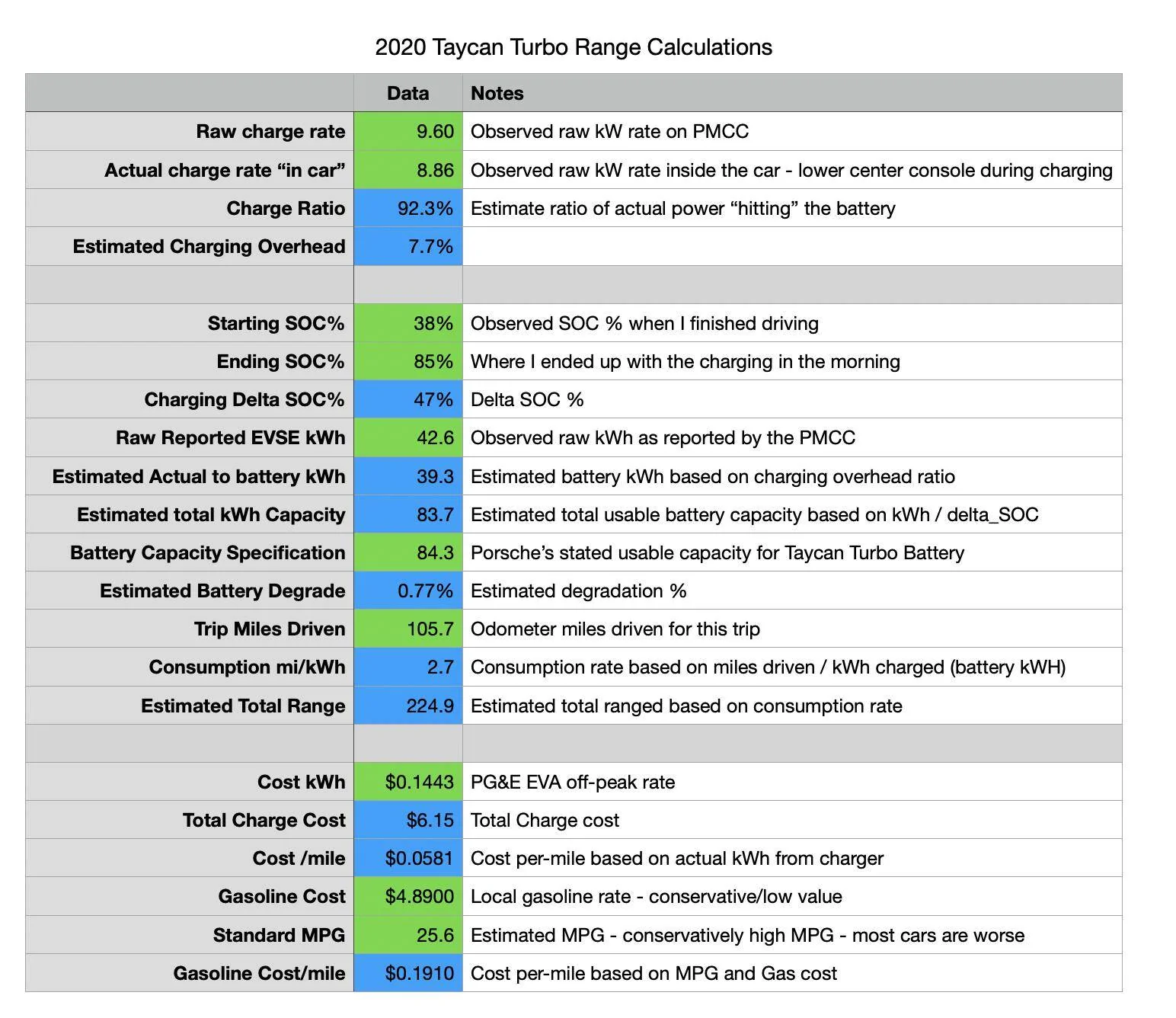
I've canceled my service appointment - I don't think the battery capacity has changed - calculations shown below:

Green Cells are "data entered manually"
Blue Cells are "calculations from the manual data"

Screen Shot 2021-10-01 at 10.35.00 AM.png


conclusion I'm getting 2.7 mi/kWh - which exactly equals 224 miles of range at that consumption rate - I recently moved from Factory Continental All Seasons to Goodyear Eagle F1 tired (N
F0)
- the Goodyears should be a sticker tire - so that may account for the consumption numbers.

in any case my charging sessions data indicated a usable battery capacity of 83.76 vs. 84.3 stated by Porsche which is a 0.77% loss of capacity

I'm going to keep more data and keep checking it - but for now I'm blaming the tires and increased consumption.

my consumption is pretty clearly 2.7 mile/kWh - which means maximum range calculates out to 224 - range isn't going to get better until I get my consumption numbers to be better.

in any case this is some pretty good data regarding the sort of range I'm seeing with the Goodyear F1 tires for Taycan - pretty heft range hit IMHO - may not be worth it for the extra sticky…
The EVs with the best "consumption" seem to have smallish low rolling resistance tyres. Not good for sporty driving (or an emergency stop) but great for range.
Our Prius PHV does around 6 miles/kWh but the standard tyres are 13" low rolling resistance ones..


Bsteffes

Well-Known Member
Joined
Jul 19, 2020
Threads
4
Messages
54
Reaction score
82
Location
Florida
Vehicles
911 S (s) Cayenne S, Taycan 4s, GT4 clubsport
Country flag
That range and timeline is similar to the numbers that I have experienced. I consistently get 205 @ 85%. I have the 21” exclusive wheels with summer rubber. I drive almost all the time with sports plus


QUOTE="RCorsa, post: 97534, member: 2598"]
Maybe the EA people read the forums and wanted to get back at you so they installed a gremlin.
Honestly though, That is very odd. My car started around 185 at 85% 10 months and 6000 miles ago. Now it seems to be around 235-245 depending on how I’ve been driving.

please keep us updated. I would fear, like you, that Porsche will claim it’s your driving and not help out
[/QUOTE]
 

Needsdecaf

Well-Known Member
First Name
Joe
Joined
Aug 17, 2021
Threads
4
Messages
230
Reaction score
189
Location
The Woodlands, TX
Vehicles
997.2 Turbo S, Cayenne Diesel, Cayenne E_Hybrid
Country flag
Yes, Teslas are well known for pretty poor vampire drain. While it's certain that the Tesla has a lot more software smarts than the Taycan, what isn't clear is why a Tesla would drain anywhere from 1-3% per day while the Taycan can sit for a week and not lose 1%.
Teslas don't do that unless you set cabin overheat to on and run Sentry mode. If you do those things, the car won't sleep and vampire drain can be bad. If the car is allowed to sleep, it'll be fine.

One weird thing I noticed when investigating was that if the car is in range of your home wifi, it has a hard time sleeping. Tesla that is.
 
OP
OP
daveo4EV

daveo4EV

Well-Known Member
First Name
David
Joined
Jan 28, 2019
Threads
192
Messages
7,007
Reaction score
10,478
Location
Santa Cruz
Vehicles
Cayenne Hybrid, 911(s) GT3/Convertable
Country flag
Teslas don't do that unless you set cabin overheat to on and run Sentry mode. If you do those things, the car won't sleep and vampire drain can be bad. If the car is allowed to sleep, it'll be fine.

One weird thing I noticed when investigating was that if the car is in range of your home wifi, it has a hard time sleeping. Tesla that is.
this is incorrect - I had everything I could "turned off" - I would routinely lose 1-3% overnight after charging finished before I got in the car every morning…and I had everything turned off that I could

this was true for my:
2014 Model S P85D
2017 Model X P100D
2018 Model 3 Performance

my experience is Tesla vampire drain is real, it's a thing and it does actually cost quite a bit over the life of the car

I had a co-worker that lived close enough to work that he walked most of the time - owned a Model S - drove it soooo little - that he spend more recharging vampire drain than he did actually driving the vehicle.
 

submatrix

Well-Known Member
Joined
May 14, 2021
Threads
19
Messages
609
Reaction score
436
Location
California
Vehicles
2021 Taycan
Country flag
this is incorrect - I had everything I could "turned off" - I would routinely lose 1-3% overnight after charging finished before I got in the car every morning…and I had everything turned off that I could

this was true for my:
2014 Model S P85D
2017 Model X P100D
2018 Model 3 Performance

my experience is Tesla vampire drain is real, it's a thing and it does actually cost quite a bit over the life of the car

I had a co-worker that lived close enough to work that he walked most of the time - owned a Model S - drove it soooo little - that he spend more recharging vampire drain than he did actually driving the vehicle.
Indeed, I also experienced 1-3% per day (usually more like 1%) vampire drain in my 2018 Model S without cabin overheat or sentry mode on.
 

Needsdecaf

Well-Known Member
First Name
Joe
Joined
Aug 17, 2021
Threads
4
Messages
230
Reaction score
189
Location
The Woodlands, TX
Vehicles
997.2 Turbo S, Cayenne Diesel, Cayenne E_Hybrid
Country flag
this is incorrect - I had everything I could "turned off" - I would routinely lose 1-3% overnight after charging finished before I got in the car every morning…and I had everything turned off that I could

this was true for my:
2014 Model S P85D
2017 Model X P100D
2018 Model 3 Performance

my experience is Tesla vampire drain is real, it's a thing and it does actually cost quite a bit over the life of the car

I had a co-worker that lived close enough to work that he walked most of the time - owned a Model S - drove it soooo little - that he spend more recharging vampire drain than he did actually driving the vehicle.
That happens to me at home too. And I couldn't understand why at work I'd have zero vampire drain after being there 9 hours. Then it hit me...wifi.

I tried turning off wifi at home and boom. No more vampire drain. Like less than 1 mile lost overnight.
 

JimBob

Well-Known Member
First Name
James
Joined
Jan 26, 2021
Threads
75
Messages
950
Reaction score
1,109
Location
Toronto Canada
Vehicles
Taycan 4S
Country flag
Interesting analysis.

Took a look at your analysis to see what is most critical to your conclusion. Any physicists or EE's could chime in.

Starting and ending SOC are the boundaries.

The Raw Reported EVSE kWh is the critical number. Honestly have never paid attention to what data the PMCC provides.

Next is Estimated Actual to battery kWh. This looks to be a soft number. The problem I think is that your charge rates are measuring power and not energy. If your power rating is an instantaneous measure it could be far off from the correct power input to the battery as the power could vary with time. For instance charging a battery shows high power input at low SOC but lower power input at high SOC.

One comment is that most reports indicate 20% charging losses. ie 20% of the energy put into the battery is lost primarily due to heating. Your numbers are much less than this which is of interest.

You might try running the test again but with a lower SOC and see how it compares. Discharging the battery to zero and charging to 100% and measure and see what the energy input is from the PMCC. I think this might require fewer assumptions.
 
OP
OP
daveo4EV

daveo4EV

Well-Known Member
First Name
David
Joined
Jan 28, 2019
Threads
192
Messages
7,007
Reaction score
10,478
Location
Santa Cruz
Vehicles
Cayenne Hybrid, 911(s) GT3/Convertable
Country flag
For instance charging a battery shows high power input at low SOC but lower power input at high SOC.
I agree in theory - charge rate however does not taper for 240V charging until one is above 93% SOC - until then charge rate is mostly linear…but yes you are correct I'm assuming charge rate losses (raw vs. actually battery kW charge rate) is mostly linear…

my ownership period of EV's since 2013 I've found charging losses routinely run in the 5-8% range - unless weather is a factor - i.e. super cold (50F or less or over 90F) - I"m in mild temps - so charging rate losses are in line with my experience and expectations - 20% charging overhead is very very high - and AC/DC inverters tend to be 9% loss or less…

20% charging loss routinely would dramatically affect the efficiencies of EV process and I've never seen any "real cost" studies that estimate them that high (unless of course again environmental conditions are causing additional drain during the charging process - again mostly do to cold weather charger which was not a factor here).
Sponsored


Top