Tooney
Well-Known Member
- Joined
- Aug 14, 2021
- Threads
- 746
- Messages
- 4,471
- Reaction score
- 3,651
- Location
- Ohio
- Vehicles
- 2022 Taycan 4S

- Thread starter
- #1
https://afdc.energy.gov/files/u/pub...infrastructure_trends_fourth_quarter_2021.pdf
Couple extracts:


"Based on NREL’s 2017 analysis that estimated the number of public and workplace chargers required to support a scenario in which there are 15 million EVs on the road by 2030, the number of DC fast and Level 2 EVSE ports as of Q4 is 79.0% and 16.8%, respectively, of the way toward meeting projected 2030 needs (Wood et al. 2017). However, the majority (58.0%) of public DC fast EVSE ports in the Station Locator are on the Tesla network and are therefore only readily accessible to Tesla drivers. When Tesla EVSE ports are removed, this decreases to 33.3% and 15.0%, respectively. Based on Atlas’ 2021 assessment that estimated the number of public and workplace chargers required in a scenario in which 100% of passenger vehicle sales are electric by 2035, the number of Level 2 and DC fast EVSE ports as of Q4 is 8.1% and 30.2%, respectively, of the way toward meeting projected 2030 needs (McKenzie and Nigro 2021). This decreases to 3.5% and 27.8%, respectively, when Tesla EVSE ports are removed.
When comparing the current rate of deployment of public charging infrastructure with the Biden administration’s goal of installing 500,000 EVSE ports in the United States by 2030, it is clear that the pace of installations will need to significantly increase. Since the start of 2020, an average of 5,077 public EVSE ports have been installed each quarter. To meet the Biden administration’s goal by 2030, approximately 12,048 public EVSE port installations will be required each quarter for the next 9 years."
Couple extracts:
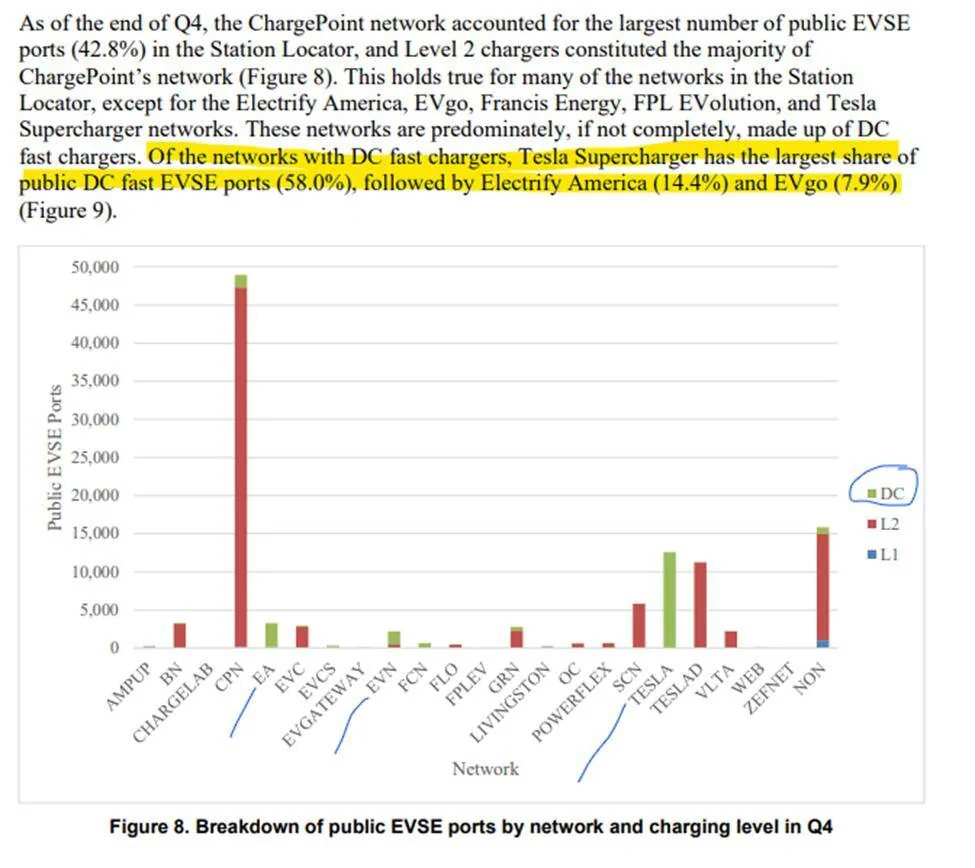
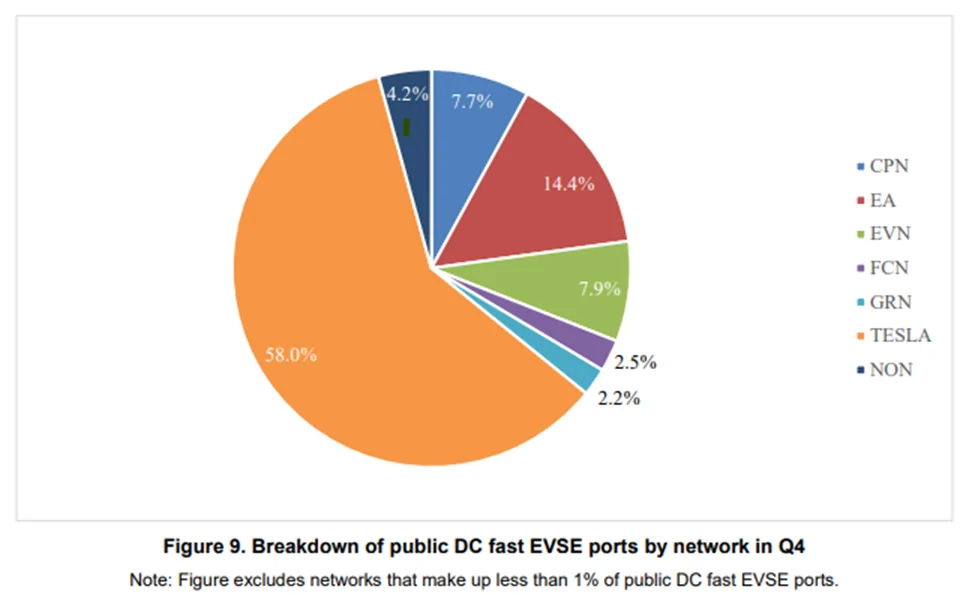
"Based on NREL’s 2017 analysis that estimated the number of public and workplace chargers required to support a scenario in which there are 15 million EVs on the road by 2030, the number of DC fast and Level 2 EVSE ports as of Q4 is 79.0% and 16.8%, respectively, of the way toward meeting projected 2030 needs (Wood et al. 2017). However, the majority (58.0%) of public DC fast EVSE ports in the Station Locator are on the Tesla network and are therefore only readily accessible to Tesla drivers. When Tesla EVSE ports are removed, this decreases to 33.3% and 15.0%, respectively. Based on Atlas’ 2021 assessment that estimated the number of public and workplace chargers required in a scenario in which 100% of passenger vehicle sales are electric by 2035, the number of Level 2 and DC fast EVSE ports as of Q4 is 8.1% and 30.2%, respectively, of the way toward meeting projected 2030 needs (McKenzie and Nigro 2021). This decreases to 3.5% and 27.8%, respectively, when Tesla EVSE ports are removed.
When comparing the current rate of deployment of public charging infrastructure with the Biden administration’s goal of installing 500,000 EVSE ports in the United States by 2030, it is clear that the pace of installations will need to significantly increase. Since the start of 2020, an average of 5,077 public EVSE ports have been installed each quarter. To meet the Biden administration’s goal by 2030, approximately 12,048 public EVSE port installations will be required each quarter for the next 9 years."
Sponsored