Sponsored

Short charging cycles vs longer cycles

What is best for a new car


  • Total voters
    40

whitex

Well-Known Member
Joined
Jul 30, 2021
Threads
87
Messages
8,218
Reaction score
7,253
Location
WA, USA
Vehicles
2023 Taycan TCT, 2024 Q8 eTron P+
Country flag
That's not data, that's propaganda. ?
I know, but it does indicate Tesla thought keeping cars plugged in whenever possible was the best way to avoid battery warranty claims, perhaps a decision based on data they have (and out of all EV manufacturers, they have most data by any measure).
 

Dee

Well-Known Member
First Name
Dee
Joined
Dec 14, 2018
Threads
78
Messages
3,508
Reaction score
4,050
Location
The Netherlands
Vehicles
A lot
Country flag
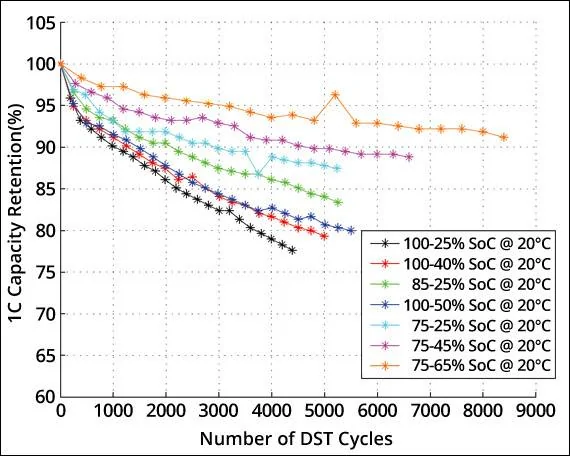
See attachement.. it shows battery degradation for different charging for li-ion batteries.
as know by most, it’s best to keep these batteries as much between 20-80% soc as possible, but it’s even better to charge more often. There’s also practicality and other factors that play a part in this.

IMG_4652.webp
It only shows 1C so that's not representative at all.
It would mean you would have a charge and discharge capacity of 84kWh on a 84kWh battery.
Charging: it doesn't say at what rate.
Is it fastcharging, like @168kW in 30 min or @21 kW in 4 hours like slow charging?
Discharging: do you drive with an average of 42kWh/100km in 2 hours? I don't think so.
Also, ambient temperature differs a lot, like -10 to +30°C so it's not representative at all.
 
  • Like
Reactions: B61


Dee

Well-Known Member
First Name
Dee
Joined
Dec 14, 2018
Threads
78
Messages
3,508
Reaction score
4,050
Location
The Netherlands
Vehicles
A lot
Country flag
I know, but it does indicate Tesla thought keeping cars plugged in whenever possible was the best way to avoid battery warranty claims, perhaps a decision based on data they have (and out of all EV manufacturers, they have most data by any measure).
It says "plugged in", it doesn't say anything about charge rate or SoC. ??‍♂
 
Last edited:
  • Like
Reactions: B61

whitex

Well-Known Member
Joined
Jul 30, 2021
Threads
87
Messages
8,218
Reaction score
7,253
Location
WA, USA
Vehicles
2023 Taycan TCT, 2024 Q8 eTron P+
Country flag
It say "plugged in", it doesn't say anything about charge rate or SoC. ??‍♂
True, the poster did not state SoC. However, Tesla in car and app UI does show "daily" vs. "trip" target charge SoC, with daily maxing out at 90%. So combine that with their "Plugged in EV is a happy EV" and you get the whole picture, including keeping it plugged in when in the garage and keeping SoC limited to under 90% is best for Tesla to avoid battery warranty claims.
 

paulbroere

Well-Known Member
First Name
Paul
Joined
May 25, 2022
Threads
1
Messages
45
Reaction score
71
Location
The Netherlands
Website
www.paulbroere.com
Vehicles
Porsche Taycan 4S (my26), BMW Z4M Roadster, previous: Sport Turismo (my23)
Country flag
It only shows 1C so that's not representative at all.
It would mean you would have a charge and discharge capacity of 84kWh on a 84kWh battery.
Charging: it doesn't say at what rate.
Is it fastcharging, like 168kW in 30 min or 21 kW in 4 hours like slow charging?
Discharging: do you drive with an average of 42kWh/100km in 2 hours? I don't think so.
Also, ambient temperature differ a lot, like -10 to +30°C so it's not representative at all.
like I said, there's many more factors that come in to play, this was only to illustrate that in fact there is/can be a difference between differente charging habbits, concerning 'longer/shorter cycles'.. and in theory it's better to do short cycles. I know temperature, charging speed ("C"), discharging speed, cooling, etc. etc. etc. can ALSO effect SoH, but that wasn't what the question was about..


whitex

Well-Known Member
Joined
Jul 30, 2021
Threads
87
Messages
8,218
Reaction score
7,253
Location
WA, USA
Vehicles
2023 Taycan TCT, 2024 Q8 eTron P+
Country flag
like I said, there's many more factors that come in to play, this was only to illustrate that in fact there is/can be a difference between differente charging habbits, concerning 'longer/shorter cycles'.. and in theory it's better to do short cycles. I know temperature, charging speed ("C"), discharging speed, cooling, etc. etc. etc. can ALSO effect SoH, but that wasn't what the question was about..
Sadly, there are also differences in the battery chemistry, BMS algorithms, etc. All of those change what is best for the car. I learned that over the decade driving Teslas. New research would come out, based on Nissan Leaf batteries, but then it would turn out the best thing for a Leaf driver was not the best for Model S driver because the Leaf did not have the same BMS (no active heating for example) and it had a different chemistry. Then someone actually did some test on a individual cells from a crashed Model S, well, couple of issues with that - first, no BMS to manage its temperature and charging speeds, but also Tesla kept evolving their battery chemistry too.

Long story short, the tech is still in its infancy, we don't really know for sure what is best, and it probably heavily depends on what car you are driving, how you drive it and where (in what temperatures). What we do know is that fast charging and fast discharging (e.g. launch mode launches) wear the battery disproportionally more - that is true across different chemistries so far. Same is true for under 10% and over 90% (true SoC, which is not always what is being reported) being unhealthy for the battery for prolonged periods of time (also true 0% SoC means battery is permanently bricked). The idea that "plugged in EV is a happy EV" makes sense assuming the car manufacturer knows what they are doing - they can always choose to not use shore power, but at least they have the option to do so. I would think the manufacturer has the most data about a particular battery they are using, so keeping the EV plugged-in allows their software to make most optimal decisions on how to get the longest life out of their battery, especially considering they have to warranty it.
 
Last edited:

B61

Well-Known Member
First Name
Bine
Joined
May 31, 2021
Threads
10
Messages
2,722
Reaction score
1,724
Location
SI
Vehicles
4S (8/2025), CT4 (9/2021-8/2025, 65k km)
Country flag
Long story short, the tech is still in its infancy, we don't really know for sure what is best, and it probably heavily depends on what car you are driving, how you drive it and where (in what temperatures).
Exactly.
That’s why one needs to observe behaviour of his/her own vehicle.
 
  • Like
Reactions: Dee

Dee

Well-Known Member
First Name
Dee
Joined
Dec 14, 2018
Threads
78
Messages
3,508
Reaction score
4,050
Location
The Netherlands
Vehicles
A lot
Country flag
Long story short, the tech is still in its infancy, we don't really know for sure what is best, and it probably heavily depends on what car you are driving, how you drive it and where (in what temperatures).
My point.
That's why I said don't worry too much and enjoy the car.
The battery will probably outlive the car (>500.000km).
All test show the degradation isn't as bad as assumed and tech is evolving in time also...
We only know about older batteries but that doesn't say all about the new batteries like the pouch cells of LG Chem in our Taycan (Tesla has Panasonic cylindrical cells).
I can imagine pouch cells have better cooling surface.
 

Dee

Well-Known Member
First Name
Dee
Joined
Dec 14, 2018
Threads
78
Messages
3,508
Reaction score
4,050
Location
The Netherlands
Vehicles
A lot
Country flag
like I said, there's many more factors that come in to play, this was only to illustrate that in fact there is/can be a difference between differente charging habbits, concerning 'longer/shorter cycles'.. and in theory it's better to do short cycles. I know temperature, charging speed ("C"), discharging speed, cooling, etc. etc. etc. can ALSO effect SoH, but that wasn't what the question was about..
If you would charge the battery at a slow speed wouldn't you agree the graphic would look completely different?
We don't know what the charge rate was and that makes a huge difference in 4000-6000 charge cycles so that's why I think it's NOT representative at all. ?
 
  • Like
Reactions: B61

paulbroere

Well-Known Member
First Name
Paul
Joined
May 25, 2022
Threads
1
Messages
45
Reaction score
71
Location
The Netherlands
Website
www.paulbroere.com
Vehicles
Porsche Taycan 4S (my26), BMW Z4M Roadster, previous: Sport Turismo (my23)
Country flag
If you would charge the battery at a slow speed wouldn't you agree the graphic would look completely different?
We don't know what the charge rate was and that makes a huge difference in 4000-6000 charge cycles so that's why I think it's NOT representative at all. ?
I would indeed agree, to some extend. We need to know how much each variable influences the SOH, for example Fast charging (heat!), or high/low Soc (for longer times), or other factors.
So you're probably right it's not really representative for overal soh after a certain number of charges, but it does give you an insight on 1 factor at least.

Probably the best conclusion from this discussion is that: 1.We still don't know much. 2.Many things can influence battery life. 3.There are difference per car brand/model because of different BMS, Cooling, battery design and chemistry, etc.

The things that we are pretty certain of:
1. Fast charging (heat) is not the best (hence the battery saving fast-charge option in the Taycan)
2. very high/low soc is not the best (expecially if the caar is at that soc for long times)
3. Heat is not good for a battery.
(edit: above is applicable for Li-ion batteries, other chemistries may require other best practices).
 
  • Like
Reactions: Dee

JimBob

Well-Known Member
First Name
James
Joined
Jan 26, 2021
Threads
75
Messages
950
Reaction score
1,109
Location
Toronto Canada
Vehicles
Taycan 4S
Country flag
You can create all sorts of straw men. But look at what Porsche says, it's their battery after all and they aren't likely to recommend practices that are going to trigger warranty claims . As far as I know, and correct me if I am wrong, they have never commented on shallow charging vs deep charging. They have commented on leaving the battery at 100% SOC, not good. Rapid DC charging, they offered the option to limit the rate to prolong the battery. They have also commented on charging batteries at very cold temperatures. Their recent comments on the electric Macan indicate some changes in the works as they have gained experience, especially with the buffer size.

If it was a factor, they would have told us.
 

whitex

Well-Known Member
Joined
Jul 30, 2021
Threads
87
Messages
8,218
Reaction score
7,253
Location
WA, USA
Vehicles
2023 Taycan TCT, 2024 Q8 eTron P+
Country flag
As a reference, 10 year old Tesla, charged daily to 90% and kept plugged in - 6% degradation. That is in line with my experience with 4 Teslas (all Model S as well, spanning 2013 to 2018 MYs).
https://teslamotorsclub.com/tmc/threads/battery-degradation-–-10-year-report.285721/
Whether or not this translates directly to Porsche, we don't know. But I plan to do the same with the Taycan, adhere to Porsche recommendation for max SoC, keep it plugged in so the car can decided when it's best to use shore power.
Sponsored

 
Last edited:


Top