Sponsored

Regenerative Breaking ... A Hypothetical Question

Neighs

Well-Known Member
First Name
Horsey
Joined
Aug 15, 2020
Threads
26
Messages
149
Reaction score
137
Location
UK
Website
www.instagram.com
Vehicles
Taycan 4S, BMW X3 35d, BMW 135i
Country flag
I tried to work this out as a thought experiment and failed dismally.

For a start I’m not really sure of all the variables.

But the question goes something like this...

What kind of spirited drive could you go on where you ended the drive with the same amount of charge in the battery as you started?

if you drove a nice mountain pass with a charge station at the top, what kind of altitude drop would you need per hour to make up for any power used during that time...

We know the weight of the car, the regenerative capacity of the motors for breaking. We know the average Kw per mile for healthy driving.
Sponsored

 

daveo4EV

Well-Known Member
First Name
David
Joined
Jan 28, 2019
Threads
192
Messages
7,006
Reaction score
10,475
Location
Santa Cruz
Vehicles
Cayenne Hybrid, 911(s) GT3/Convertable
Country flag
there is no free lunch - regen best case is a 70% recovery - and even that might be optimistic

so really really really effective best case optimistic perfect conditions regen means you spend 10 kWh you can recover 7 kWh - then when you spend that 7 kWh again - you can recover 4.9 kWh…conservation of energy and thermodynamic laws require that - can't get more energy out of a system than you put into a system - and given there are losses you can never recover (waste heat & resistance in the wires for example) - well you can't get back to where you started - ever!

if you spend 10 kWh for a given distance the MOST you could possibly recover traveling the same distance would be 7 kWh back in the battery - and I believe even that number is insanely optimistic…

there are losses all along the way DC to AC conversion (consumption) - AC to DC conversion (regen) - rolling friction, AC/HVAC Loads, aero dynamics, and parasitic losss - losses to heat and battery management…

I think if you consume 10 kWh going up say 10,000 feet - you'd have to travel like at least 16,000 feet down to get back to equal...but now we're putting "more" energy into the system - the extra 6,000 feet of kinetic energy is additional energy beyond what we put in to start with…

I don't think there is _ANY_ scenario under which where the car is accelerating/decelerating where you will get back to equal - you lose at least 2-3% just getting power out of the battery to the AC motors - so that alone would require you to travel more distance under-regen before you account for any other losses…

there is no free lunch - and there is always loss in energy conversions - and there are a lot of conversions going on in an EV - the only thing that makes them better than ICE vehicles is the conversions are more efficient that the same conversions in the ICE world.
 
Last edited:

daveo4EV

Well-Known Member
First Name
David
Joined
Jan 28, 2019
Threads
192
Messages
7,006
Reaction score
10,475
Location
Santa Cruz
Vehicles
Cayenne Hybrid, 911(s) GT3/Convertable
Country flag
now if your question is in a pure downhill scenario can I arrive at the bottom on the hill with more power than I used going down hill - yes...I've done it - coming out of the grape vine south bound into LA - I often arrive at the bottom of the hill as compared to the top of the hill at a higher battery percentage...

regen can effectively make going down hill "free" + dividends paid to the battery - that's because the car is coasting - and you're not using more power than your regen is capable of - the only power you're using is the "vampire" power to keep the systems running - AC/HVAC radio, seats and such - yes a 5,100 lbs sedan going down hill at 65 mph has a lot of kinetic energy and you can recover some of that kenetic energy on the way down and it will be more than the car "used" to run the non-drive train systems…

example:
  • bottom of the grape vine - 95% battery - south bound - uphill
  • top of the the grapevine - 58% battery
  • bottom of the gape vine - 68% battery - south bound - downhill
yes you can "gain" battery - making the downhill "effectively free" - but you can _NOT_ get back to 95% battery - which is where you started before going up hill…but you can be at more battery than you had at the top of the hill...

I hear people do this all the time going south out of Tahoe with Model 3's - southbound coming from Tahoe is soooo much downhill it's effectively free - you end up leaving Truckee, and arriving in north Sacramento having used almost _NO_ battery - even though you've driven over 50 miles…

but you haven't gained any energy in the Total sum of things - you've used less than you consumed cause you were coasting downhill…and recovering some of your coasting speed - but to properly account for that "recovered" energy you have to remember how much you spent Thursday evening "climbing" the hill north bound - and how much you put into the EV at the "top" of the hill in Tahoe - but yeah for a given a downhill segment you can start with less battery at the top than you have at the bottom…but you didn't really gain anything in total energy spent if you include _ALL_ the energy in/out of the system…round trip to your home - to/from Tahoe - you spent more than you gained - it has to be that way due to physics - even if you home is exactly at the bottom of the hill…

you'll spend 67 kWh going uphill
you'll charge to 100% at the top of the hill - 72 kWh to charge
you'll start out at the top of the hill with 98% battery
you arrive home with 96% battery
you spend 5 kWh getting back to 100% @ home
you spent 77 kWh for the drive up/down the hill
even if you used next to nothing going down the hill - you spent 72 kWh to get there.
 
Last edited:

daveo4EV

Well-Known Member
First Name
David
Joined
Jan 28, 2019
Threads
192
Messages
7,006
Reaction score
10,475
Location
Santa Cruz
Vehicles
Cayenne Hybrid, 911(s) GT3/Convertable
Country flag
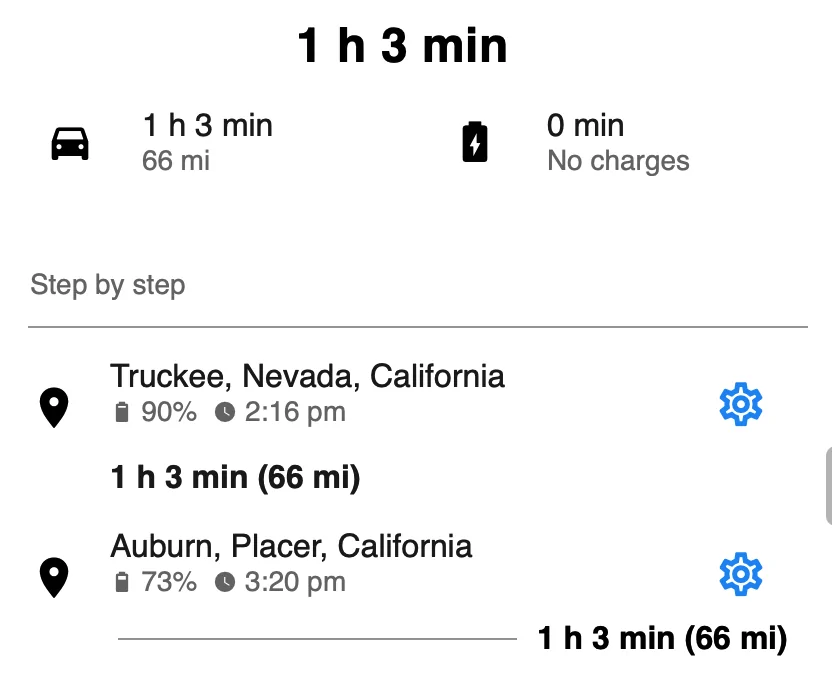
here is A Better Route Planner estimates for Truckee to Auburn (effectively the downhill portion south bound Tahoe)

this a Long Range Model 3 w/18" aero wheel - a current benchmark for EV efficiency…

this says you start 90% battery - drive 66 miles and arrive in Auburn at 73% battery

now that is a estimated kWh usage of 75 kWh * 17% - 12.75 kWh

12.75 kWh / 66 miles = 193 wh/mile - that's super cheap - given that 250 or 230 wh/mile is normal…

Porsche Taycan Regenerative Breaking ... A Hypothetical Question Screen Shot 2020-09-17 at 2.16.54 PM
 

daveo4EV

Well-Known Member
First Name
David
Joined
Jan 28, 2019
Threads
192
Messages
7,006
Reaction score
10,475
Location
Santa Cruz
Vehicles
Cayenne Hybrid, 911(s) GT3/Convertable
Country flag
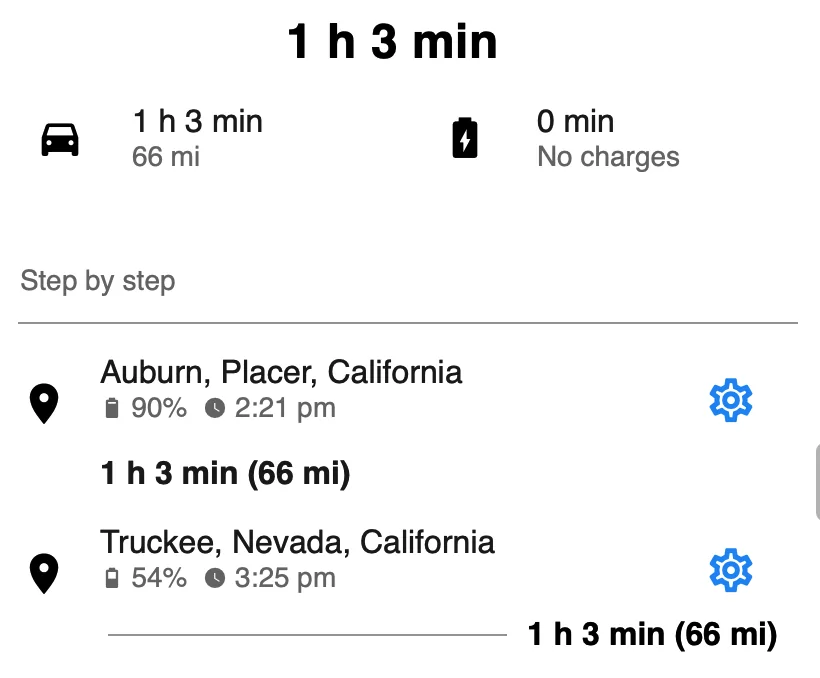
the reverse trip is more expensive - Auburn to Truckee is 90% to 53%

or 36% or - 27 kWh for the same distance, but it's uphill

Porsche Taycan Regenerative Breaking ... A Hypothetical Question Screen Shot 2020-09-17 at 2.22.22 PM


daveo4EV

Well-Known Member
First Name
David
Joined
Jan 28, 2019
Threads
192
Messages
7,006
Reaction score
10,475
Location
Santa Cruz
Vehicles
Cayenne Hybrid, 911(s) GT3/Convertable
Country flag
so we use 27 kWh to drive 66 miles uphill
we use 13 kWh to drive 66 miles downhill

for a total of 27 + 13 = 40 kWh to drive 132 miles total

40 kWh / 132 miles = 303 wh/mile - which is about the normal consumption for a Model 3 on flat terrain at constant speed and temperature.
 

Miwa

Well-Known Member
Joined
Oct 3, 2019
Threads
10
Messages
820
Reaction score
860
Location
Bay Area, CA, USA
Vehicles
Taycan Turbo
Country flag
The energy losses from friction with the air, and tires on the road, and mechanical losses plus the loss of energy from regen not being perfect, plus the loss of energy from converting battery power to kinetic energy has to equal the potential energy from being at the top of a hill for it to take zero net energy from the battery.

So, you just have to calculate all those losses :p
 

evanevery

Well-Known Member
First Name
Ed
Joined
Sep 10, 2019
Threads
38
Messages
998
Reaction score
1,143
Location
Wisconsin
Vehicles
2020 Taycan Turbo S, 2019 BMW i8, 2023 BMW iXM60
Country flag
Its a fairly simple analysis (except for the details) ;-)

You are effectively converting one type of potential energy (elevation) into another type of potential energy (electrical/battery storage) or a rate of energy consumption (for downhill charging).

The potential energy due to a change in elevation is simply the change in elevation times the weight of the car (PE = Ft/Lbs).

If you want to calculate STORED potential energy in the battery can be expressed in kwh. Ftlbs can be directly converted to kwh by multiplying by 3.76616e-7. (1 ftlb = 3.76616e-7 kwh).

Energy CONSUMED (or CHARGED) for the vehicle is typically rated in Wh. FtLbs can be directly converted to Wh by multiplying by 0.000376616000006047. ...so that's directly convertible from a change in elevation!

You can always ROLL to the bottom of a hill for free - in any car. So that's not really the question here. You can either run the calculations to determine how FAR to get back a certain charge LEVEL (KWH) for a given gradient, or what GRADIENT is required to achieve a particular charge RATE (wh/mi), or what GRADIENT is required to get back a certain charge level (KWH) in a specific distance traveled.

Assuming we already have the weight of the car, you will need to know the distance you will travel, the total change in elevation, and some combined efficiency factor to represent losses due to things like rolling resistance, wind resistance, parasitic electrical consumption, and charging efficiency. (The "combined efficiency factor" is really the big question here - but its just a number - so lets GUESS one and move on - 80%). If you have one parameter you want to calculate, you just need to know all the others.

Lets assume you want to achieve a charging rate equal to the consumption rate of your car on level ground. ABRP estimates 405 wh/mile for the Turbo S. Lets also use a vehicle weight of 5121 Lbs. 5121 x 0.000376616000006047 gives us 1.9286505 Wh/ft of elevation change. In order to get 405 Wh/Mile back in exchange, we would need to drop about 210 ft (405/1.9286505) every mile. That would make the required gradient about 262.5 ft/ mile (262.5 ft/5280ft). To get the gradient, we find the angle whose SIN is equal to the change in elevation (opposite) over the distance traveled (hypotenuse)(SOHCAHTOA. 262.5/5280 = 0.0497159. InvSin(0.0497159) = about 2.85 degrees. In order to get the GRADE of the road (typically used) = (262.5/5280) * 100 = 4.97%. So lets assume a 5% grade is what is needed to downhill charge at 405 Wh/Mile.

A 5% grade is reasonably steep for a road so I think the math is likely in the ballpark. The "grapevine" (as mentioned previously) seems to run between 5 and 7% at its steepest as noted here.

...and "they" told you that geometry would be of no use after you left high school? ;)


daveo4EV

Well-Known Member
First Name
David
Joined
Jan 28, 2019
Threads
192
Messages
7,006
Reaction score
10,475
Location
Santa Cruz
Vehicles
Cayenne Hybrid, 911(s) GT3/Convertable
Country flag
@evanevery you made my afternoon!!! thank you for that!! honestly during lock down, fires, pandemics, riots, fake news, social networks, frazzled relationships due to too much time together - that was the most fun I've had in a while...thanks for the analysis!!

honestly - truly awesome - now if we can just get people to approach everything with such a straight forward recitation of the facts we'd all be better off.

stupendous work - honestly - awesome!
 

evanevery

Well-Known Member
First Name
Ed
Joined
Sep 10, 2019
Threads
38
Messages
998
Reaction score
1,143
Location
Wisconsin
Vehicles
2020 Taycan Turbo S, 2019 BMW i8, 2023 BMW iXM60
Country flag
@evanevery you made my afternoon!!! thank you for that!! honestly during lock down, fires, pandemics, riots, fake news, social networks, frazzled relationships due to too much time together - that was the most fun I've had in a while...thanks for the analysis!!
Apparently we BOTH need professional help! ;)
 
OP
OP
Neighs

Neighs

Well-Known Member
First Name
Horsey
Joined
Aug 15, 2020
Threads
26
Messages
149
Reaction score
137
Location
UK
Website
www.instagram.com
Vehicles
Taycan 4S, BMW X3 35d, BMW 135i
Country flag
Its a fairly simple analysis (except for the details) ;-)

You are effectively converting one type of potential energy (elevation) into another type of potential energy (electrical/battery storage) or a rate of energy consumption (for downhill charging).

The potential energy due to a change in elevation is simply the change in elevation times the weight of the car (PE = Ft/Lbs).

If you want to calculate STORED potential energy in the battery can be expressed in kwh. Ftlbs can be directly converted to kwh by multiplying by 3.76616e-7. (1 ftlb = 3.76616e-7 kwh).

Energy CONSUMED (or CHARGED) for the vehicle is typically rated in Wh. FtLbs can be directly converted to Wh by multiplying by 0.000376616000006047. ...so that's directly convertible from a change in elevation!

You can always ROLL to the bottom of a hill for free - in any car. So that's not really the question here. You can either run the calculations to determine how FAR to get back a certain charge LEVEL (KWH) for a given gradient, or what GRADIENT is required to achieve a particular charge RATE (wh/mi), or what GRADIENT is required to get back a certain charge level (KWH) in a specific distance traveled.

Assuming we already have the weight of the car, you will need to know the distance you will travel, the total change in elevation, and some combined efficiency factor to represent losses due to things like rolling resistance, wind resistance, parasitic electrical consumption, and charging efficiency. (The "combined efficiency factor" is really the big question here - but its just a number - so lets GUESS one and move on - 80%). If you have one parameter you want to calculate, you just need to know all the others.

Lets assume you want to achieve a charging rate equal to the consumption rate of your car on level ground. ABRP estimates 405 wh/mile for the Turbo S. Lets also use a vehicle weight of 5121 Lbs. 5121 x 0.000376616000006047 gives us 1.9286505 Wh/ft of elevation change. In order to get 405 Wh/Mile back in exchange, we would need to drop about 210 ft (405/1.9286505) every mile. That would make the required gradient about 262.5 ft/ mile (262.5 ft/5280ft). To get the gradient, we find the angle whose SIN is equal to the change in elevation (opposite) over the distance traveled (hypotenuse)(SOHCAHTOA. 262.5/5280 = 0.0497159. InvSin(0.0497159) = about 2.85 degrees. In order to get the GRADE of the road (typically used) = (262.5/5280) * 100 = 4.97%. So lets assume a 5% grade is what is needed to downhill charge at 405 Wh/Mile.

A 5% grade is reasonably steep for a road so I think the math is likely in the ballpark. The "grapevine" (as mentioned previously) seems to run between 5 and 7% at its steepest as noted here.

...and "they" told you that geometry would be of no use after you left high school? ;)
I knew there was a simple answer.
 
OP
OP
Neighs

Neighs

Well-Known Member
First Name
Horsey
Joined
Aug 15, 2020
Threads
26
Messages
149
Reaction score
137
Location
UK
Website
www.instagram.com
Vehicles
Taycan 4S, BMW X3 35d, BMW 135i
Country flag
Its a fairly simple analysis (except for the details) ;-)

You are effectively converting one type of potential energy (elevation) into another type of potential energy (electrical/battery storage) or a rate of energy consumption (for downhill charging).

The potential energy due to a change in elevation is simply the change in elevation times the weight of the car (PE = Ft/Lbs).

If you want to calculate STORED potential energy in the battery can be expressed in kwh. Ftlbs can be directly converted to kwh by multiplying by 3.76616e-7. (1 ftlb = 3.76616e-7 kwh).

Energy CONSUMED (or CHARGED) for the vehicle is typically rated in Wh. FtLbs can be directly converted to Wh by multiplying by 0.000376616000006047. ...so that's directly convertible from a change in elevation!

You can always ROLL to the bottom of a hill for free - in any car. So that's not really the question here. You can either run the calculations to determine how FAR to get back a certain charge LEVEL (KWH) for a given gradient, or what GRADIENT is required to achieve a particular charge RATE (wh/mi), or what GRADIENT is required to get back a certain charge level (KWH) in a specific distance traveled.

Assuming we already have the weight of the car, you will need to know the distance you will travel, the total change in elevation, and some combined efficiency factor to represent losses due to things like rolling resistance, wind resistance, parasitic electrical consumption, and charging efficiency. (The "combined efficiency factor" is really the big question here - but its just a number - so lets GUESS one and move on - 80%). If you have one parameter you want to calculate, you just need to know all the others.

Lets assume you want to achieve a charging rate equal to the consumption rate of your car on level ground. ABRP estimates 405 wh/mile for the Turbo S. Lets also use a vehicle weight of 5121 Lbs. 5121 x 0.000376616000006047 gives us 1.9286505 Wh/ft of elevation change. In order to get 405 Wh/Mile back in exchange, we would need to drop about 210 ft (405/1.9286505) every mile. That would make the required gradient about 262.5 ft/ mile (262.5 ft/5280ft). To get the gradient, we find the angle whose SIN is equal to the change in elevation (opposite) over the distance traveled (hypotenuse)(SOHCAHTOA. 262.5/5280 = 0.0497159. InvSin(0.0497159) = about 2.85 degrees. In order to get the GRADE of the road (typically used) = (262.5/5280) * 100 = 4.97%. So lets assume a 5% grade is what is needed to downhill charge at 405 Wh/Mile.

A 5% grade is reasonably steep for a road so I think the math is likely in the ballpark. The "grapevine" (as mentioned previously) seems to run between 5 and 7% at its steepest as noted here.

...and "they" told you that geometry would be of no use after you left high school? ;)
Thank you so much for this gargantuan effort!

So are you basically saying that a net 5% drop will be “break even” on an undulating drive (accepting maximum charging rate is limited on increased gradients)?

I know there are too many other variables like battery charge level etc.

The question was meant as a bit of fun and a bit of a thought experiment, and I was hoping someone was up to the task.

I am not talking about a straight downhill run, rather something that consumes and regenerates battery charge, requiring both acceleration and braking. Say a fun drive in the Swiss Alps or wherever there is a nice mountain pass.

i was trying to determine if there was a hypothetical but plausible situation where a Taycan could outperform an ICE which by definition will run out of fuel eventually (in the absence of a fuel stop) while an EV with the right elevation change can theoretically go on forever...
 

wmras

Well-Known Member
First Name
Bill
Joined
Apr 6, 2020
Threads
3
Messages
453
Reaction score
435
Location
Oregon
Vehicles
Taycan TS, GT4 (sold), Macan Turbo, Cayman SBE 987.18
Country flag
Apparently we BOTH need professional help! ;)
However, if you charged to 100% at the top of the hill, the analysis is worse - there is no place for the regen energy to go, except to heat.
 

evanevery

Well-Known Member
First Name
Ed
Joined
Sep 10, 2019
Threads
38
Messages
998
Reaction score
1,143
Location
Wisconsin
Vehicles
2020 Taycan Turbo S, 2019 BMW i8, 2023 BMW iXM60
Country flag
...So are you basically saying that a net 5% drop will be “break even” on an undulating drive (accepting maximum charging rate is limited on increased gradients)?...
THEORETICALLY (perfect efficiency) all you need is a downhill gradient. ...ANY gradient at all ...with any car (not just an EV) and you should be able to roll to the bottom without using ANY energy. And THEORETICALLY all you need is a final elevation that is below the starting elevation. IE: Going down a 50 ft hill will THEORETICALLY overcome any 49 ft uphill which follows. THEORETICALLY (100% efficiency), it doesn't matter what the changes in elevation are between the start and finish (as long as nothing in the middle exceeds the starting elevation). Just release the brakes on our theoretical vehicle and you will roll to the bottom... You don't need ANY energy for a theoretically perfect vehicle.
 

daveo4EV

Well-Known Member
First Name
David
Joined
Jan 28, 2019
Threads
192
Messages
7,006
Reaction score
10,475
Location
Santa Cruz
Vehicles
Cayenne Hybrid, 911(s) GT3/Convertable
Country flag
well if there is 50 ft “downhill” and you start 49 ft “uphill” - there was some point in time that you were at true “zero” ft - and you have to account for that energy originally that got the object to “1 ft” mark…

there is no free lunch, and conservation of energy requires that you can not recieve more energy than you put in - if there is 50ft of “energy” available downhill - then there was 50 ft of energy available to raise the object to that height to begin with.

no free lunch.

and no 100% efficiency

so you can not run a Taycan/EV on uphill/downhill grades forever - at a minimum regen is NOT 100% efficient - far from it - and there are losses, and there is energy draw in the vehicle running systems you don’t control and can not be shut down (power steering, ECU, BMS, brake boost, PDCC, etc…) there are many many electrical mouths to feed in a modern vehicle - so even _IF_ the drive train is using zero power - the rest of the systems are running…

the best you can achieve is than Regen can overcome the non-drive train based power consumption - you can start at the bottom of a hill with say 75% battery - be at 50% at the top - and reach the bottom on the other side with maybe 60% battery (more than you had at the top, but not more than you had when you started). But you can never recovery all the power spent - you lose at least 2-3% the moment power is consumed “from the battery” due to heat losses and conversion inefficiency (chemical to electrical)…
Sponsored


Top