Sponsored

Counterintuitive evidence regarding EV Batteries

Gino

Well-Known Member
First Name
Gino
Joined
Apr 2, 2024
Threads
29
Messages
889
Reaction score
446
Location
Orange County, CA
Vehicles
2000 Boxster & 2021 Taycan
Country flag
I guess we’ll find out…
We charge to 85% maybe once every week or two from 30% to 40%. I’m assuming my HV battery is on vacation so to speak and hopefully I will begin to see a clearer picture at the end of year four.
The first 2 years my Taycan was driven 30K miles and was charged to 100% at the Porsche dealer almost ever day. When I bought it as a CPO the SOC was a 90% capacity.
Almost 2 years later at 5K miles/year on average I don’t see any further battery range degradation but I think it’s too soon to make that determination.
The true test for me will be when I get to 60K miles which will be around January 2030 and the end of my 8 year warranty. If my range loss is at an additional 10% or less then I will feel very confident my use case will keep my range at an acceptable level for many more years to come.
At this point I’m unsure if battery degradation is linear based on total miles driven but I assume this is unlikely. I hope battery degradation over time/miles will become more gradual until it goes off a cliff sometime after 8+ years & 100K+ miles.
Only time will tell if my battery is still showing no signs of significant degradation with my low use case.
I hope I’ll be pleasantly surprised…
Mine is a 25 4S and bought it new. Planning to keep 10 years and that battery lasts that long.
[/QUOTE]
It really should depending on how many miles you drive. People on this forum have speculated the battery should last 200K to 300K miles. I’ll be lucky to get to 70K in 10 years but I plan to keep it until I’m dead…
Sponsored

 

herminal

Well-Known Member
Joined
Feb 1, 2022
Threads
3
Messages
49
Reaction score
33
Location
Belgium
Vehicles
Tesla model S
Country flag
Calendar aging is the biggest factor. Even if you don’t drive the car, after around 7-8 years around 15-20% will be lost. Normally after one year 5% will be lost, then it evens out to about 1-2 % : year.

biggest factor seems to be ambient temp and the SOC.
The higher both of these the higher the degradation.

Also a factor : the way you drive. The more power you ask from the battery the more it will degrade. There’s a reason an EV can’t do 1-2 laps on the nordschleife ( battery gets too hot and you’ll go in limp mode )

because you can’t do much about calendar aging, you shouldn’t worry too much.

normally the battery should last 10 years.

oh and zero miles means as good as empty on the taycan.
 

Gino

Well-Known Member
First Name
Gino
Joined
Apr 2, 2024
Threads
29
Messages
889
Reaction score
446
Location
Orange County, CA
Vehicles
2000 Boxster & 2021 Taycan
Country flag
Calendar aging is the biggest factor. Even if you don’t drive the car, after around 7-8 years around 15-20% will be lost. Normally after one year 5% will be lost, then it evens out to about 1-2 % : year.

biggest factor seems to be ambient temp and the SOC.
The higher both of these the higher the degradation.

Also a factor : the way you drive. The more power you ask from the battery the more it will degrade. There’s a reason an EV can’t do 1-2 laps on the nordschleife ( battery gets too hot and you’ll go in limp mode )

because you can’t do much about calendar aging, you shouldn’t worry too much.

normally the battery should last 10 years.

oh and zero miles means as good as empty on the taycan.
Well, I hope my very light use, very reasonable ambient temps and easy going driving style should get me the max life out of the battery.
If I get 10-12 years out of my battery with only 70% SOC remaining I will be very happy. The first two years of my CPO with 30K miles the range dropped 10%.
The last two years I’ve put 10K on it and haven’t seen any additional loss in range likely due to not driving it much, charging it typically only to 85% and not pushing the car hard.
If I lose even 2% a year for the next 5 years I will be at 80% SOC. It would be 15 years before I would drop to 70%.
By then I would likely have options to replace/upgrade my batteries to breath new life into my baby.
I’m keeping my fingers crossed your numbers will be what I end up getting.
 

violuma

Well-Known Member
Joined
Jul 21, 2023
Threads
3
Messages
451
Reaction score
676
Location
San Carlos, CA
Vehicles
2024 RWD
Country flag
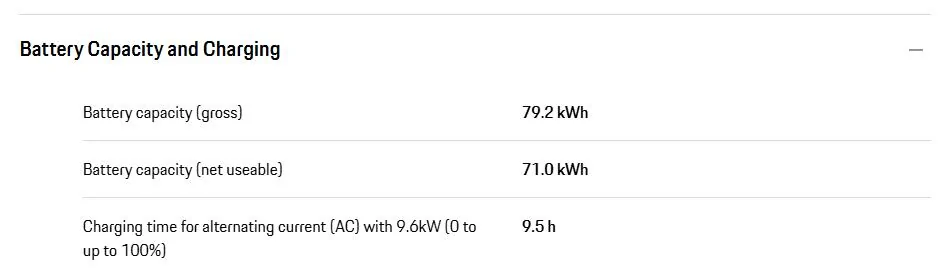
A lithium ion battery should never be fully charged or discharged. The PB total capacity is 79.2 kWh with 71 kWh usable, the PB+ total capacity is 93.4 kWh with 83.7 kWh usable.
I'm sort of having a difficult time parsing the tone of the rest of your post, as it seems like it's saying my original statement was silly and wrong. So I'll quote this part and say that the difference between "total" and "usable" capacity that you describe here is what I was referring to as "invisible" capacity that is hidden from us by the battery management software.
 

Gino

Well-Known Member
First Name
Gino
Joined
Apr 2, 2024
Threads
29
Messages
889
Reaction score
446
Location
Orange County, CA
Vehicles
2000 Boxster & 2021 Taycan
Country flag
I'm sort of having a difficult time parsing the tone of the rest of your post, as it seems like it's saying my original statement was silly and wrong. So I'll quote this part and say that the difference between "total" and "usable" capacity that you describe here is what I was referring to as "invisible" capacity that is hidden from us by the battery management software.
Yes, I believe Porsche has hidden capacity at the bottom & top of the battery’s range which the user cannot access but is used as the buffer Porsche feels is necessary to protect the health & longevity of the battery during the warranty period & beyond.


hifi239

Well-Known Member
First Name
Will
Joined
Mar 15, 2023
Threads
27
Messages
470
Reaction score
423
Location
Boston
Vehicles
Taycan
Country flag
I'm sort of having a difficult time parsing the tone of the rest of your post, as it seems like it's saying my original statement was silly and wrong.
Sorry no tone. Just remarking that Porsche publishes the total capacity and the usable capacity. “Invisible” makes it seem like the buffer is a mystery and it’s size isn’t known.
 

Gino

Well-Known Member
First Name
Gino
Joined
Apr 2, 2024
Threads
29
Messages
889
Reaction score
446
Location
Orange County, CA
Vehicles
2000 Boxster & 2021 Taycan
Country flag
Sorry no tone. Just remarking that Porsche publishes the total capacity and the usable capacity. “Invisible” makes it seem like the buffer is a mystery and it’s size isn’t known.
My 2021 CPO shows 79.2 KwH performance battery option but the maximum charge I put in it after I drove it down to 2 miles remaining for rebalancing was 73 KwH after 2 years &
30K miles.
I just assumed there is some buffer amount beyond the 79.2KwH since I get about 10% less range than when it was new 2 years earlier and at zero miles.
When it was new I was told the range was 225 but after 2 years 30K miles the max range I get is 205.
It appears my 2021 has about 74KwH available after 2 years but I am not aware of any total capacity amount of the performance battery.
There is nothing in my Porsche manual which states total capacity & usable capacity. Where does Porsche publish these numbers?
 

Gino

Well-Known Member
First Name
Gino
Joined
Apr 2, 2024
Threads
29
Messages
889
Reaction score
446
Location
Orange County, CA
Vehicles
2000 Boxster & 2021 Taycan
Country flag
I’m hopeful because my range loss over the first 22 months and 30K miles on my CPO was just under 10% but the next 16 months and 8K miles I am not seeing any additional range loss yet.
At the most maybe I will see 1% a year at this pace so if the rate of range loss over time stays in the 1% per year range then I would get to year 13 before dropping to 80%.
My experience with Lithium Ion batteries usually has the batteries staying at a very gradual loss over a certain period of time and then it drops off a cliff. I’m hoping that cliff won’t come for me and my driving habits until year 12-15 but won’t be surprised if it happens in year 10-12 so I’ll have to buy a upgrade/replacement battery pack. If the chemistry of the LG batteries is not likely to fall off a cliff and simply lose 3-5% per year after year 10 then I would be happy to make it to year 15 with 60% range or 120 miles.
By that time I have to believe competition on battery replacements from 3rd parties will result in several very reasonable options to get back my original range & more. The only thing I hope doesn’t happen is the battery simply fails completely as some owners have seen forcing the battery to be replaced completely sometime shortly after 8 years even if I only have only 60K miles on it.
My last Porsche was 20 years old with 42K miles on it but I was the only one driving it. My wife & I are on pace to put 60K max. I’m not really worried. It is what it is and if I need a new battery after 8-10 years even with very low use then so be it. I’ll gladly replace the battery unless the rest of the vehicle demonstrates mechanical or electrical/electronic unreliability.


Gino

Well-Known Member
First Name
Gino
Joined
Apr 2, 2024
Threads
29
Messages
889
Reaction score
446
Location
Orange County, CA
Vehicles
2000 Boxster & 2021 Taycan
Country flag
Perhaps there are other opposing studies that contradict this but here’s the summary I’ve distilled from this:

Intermittent hard acceleration is good for battery health.

DC fast charging vs Level 2 is not materially different for battery health, although DC fast charging can be detrimental for a very hot battery (probably applicable to a high ambient temp environment).

The rest time at a high state of charge should be minimized as rest time at high state of charge is associated with degradation. (In excess of about 80%). That’s likely what the Taycan’s timer feature is all about.

Constant low current demand cycles will tend to accelerate battery degradation.

Repeated deep discharge (study used an 85% depth of discharge) is negative for battery health.

EV batteries should average a 200,000 mile or so usable life.

Please feel free to correct me if I am misstating the implications of these studies or if you have other recent data that has some other conclusions.


https://www.nature.com/articles/s41560-024-01675-8
https://thedriven.io/2025/04/10/ev-...-than-previously-thought-new-study-shows/amp/
https://cleantechnica.com/2023/11/0...fast-charging-on-electric-car-battery-health/
The only thing I am wondering about is your statement
“Constant low current demand cycles will tend to accelerate battery degradation”

What does this really mean?
If you rarely accelerate hard when you drive it and instead always accelerate slowly will this cause battery degradation? Not sure what data there is to suggest this. Seems as though you can cause more battery degradation when you heat up the battery with extended hard acceleration but slow charging vs fast charging within the charging limits set by the BMS does not make any difference.
Wouldn’t that suggest discharging the battery fast or slowly within the same range would also have a negligible effect on battery degradation?
I would love to see data on this.
A slow rate of discharge by driving too slowly as well as leaving the vehicle sitting at 80% for a few weeks while on vacation would then likely be worse for the battery in terms of degradation than if left at 50% before letting the car sit for a few weeks.
If at 100% charge the battery packs become stressed and degrade to a higher degree than at 80% then the same should be true when stored at 80% vs 50%, right?
I know it’s not good to discharge too low SOC and not good to be at too high SOC for long periods either but I am under the impression the sweet spot is for the battery to be between 80% & 30% ideally to maximize battery life.
Maybe this is why in the 18 months & 8K miles since I got my 2021 CPO that I have not seen any discernible battery degradation since my range has not changed. I have rebalanced the battery once every 6 months (3 times) since I got the car. I’ve only driven it twice on long trips where I averaged 80mph & very briefly at 100-120mph for 5-10 seconds at the most.
I know Porsche does state in their warranty manual that they expect the vehicle to be driven a minimum of 6K miles per year but not sure what the exact reason is for Porsche to state this.
Has any of the Porsche owners ever seen a minimum yearly mileage requirement for their ICE Porsche’s?
If they only make this statement on their EVs then I would love to understand what they base this minimum mileage requirement on & why…
 

Tooney

Well-Known Member
Joined
Aug 14, 2021
Threads
741
Messages
4,450
Reaction score
3,637
Location
Ohio
Vehicles
2022 Taycan 4S
Country flag
I find charging to 60% and then recharging at 40% works for me and my low mileage. I then charge to 85% and that gets me more than enough for most of my regular longer trips.

I'm just unsure if it's better for the battery?
a. do as above 60-40% and back up every 3 days, OR;
b. charge to 85% then drop to 40% and thus charge less often (maybe every 5 days)
Article from Recurrent about depth of discharge: One simple trick to increase EV battery life: depth of discharge
 

joefig44

Well-Known Member
First Name
Joe
Joined
Dec 29, 2024
Threads
11
Messages
97
Reaction score
22
Location
Ontario, Canada
Vehicles
2025 Porsche Taycan 4S, 2023 Mercedes Benz GLC300
Country flag

Gino

Well-Known Member
First Name
Gino
Joined
Apr 2, 2024
Threads
29
Messages
889
Reaction score
446
Location
Orange County, CA
Vehicles
2000 Boxster & 2021 Taycan
Country flag
Thank you so much! This article confirms why my battery has not degraded at all or at least in any measurable way over the last 18 months since I’ve typically always charged to 80-85% and discharged to 40-45% roughly once every week.
The first 18 months it lost almost 10% after being driven 30K miles and charged to 100% by topping off the charge at the dealership where the Porsche sales manager works.
He had a 120 mile round trip every day for work so he discharged my vehicle daily at least 60% every day plus whatever other daily driving he was doing so he could have been discharging to at least 70% to 80% SOC on a routine basis.
I, on the other hand have a zero commute since my office is in my home and have typically charged to 85% and worst case recharged again once I hit 40-45%.
The fact I don’t need more than 100-150 miles available each week means I could actually charge it twice as often and limit the discharge per cycle easily to 40% or less to extend the life of my battery.
Has anyone seen any research that shows the point where EV batteries begin to fail after a certain number of cycles. Do these batteries become completely useless at some point because the range is so bad or do they simple stop holding any charge at that point like when my cell phone battery finally becomes worthless. I charge it to 100% but it dies in a few minutes after a full charge. After 4-5 years of charging to 100% every day I have obviously exceeded the number of charge cycles so I have no choice but to replace the battery.
 

hifi239

Well-Known Member
First Name
Will
Joined
Mar 15, 2023
Threads
27
Messages
470
Reaction score
423
Location
Boston
Vehicles
Taycan
Country flag
My 2021 CPO shows 79.2 KwH performance battery option but the maximum charge I put in it after I drove it down to 2 miles remaining for rebalancing was 73 KwH after 2 years & 30K miles.
You may have paid the power company 73kWh for charging the battery, but that's not the same as the charge the battery is holding. There is a charging loss of about 600 Watts for level 2, so for a full 10-hour charge, that's a loss of 6 kWh. This is likely more for DC. At 2 years and 30K miles, it is likely your usable stored charge is now around 71.0 * 90% = 64 kWh.

Published? If you search the phrase "The entry-level Taycan has a 79.2kWh battery with a usable capacity of 71.0kWh." you will see many articles quoting this number. Also, PCNA listings for J1.1 Porsche Taycan Base models show the below.
Porsche Taycan Counterintuitive evidence regarding EV Batteries 1744688317952-vv
 

Gino

Well-Known Member
First Name
Gino
Joined
Apr 2, 2024
Threads
29
Messages
889
Reaction score
446
Location
Orange County, CA
Vehicles
2000 Boxster & 2021 Taycan
Country flag
You may have paid the power company 73kWh for charging the battery, but that's not the same as the charge the battery is holding. There is a charging loss of about 600 Watts for level 2, so for a full 10-hour charge, that's a loss of 6 kWh. This is likely more for DC. At 2 years and 30K miles, it is likely your usable stored charge is now around 71.0 * 90% = 64 kWh.

Published? If you search the phrase "The entry-level Taycan has a 79.2kWh battery with a usable capacity of 71.0kWh." you will see many articles quoting this number. Also, PCNA listings for J1.1 Porsche Taycan Base models show the below.
1744688317952-vv.webp
Thanks for the info…
Sponsored


Top