Sponsored

RWD Power/Weight vs Accel Anomoly

Marcad80

Well-Known Member
First Name
Marc
Joined
Nov 29, 2021
Threads
10
Messages
232
Reaction score
281
Location
Florida
Vehicles
Model S
Country flag
After owning a Model S for the last 6 years it’s very clear that:

Tesla -> overcommit under deliver
Porsche -> undercommit over deliver

As an excited Taycan enthusiast waiting for his cars turn on the assembly line, the Porsche approach makes this journey a lot more fun.

But finding the actual facts can be difficult (although always with happy results)

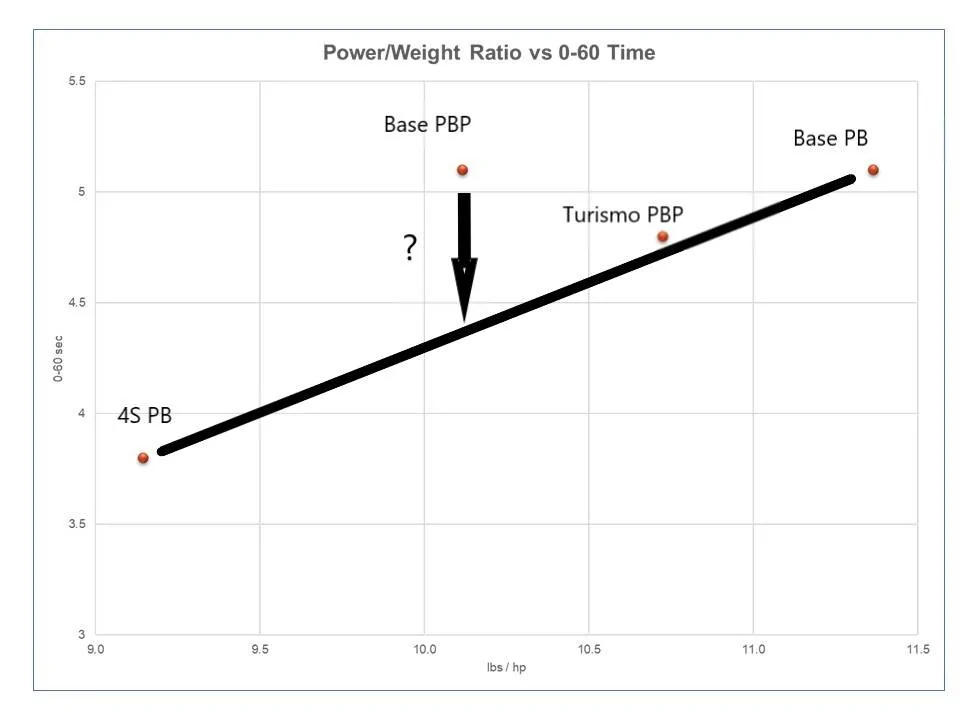
I finally got through all the under commits on the range, which was why I had disregarded the Taycan years ago, but I still can’t figure out the acceleration undercommits yet. The excuse that the RWD PBPs additional 67 hp goes to accelerate the additional battery weight is clearly false. See the attached graph.

Based on the Power to Weight ratios of the various Taycan versions the Base model with the PBP should be accelerating at 4.3 sec 0-60 not 5.1 sec. Now I understand Porsche underestimates and over delivers and Car and Driver has verified this model is actually 4.7 sec (with rollout) and not 5.1. But why is Porsche pulling power to not achieve 4.3 sec? Clearly the graph shows a very linear relationship with Power/weight ratio and acceleration with the other three models. Why is there commitment and C/D tests off the line?

I don’t believe it’s traction because the 300lb heavier RWD CT is 4.8 sec, and Tesla Model S’s have run lower 0-60 RWD versions on all season 245 tires as opposed to these 275s.

It would be interesting to understand why they are pulling power, and if someday, through a software update they might give it back…..
Porsche Taycan RWD Power/Weight vs Accel Anomoly 4DF8886D-4446-4C55-9F07-968E849BFBCF
Sponsored


logic

Well-Known Member
Joined
Nov 19, 2021
Threads
0
Messages
50
Reaction score
78
Location
Belgium
Vehicles
E-tron GT, BMW M4
Country flag
I think the gearing will make the difference, especially when you have a second motor and gear ratio to account for.

And I also think that a rollout isn't overdelivering but cheating. :)
 

Fish Fingers

Well-Known Member
Joined
Feb 20, 2021
Threads
50
Messages
2,534
Reaction score
3,285
Location
UK
Vehicles
Sold
Country flag
Interesting post.
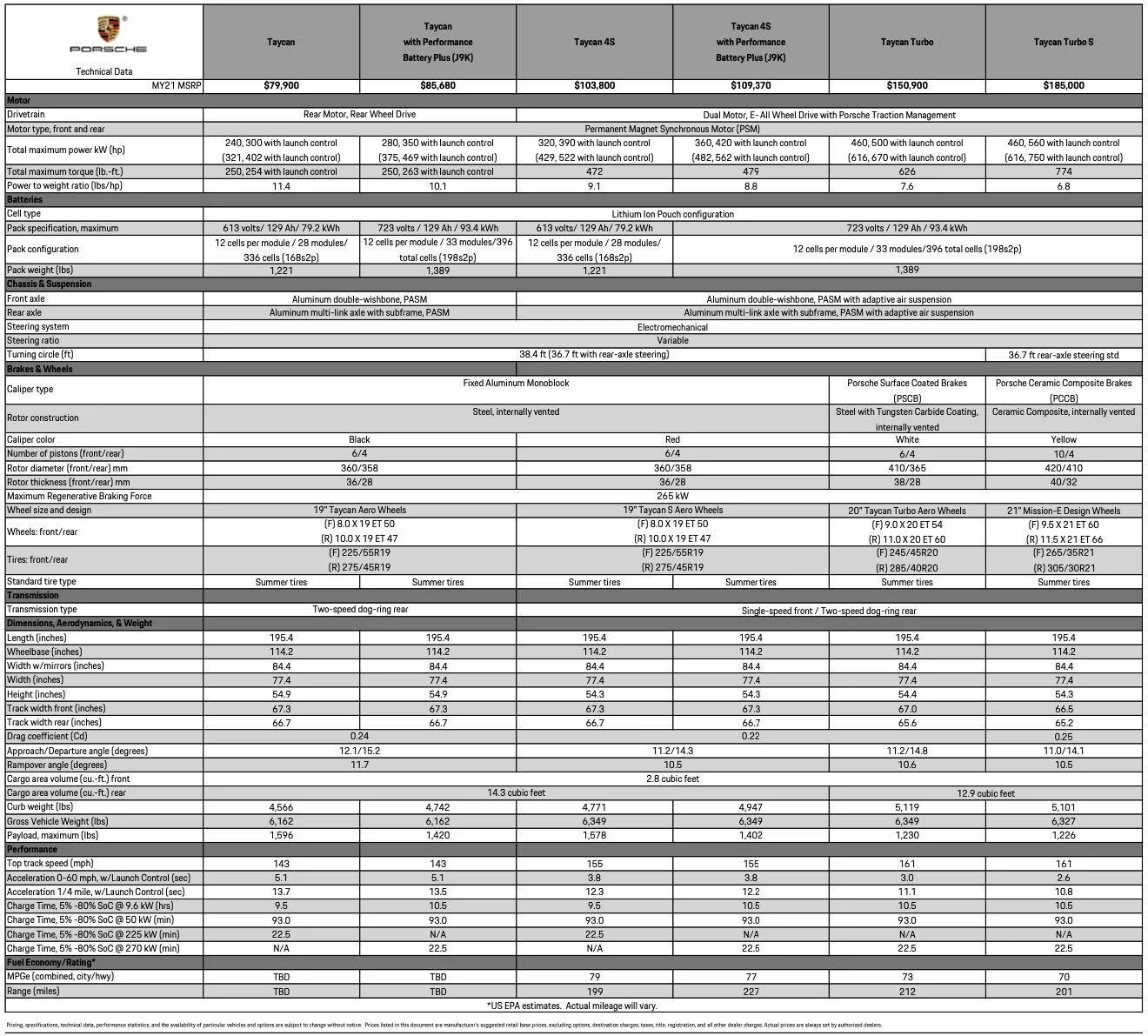
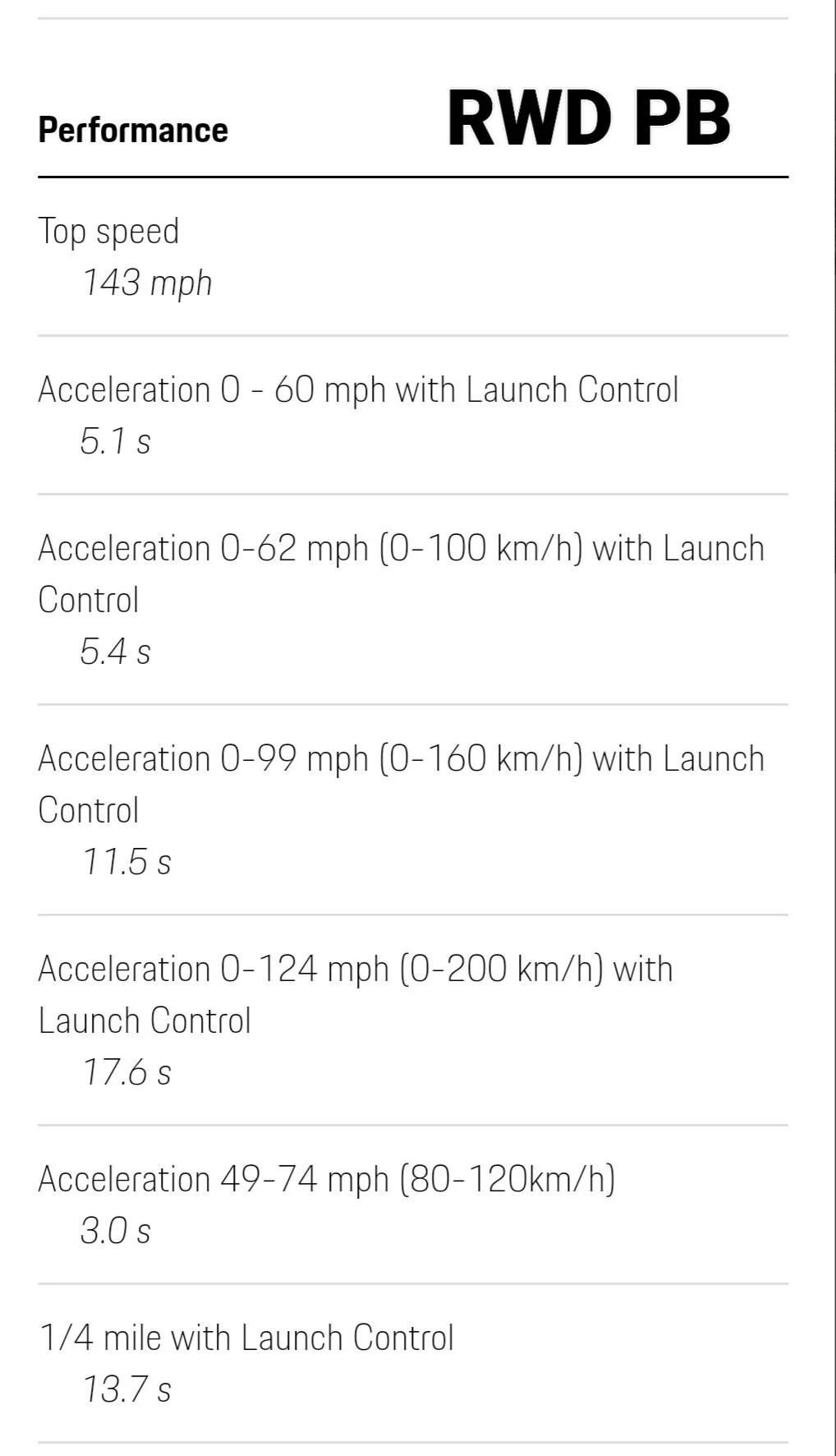
According to Porsche the power to weight ratio is higher with the PB+ (attached 1).
And the RWD standard battery v PB+ stats are also an anomoly and discussed here previously.

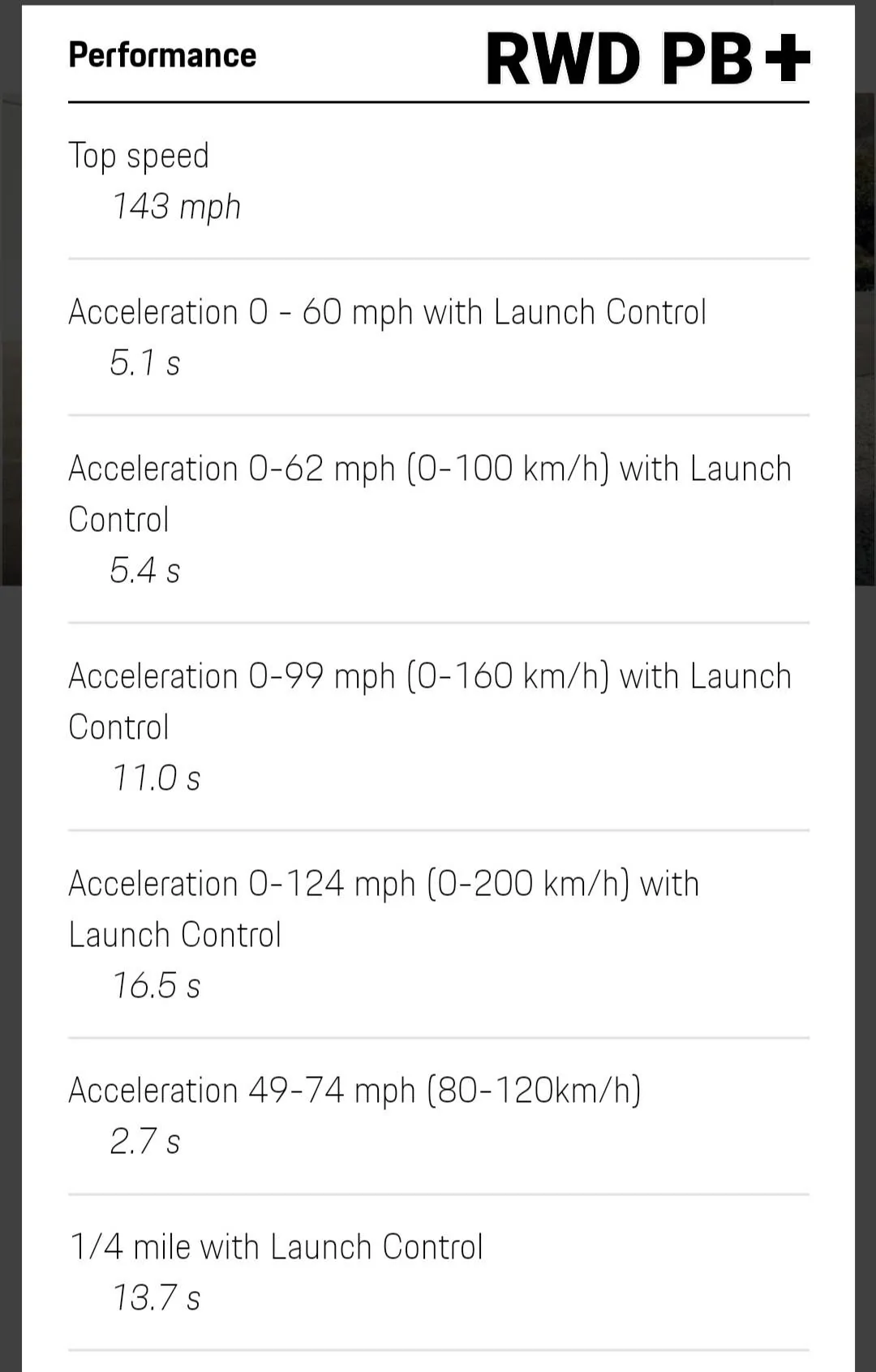
According to those they both have the same 0-60 and similar 1/4 mile, yet the PB+ has faster mid range (attached 2 & 3).
Suggesting they launch the same, then the PB+ pulls away.....then loses it at the end.

?

Doesn't make sense apart from either software settings or false stats.

Porsche Taycan RWD Power/Weight vs Accel Anomoly Porsche-Taycan-full-spec-sheet


Porsche Taycan RWD Power/Weight vs Accel Anomoly Screenshot_20210912-065022_Chrom


Porsche Taycan RWD Power/Weight vs Accel Anomoly Screenshot_20210912-064847_Chrom
 
Last edited:

logic

Well-Known Member
Joined
Nov 19, 2021
Threads
0
Messages
50
Reaction score
78
Location
Belgium
Vehicles
E-tron GT, BMW M4
Country flag
Doesn't make sense apart from either software settings or false stats.
Simple logic :)
The weight is keeping the PB+ down in an acceleration from zero. And the quarter mile is too short to make any measurable difference, just as the 0-60 range is too short.

But if you don't start from zero, the weight doesn't have the same impact and therefor the PB+ is quicker in the rolling races.

If you'd look at a longer race, half mile or full mile, the PB+ definitely will be faster.


Jrkennedy37

Well-Known Member
First Name
James
Joined
Apr 12, 2021
Threads
6
Messages
348
Reaction score
289
Location
Dallas TX
Vehicles
'18 Panamera ST, '21 Taycan CT4
Country flag
I don’t think PWR is the primary factor for EV performance. The larger battery capacity allows more electrons to flow out in a given period of time, creating more power. PWR is secondary to this part of the equation.

With that said, I also think there are some software shenanigans for the base models, as I expressed in a thread about launching the CT4.
 
OP
OP

Marcad80

Well-Known Member
First Name
Marc
Joined
Nov 29, 2021
Threads
10
Messages
232
Reaction score
281
Location
Florida
Vehicles
Model S
Country flag
The answer is in Fish Fingers post…. I’ll be darn.

They are torque limiting the PBP! Both the PB and the PBP are maxed Torque at 250ftlbs

Since HP is torque x rpm, the added HP would only keep the torque from dropping off earlier at higher revs.
In other words the torque / rev curves would look the same until a high rev level, that would only occur at higher speeds.

They are “clipping” the torque in the software code…..

This would account for C/D slightly better 0-60 time in the PBP, and why the PBP can’t achieve the 4.3 sec time the HP represents.

Now, why are they clipping the torque. Clearly the rear drivetrain can take way more torque per the rear drivetrain on the turbo and turbo S…. Or are they different driveline components…..
 

Genau

Well-Known Member
First Name
Dan
Joined
Dec 15, 2019
Threads
4
Messages
939
Reaction score
992
Location
Reston, Virginia
Vehicles
2020 Taycan 4S
Country flag
Based on the Power to Weight ratios of the various Taycan versions the Base model with the PBP should be accelerating at 4.3 sec 0-60 not 5.1 sec. Now I understand Porsche underestimates and over delivers and Car and Driver has verified this model is actually 4.7 sec (with rollout) and not 5.1. But why is Porsche pulling power to not achieve 4.3 sec?
I've read this thread several times and I don't understand the mystery. The RWD model has slower acceleration than the other models because it is fitted with a single electric motor instead of two.
Update: I just noticed that Porsche's spec sheet legend (above) says "power to weight ratio" but then gives the reverse formula, "lbs/hp". Perhaps that is causing the confusion?
Also, note that the Performance Battery and the Performance Battery Plus have different peak voltages, which affect peak motor power. So it's not just the weight of the battery that affects the acceleration. https://www.taycanforum.com/forum/threads/how-big-a-deal-is-it.5685/post-78591
 
Last edited:


OP
OP

Marcad80

Well-Known Member
First Name
Marc
Joined
Nov 29, 2021
Threads
10
Messages
232
Reaction score
281
Location
Florida
Vehicles
Model S
Country flag
You are correct about the power to weight ratio. I should have technically been saying weight to power

But something that has 10.1 lbs per every 1HP should substantially out accelerate something that has 11.4 lbs for every 1HP.

I believe I’ve found the answer in the math.

The PBP vehicle is 3.8% more weight than the PB version. Guess what the programmed torque limit increase is for the PBP (despite having the ability to generate over 10% more torque). It’s 3.5% more torque….

I bet the .3% difference is because the PB probably starts power flatening (power = torque x rpm, so flat power in increasing rpm means torque is reducing) just before 60mph….. that’s why we see an improvement in passing 40-70mph in the PBP.

Its clear to me that Porsche programming makes these two cars, in launch mode, accelerate exactly the same.

The sad thing is that, in non-launch mode they torque limit at the same value (250 lb-ft). So the heavier PBP will accelerate slower off the line than the PB in 99% of my driving conditions….
 

285kph

Well-Known Member
Joined
Aug 30, 2019
Threads
1
Messages
126
Reaction score
140
Location
Boston
Vehicles
2012 BMW X5 - 2021 Taycan - 2022 BMW X5 45e
Country flag
But if you don't start from zero, the weight doesn't have the same impact and therefor the PB+ is quicker in the rolling races.
That's not how physics works.
 

f1eng

Well-Known Member
First Name
Frank
Joined
Aug 19, 2021
Threads
48
Messages
4,765
Reaction score
8,335
Location
Oxfordshire, UK
Vehicles
Taycan CT4S, Ferrari 355, Merc 500E, Prius PHV
Country flag
Being in England I have never had any interest in drag races since the road layouts don't lend themselves but don't forget the contribution of the grip and tyre.

Whilst the electric motor is easily torque managed there is also the aspect of actual available grip and the torque may well also be limited by the traction control system depending on the actual grip available.

What if the actual acceleration limit for the RWD is traction, not power?

This is entirely likely, my Ferrari is entirely grip limited for acceleration up to about 80mph and entirely depends on me modulating the throttle for best performance (it is too old to have TC, just a limited slip diff that is what I like about it).

Nowadays we have got used to super high quoted power figures but almost always forget that there is a control box in there that in reality is preventing the driver from having it almost all the time other than track days.

It wouldn't surprise me if the wheel/tyre choice makes a difference to maximum low speed acceleration in real world conditions in both 4WD and particularly RWD.
 
OP
OP

Marcad80

Well-Known Member
First Name
Marc
Joined
Nov 29, 2021
Threads
10
Messages
232
Reaction score
281
Location
Florida
Vehicles
Model S
Country flag
Being in England I have never had any interest in drag races since the road layouts don't lend themselves but don't forget the contribution of the grip and tyre.

Whilst the electric motor is easily torque managed there is also the aspect of actual available grip and the torque may well also be limited by the traction control system depending on the actual grip available.

What if the actual acceleration limit for the RWD is traction, not power?

This is entirely likely, my Ferrari is entirely grip limited for acceleration up to about 80mph and entirely depends on me modulating the throttle for best performance (it is too old to have TC, just a limited slip diff that is what I like about it).

Nowadays we have got used to super high quoted power figures but almost always forget that there is a control box in there that in reality is preventing the driver from having it almost all the time other than track days.

It wouldn't surprise me if the wheel/tyre choice makes a difference to maximum low speed acceleration in real world conditions in both 4WD and particularly RWD.
Agree 100%, but usually when a car company lists the motor torque they show the torque capability of the motor alone. In this case they show both the PB and the PB+ at the same torque capability. This means there holding the current lower on the Pb+ than the PB because the Voltage is definitely higher.

the other data point I have is that the RWD model s on smaller tires(245s) accelerates in the low 4’s. A car of equal weight should be able to do much quicker than 5.1 sec with 275s.
 

hhf2

Active Member
First Name
Heiko
Joined
Jan 11, 2022
Threads
0
Messages
35
Reaction score
30
Location
Berlin Germany
Vehicles
2022 Taycan RWD PB
Country flag
The answer is in Fish Fingers post…. I’ll be darn.

They are torque limiting the PBP! Both the PB and the PBP are maxed Torque at 250ftlbs

Since HP is torque x rpm, the added HP would only keep the torque from dropping off earlier at higher revs.
In other words the torque / rev curves would look the same until a high rev level, that would only occur at higher speeds.

They are “clipping” the torque in the software code…..

This would account for C/D slightly better 0-60 time in the PBP, and why the PBP can’t achieve the 4.3 sec time the HP represents.

Now, why are they clipping the torque. Clearly the rear drivetrain can take way more torque per the rear drivetrain on the turbo and turbo S…. Or are they different driveline components…..
I agree this is done on account of sales/marketing and establishing a clear hierarchy of models.
 

whan

Well-Known Member
First Name
Will
Joined
Nov 5, 2021
Threads
14
Messages
581
Reaction score
509
Location
Marin Co, CA
Vehicles
Taycan RWD, Ferrari 458, Lexus GX460
Country flag
Some more musings about potential Porsche software detuning of the lower level Taycans. Comparing a RWD specifically to a Model Y Performance, both make similar peak power of ~470hp (using the Model 3 dyno here as a proxy https://insideevs.com/reviews/401474/tesla-model-3-standard-performance-dyno/)

The Model Y does make more torque at 400-420 lb-ft vs. RWD 263. BUT, the Taycan is geared a lot shorter in 1st, at ~15:1, while the Model Y is at 9:1. In reality, this should make up for the torque differential at the wheels (263*15/9=438, pretty similar when adjusting for gearing).

EV max torque is provided at low RPMs up until a certain RPM, from which it then tapers off. In order for the motor in the Taycan RWD to produce 470hp at only 263lb-ft, it implies that it should be holding max torque for a longer period of time to higher RPMs vs. the Tesla, as that's the only way it makes sense (power being torque * RPM * constant). The Tesla makes peak power at near max torque at ~5700 motor RPM which = ~55MPH at 9:1 gear ratio. Based on published figures, the Taycan should be making peak power at a similar MPH despite a 15:1 gear ratio, given it's able to produce peak power using lower peak torque (Need to rev to 52% higher at max torque vs having a 66% shorter gear ratio)

Because of this gearing difference, you'd expect the Taycan to have somewhat of a similar 0-60 time as the Tesla Y Performance (at least low 4s if not high 3s) given similar-ish weight, HP, gearing-adjusted, but that's not the case. I feel like this is only explained by Porsche not providing the peak torque on launch at 0rpm that it is capable of. Quite a few reviewers have noted that there's not an initial shove in the RWD you get from EVs, but that it builds pretty quickly afterwards, or even once on the move for passing power.
 

gnop1950

Well-Known Member
First Name
Gary
Joined
Nov 5, 2021
Threads
6
Messages
539
Reaction score
639
Location
Sierra Vista, AZ
Vehicles
2022 Taycan 4s
Country flag
Being in England I have never had any interest in drag races since the road layouts don't lend themselves but don't forget the contribution of the grip and tyre. ...
Oh, you don't have to be in England to not have any interest in drag racing from stoplights, I know I don't, :cool: It is a good way to get unwanted attention, can be dangerous, etc. About the only time I step on it from a traffic light is when I'm on my MC and that is as much about self-preservation as anything else.

P.S. In Arizona (USA) there is a two-second delay between when your light turns red and the opposite direction turns green. You wouldn't believe how many Arizona drivers are time-challenged and zoom through a red light. Stepping on it when your light turns green is a good way to get t-boned.
Sponsored


Top