Sponsored

Need a Class Action Lawsuit - Porsche Mobile Charger

Status
Not open for further replies.

Scotty

Well-Known Member
First Name
Scott
Joined
Oct 7, 2020
Threads
35
Messages
187
Reaction score
230
Location
Los Angeles
Vehicles
Taycan4s
Country flag
any reference material is noted in the thread I've linked - including engineering tables showing expected temperature deltas above ambient for variouis AWG wire @ various AMP flows…

from the thread:
  • post #1 shows power supply EVSE temps in 64F ambient conditions after 2 hours of use
  • post #37 shows 10 AWG embossed on the cable
  • post #78 shows a standard EE engineering table with expect temperature rise for variousAWG wire at various loads
    • various forum members who claim to be EE's assert the observed thermal performance of porsche's power supply cable exactly match predictions/expectations/published-standard-engineering-tables for 10 AWG wire at 240V/40 amps - YMMV
  • post #111 Aug. 11, 2020 - is an assertion of an "Offiical" Porscheresponse
    • at that time they acknowledge the issue and recommended using the unit at a lower AMP settings to avoid the thermal issues discussed.
    • customer complaint: your cable gets too hot when used at 40 amps
    • porsche response: don't use our device at 40 amps
other EVSE's sold/manufactured/designed for North American use tend to ship with 6/8 AWG wire - Porsche is almost unique in the North American market with a 9.6 kW/40 amp EVSE shipping with 10 AWG wire for their 50/40 amp power supply cables - JBooster a recent NA entry also uses 10 AWG but uses multiple 10 AWG wires inside the power supply cable for better thermal characteristics according to them…

I have not disassembled a Porsche supply cable to confirm it's internal design - nor would I be qualified to comment if I did.

a thorough read of the afore mentioned thread from 2020 illuminates relatively "informed" discussion of the issue as it was discovered over 2 years ago - it would be my source material for any discussion

conclusions of the thread are that AWG is a poor choice for a 40 AMP 9.6 kW load due to predictable thermal stress under that load, but it's not electrically unsafe and to date I do not believe there is evidence of the power supply cord failing - rather we've had "socket" failures when the cord is combined with a low-qualty/cheap NEMA socket

making the case that 10 AWG wire "is the problem" is going to be an uphill battle as their actual EE experts can assert with authority that there is sufficient margin for electrically safety - and unless you have a power supply cable with melted insulation in your hand - well I don't see it happening in your favor.

my opinion is that yes the cord can be very very very warm/hot - but by itself is not a problem - but it certainly will not help the situation when it gets really really warm/hot and it is also being used in conjunction with a cheap/poorly-fitting/poorly-connected NEMA socket - no single component is "bad" but when combined with each other - well…problems can ensue…

but the socket choice by the owner is _NOT_ Porsche's problem - it's out side their control - and that is the core assertion of this update - that their units are not safe with crappy sockets that they assert are endemic in North American EVSE residential installs…

as to porsche "using" 10 AWG wire - well the AWG wire rating is "embossed/stamped" into the insulation on the power supply cable from porsche - simple inspection of any PMC+/PMCC supply cable will indicate 10 AWG.

as for calling me as an expert witness - I only have a DIY understanding of this stuff from 12 years of EV ownership, but my background/credentials are Computer Science not EE - so I doubt I could be designated as "an expert" - it doesn't mean I'm wrong, it just means I can be undermined due to lack of formal training or any commerical experience in an EE related capacity - I'm a well informed EV enthusiast - but not an expert by any stretch of imagination - and lack deep formal understand of all the characteristics for EE issues - I'd be easily tripped up by any broad questioning

I however feel I have a deep customer level understanding of this single particlular issue and can make assertions based on observed differences in competitive products and easily gathered thermal data using consumer level temperature monitoring devices.

But I'm not qualified nor would make claim that Porsche should not have used 10 AWG wire - my observed data is in my case their supply cable achieves temperatures of at least 166F in normal use (well and safely under the 105C rating on the cable insluation) - and other EVSE's I've used running at similar capacities do not reach similar temperatures vs. the Porsche units. I then speculate maybe a 8/6 gauge wire like the other guys use would offer lower temps…but that's the limit of my understanding.
Appreciate the time you took to provide more useful information. I will keep you updated as I move along with arbitration. From my experience it will take 4 to 6 months to set a date for arbitration. I have done hundreds of arbitrations over the years. Most likely the arbitrator will have a legal background and little understanding of electrical engineering like most of us in the forum. My approach will be try and keep it straight forward and not too technical. I suspect thou Porsche, based on my past dealings with them and my experience with BMW will never allow this to go to arbitration. They usually offer some sort of settlement, e.g. loyalty vouchers that can be used for future repairs. All the downside risks with arbitration are with them not me. First there is no cost other than my time. The cost is of no concern to Porsche but an adverse judgement is a problem for them. I would publish the arbitrators decision, have a PR firm i know send the award to every car magazine/ internet blogger. I am optimistic I can offer a logical compelling presentation to an arbitrator to remedy the issue. (unfortunately the remedy will only apply to me)
Sponsored


JRNJTAYCAN

Well-Known Member
First Name
Joe
Joined
Jan 5, 2022
Threads
45
Messages
398
Reaction score
245
Location
NJ
Vehicles
22 Ferrari, 22 Q5, 2015 Titan, 2015 Wrangler
Country flag
Love my Juicebox. Simple and works perfectly.
I do not have the upgraded Porsche charger so it can not be updated OTA. However I have stopped using this charger and went to a Juicebox and Grizzly both purchased from Amazon and have been very happy with them. I was able to continue to use my 50 amp NEMA 14-50 plug.
 

daveo4EV

Well-Known Member
First Name
David
Joined
Jan 28, 2019
Threads
192
Messages
7,007
Reaction score
10,478
Location
Santa Cruz
Vehicles
Cayenne Hybrid, 911(s) GT3/Convertable
Country flag
Appreciate the time you took to provide more useful information. I will keep you updated as I move along with arbitration. From my experience it will take 4 to 6 months to set a date for arbitration. I have done hundreds of arbitrations over the years. Most likely the arbitrator will have a legal background and little understanding of electrical engineering like most of us in the forum. My approach will be try and keep it straight forward and not too technical. I suspect thou Porsche, based on my past dealings with them and my experience with BMW will never allow this to go to arbitration. They usually offer some sort of settlement, e.g. loyalty vouchers that can be used for future repairs. All the downside risks with arbitration are with them not me. First there is no cost other than my time. The cost is of no concern to Porsche but an adverse judgement is a problem for them. I would publish the arbitrators decision, have a PR firm i know send the award to every car magazine/ internet blogger. I am optimistic I can offer a logical compelling presentation to an arbitrator to remedy the issue. (unfortunately the remedy will only apply to me)
interesting I appreciate the update and any future updates - it's a tough situation for Porsche to have to deal with something like this given they really don't like/care for EV's…this is an annoyance for technology they'd rather not deal with anyways…
 

daveo4EV

Well-Known Member
First Name
David
Joined
Jan 28, 2019
Threads
192
Messages
7,007
Reaction score
10,478
Location
Santa Cruz
Vehicles
Cayenne Hybrid, 911(s) GT3/Convertable
Country flag
Appreciate the time you took to provide more useful information. I will keep you updated as I move along with arbitration. From my experience it will take 4 to 6 months to set a date for arbitration. I have done hundreds of arbitrations over the years. Most likely the arbitrator will have a legal background and little understanding of electrical engineering like most of us in the forum. My approach will be try and keep it straight forward and not too technical. I suspect thou Porsche, based on my past dealings with them and my experience with BMW will never allow this to go to arbitration. They usually offer some sort of settlement, e.g. loyalty vouchers that can be used for future repairs. All the downside risks with arbitration are with them not me. First there is no cost other than my time. The cost is of no concern to Porsche but an adverse judgement is a problem for them. I would publish the arbitrators decision, have a PR firm i know send the award to every car magazine/ internet blogger. I am optimistic I can offer a logical compelling presentation to an arbitrator to remedy the issue. (unfortunately the remedy will only apply to me)
my personal goal for any outcome would be:
  • return the units for some reasonable compensation… or…
    • or a plan for restoration of published specifications of 40 amp/9.6 kW capacity
  • if Porsche is unable or unwilling to authorize/trust their device for 40 amp/9.6 kW usage a clear recommendation for alternative EVSE products that customers should obtain (i.e. do they recommend ClipperCreek as an alternative).
  • a 100% MSRP voucher for a GT3 RS to be redeemed at some point in the future for any all affected customers…
  • free EA charging for life of the owner
  • popcorn - lots and lots of popcorn provided in bags at the dealerships…
so of the requests above are negotiable :rock::clap::cool::p:CWL::handsinair:
 

FrozenBerries

Well-Known Member
Joined
Oct 7, 2022
Threads
5
Messages
70
Reaction score
41
Location
USA
Vehicles
CT4
Country flag
My take on this is that Porsche are fully aware of the problem, of the gap in their testing that allowed this design flaw to ship, of the solution and the cost of that solution. They probably don't have a good handle on the timeline. Their official response is what they can legally get away with - at least until they can tame their other logistics issues. They're not acknowledging/issuing a mea culpa because it's not in their genes - never have, never will publicly admit something they made/designed is subpar, but they always worked on fixing it (not fixing the relationship with the customer, but fixing the flaw). And I'm talking about exploding engines (literally), faulty metallurgy, insufficient sealing (oil or water)/bracing/reinforcing etc. Small consolation for those who paid for those faulty chargers (or engines, or...), I know.
As a potentially new person in the Porsche sphere... is this broadly the level of service and quality to expect from the brand?


Scotty

Well-Known Member
First Name
Scott
Joined
Oct 7, 2020
Threads
35
Messages
187
Reaction score
230
Location
Los Angeles
Vehicles
Taycan4s
Country flag
interesting I appreciate the update and any future updates - it's a tough situation for Porsche to have to deal with something like this given they really don't like/care for EV's…this is an annoyance for technology they'd rather not deal with anyways…
Something is not making any sense: First lets try and agree on terminology as defined by Porsche: All components we are talking about are:
Charge ports ( 2 on taycan )
Supply Cable
Power Plug
Control Unit
Vehicle plug ( plug that connects to the car)
Vehicle Cable( cable leading from the control unit to the vehicle plug that connects to the charging port.)
Porsche is concerned with the heat temperatures at the plug socket(plug the connects to the electrical socket). The heat damage can occur at the electrical socket.
The supply cable has a NEMA plug . The supply cable is what is heating up potentially. However, the highest temperature reported I have been able to find on the supply cable is around 200 degrees F.
Per Porsche the risk of fire etc is at the electrical socket not the car itself ?
The type of plastic used in 240V electrical sockets can melt and catch fire anywhere from 410-518 degrees F.
If the electrical socket heats up and even catches on fire the electrical breaker should trip cutting off all power to the socket.
If the Porsche mobile charger is in a garage then I can see the potential fire risk and the garage catching on fire. If the garage is attached to the house then the entire house could conceivable catch on fire.
If the charger is mounted outside to the side of the house then the risk of fire is low since most house's exterior are stucco, brick etc
I can fine few if any reported electrical socket fires related to Porsche. In addition, overall for all EV's battery fires are rare.
The supply cable used by Porsche appears to be the wrong gauge based on research for 240AMP s / 9.6 KW. Porsche originally rated the power cable up to 19.2 KW. However, they may have goofed in using European standards vs USA. ( further research needed here).
The question is why did Porsche decide this was such a risk that they reduced the KW for the control unit by 50%? The data doesn't seem to support this being a high or even medium risk if the electrical socket melts.
It doesn't change the fact the control unit was rated at 40amps and 9.6 kw and Porsche's update has diminished its performance. Why do the update at all? What does Porsche know that the rest of us are not seeing? What am I missing to see here?
 

WasserGKuehlt

Well-Known Member
Joined
Sep 7, 2022
Threads
5
Messages
2,066
Reaction score
2,456
Location
WA
Vehicles
4CT, 996C2, MacanS
Country flag
As a potentially new person in the Porsche sphere... is this broadly the level of service and quality to expect from the brand?
Definitely not, and I should be a bit more guarded in what I say/how I say it.

Porsche makes damn good products - I would say their preferred characterization would be "high-quality robust performance". They beat the crap out of their products - on the track and in the desert/Lapland. They take their road products racing (for the immediacy of feedback), and bring race tech to their road products too. This means, in principle, that their cars are overengineered well beyond normal user expectations.

Their blind spot - and the reason for the aforementioned lack of forthcomingness - is that set of low/slow-evolving problems which escape detection in their testing, and which have a whiff of "misuse" about them (a la "you're holding it wrong"). By way of examples, famous issues of exploding engines were caused by "infrequent use, not revving the engine high/long enough"; issues of failing transfer cases were caused by "not changing the PDK transmission fluid on a yearly basis" - and the list goes on. That is, it's rarely - with Porsche - an outright design flaw, but rather a case of "we didn't see this case in 2M test miles/360d of endurance racing, you must be doing something differently that we didn't account for. (Here's a private token of our appreciation, counting on your discretion.)"

Having said that, the SW issues are not theirs alone, and the subject of this thread - the EVSE - was probably outsourced. As @daveo4EV explained earlier, it may not have been even designed for this application (the Taycan/higher-powered EVs), and its design was not re-evaluated or thoroughly tested in the US market. Even here, you'll have noticed, the product is safe except when paired with (what Porsche would call) a subpar circuit/power outlet.
 

daveo4EV

Well-Known Member
First Name
David
Joined
Jan 28, 2019
Threads
192
Messages
7,007
Reaction score
10,478
Location
Santa Cruz
Vehicles
Cayenne Hybrid, 911(s) GT3/Convertable
Country flag
Something is not making any sense: First lets try and agree on terminology as defined by Porsche: All components we are talking about are:
Charge ports ( 2 on taycan )
Supply Cable
Power Plug
Control Unit
Vehicle plug ( plug that connects to the car)
Vehicle Cable( cable leading from the control unit to the vehicle plug that connects to the charging port.)
Porsche is concerned with the heat temperatures at the plug socket(plug the connects to the electrical socket). The heat damage can occur at the electrical socket.
The supply cable has a NEMA plug . The supply cable is what is heating up potentially. However, the highest temperature reported I have been able to find on the supply cable is around 200 degrees F.
Per Porsche the risk of fire etc is at the electrical socket not the car itself ?
The type of plastic used in 240V electrical sockets can melt and catch fire anywhere from 410-518 degrees F.
If the electrical socket heats up and even catches on fire the electrical breaker should trip cutting off all power to the socket.
If the Porsche mobile charger is in a garage then I can see the potential fire risk and the garage catching on fire. If the garage is attached to the house then the entire house could conceivable catch on fire.
If the charger is mounted outside to the side of the house then the risk of fire is low since most house's exterior are stucco, brick etc
I can fine few if any reported electrical socket fires related to Porsche. In addition, overall for all EV's battery fires are rare.
The supply cable used by Porsche appears to be the wrong gauge based on research for 240AMP s / 9.6 KW. Porsche originally rated the power cable up to 19.2 KW. However, they may have goofed in using European standards vs USA. ( further research needed here).
The question is why did Porsche decide this was such a risk that they reduced the KW for the control unit by 50%? The data doesn't seem to support this being a high or even medium risk if the electrical socket melts.
It doesn't change the fact the control unit was rated at 40amps and 9.6 kw and Porsche's update has diminished its performance. Why do the update at all? What does Porsche know that the rest of us are not seeing? What am I missing to see here?
I agree - we're missing some data that Porsche has access to and we don't.


daveo4EV

Well-Known Member
First Name
David
Joined
Jan 28, 2019
Threads
192
Messages
7,007
Reaction score
10,478
Location
Santa Cruz
Vehicles
Cayenne Hybrid, 911(s) GT3/Convertable
Country flag
Definitely not, and I should be a bit more guarded in what I say/how I say it.

Porsche makes damn good products - I would say their preferred characterization would be "high-quality robust performance". They beat the crap out of their products - on the track and in the desert/Lapland. They take their road products racing (for the immediacy of feedback), and bring race tech to their road products too. This means, in principle, that their cars are overengineered well beyond normal user expectations.

Their blind spot - and the reason for the aforementioned lack of forthcomingness - is that set of low/slow-evolving problems which escape detection in their testing, and which have a whiff of "misuse" about them (a la "you're holding it wrong"). By way of examples, famous issues of exploding engines were caused by "infrequent use, not revving the engine high/long enough"; issues of failing transfer cases were caused by "not changing the PDK transmission fluid on a yearly basis" - and the list goes on. That is, it's rarely - with Porsche - an outright design flaw, but rather a case of "we didn't see this case in 2M test miles/360d of endurance racing, you must be doing something differently that we didn't account for. (Here's a private token of our appreciation, counting on your discretion.)"

Having said that, the SW issues are not theirs alone, and the subject of this thread - the EVSE - was probably outsourced. As @daveo4EV explained earlier, it may not have been even designed for this application (the Taycan/higher-powered EVs), and its design was not re-evaluated or thoroughly tested in the US market. Even here, you'll have noticed, the product is safe except when paired with (what Porsche would call) a subpar circuit/power outlet.
what he said. +1.
 

daveo4EV

Well-Known Member
First Name
David
Joined
Jan 28, 2019
Threads
192
Messages
7,007
Reaction score
10,478
Location
Santa Cruz
Vehicles
Cayenne Hybrid, 911(s) GT3/Convertable
Country flag
The question is why did Porsche decide this was such a risk that they reduced the KW for the control unit by 50%? The data doesn't seem to support this being a high or even medium risk if the electrical socket melts.
this in particular for me is interesting in that the unit operates really really well at 32 amps with ZERO reports of any thermal issues running at this rate - it's still a reduction vs 40 amps but way better than 50% (20 amps)

did they do the 50% for the PMCC to be consistent with the PMC+ which lacks fine grain control and only offers a 50% on/off button?

they also have YEARS of experience running these units at 32 amp (or less) from their Hybrid products - all of which are either 16/32 amp charging vehicles - so there has been no whiff of issues for these units at all for 32 amp usage…for significant number of vehicles - the Hybrid line by all accounts is quite successful - and the attach rate of a PMC+/PMCC for each Hybrid sale (since it's included) is likely nearly 100% - so it's very very very likely that 95% or greater of their hybrid customers are using a PMC+/PMCC at 32/16 amps with no reported issues.

I think another factor we need to consider is what data they are gathering from the VW/Audi side of the house - this unit and it's parts are shared across the VW/Audi/Porsche line - so eTron and ID.4 (eGolf?) users may have contributed data that lead to this decision - it's not exclusively a Porsche problem - it's a VW/Audi/Porsche problem…and 9.6 kW @ 40 amps is the same regardless of the badge on the hood of the vehicle.

there is some data here that we're not privy to - or they simply over reacted to be "as safe as possible".
 

FrozenBerries

Well-Known Member
Joined
Oct 7, 2022
Threads
5
Messages
70
Reaction score
41
Location
USA
Vehicles
CT4
Country flag
Definitely not, and I should be a bit more guarded in what I say/how I say it.

Porsche makes damn good products - I would say their preferred characterization would be "high-quality robust performance". They beat the crap out of their products - on the track and in the desert/Lapland. They take their road products racing (for the immediacy of feedback), and bring race tech to their road products too. This means, in principle, that their cars are overengineered well beyond normal user expectations.

Their blind spot - and the reason for the aforementioned lack of forthcomingness - is that set of low/slow-evolving problems which escape detection in their testing, and which have a whiff of "misuse" about them (a la "you're holding it wrong"). By way of examples, famous issues of exploding engines were caused by "infrequent use, not revving the engine high/long enough"; issues of failing transfer cases were caused by "not changing the PDK transmission fluid on a yearly basis" - and the list goes on. That is, it's rarely - with Porsche - an outright design flaw, but rather a case of "we didn't see this case in 2M test miles/360d of endurance racing, you must be doing something differently that we didn't account for. (Here's a private token of our appreciation, counting on your discretion.)"

Having said that, the SW issues are not theirs alone, and the subject of this thread - the EVSE - was probably outsourced. As @daveo4EV explained earlier, it may not have been even designed for this application (the Taycan/higher-powered EVs), and its design was not re-evaluated or thoroughly tested in the US market. Even here, you'll have noticed, the product is safe except when paired with (what Porsche would call) a subpar circuit/power outlet.
Thank you for the detailed additional context! I appreciate it as my main goal is to have a reliable, high quality vehicle, coming from reliable, cheap Japanese vehicles of yore :).
 

daveo4EV

Well-Known Member
First Name
David
Joined
Jan 28, 2019
Threads
192
Messages
7,007
Reaction score
10,478
Location
Santa Cruz
Vehicles
Cayenne Hybrid, 911(s) GT3/Convertable
Country flag
Even here, you'll have noticed, the product is safe except when paired with (what Porsche would call) a subpar circuit/power outlet.
it's worth illuminating this topic one more time

for _ANY_ high amp EVSE (Porsche or otherwise) usage (40 amps @ 9.6 kW) it is best practice, if not required, to install a high quality high reliability NEMA 14-50/6-50 plug socket.

most EV vendors that make a recommendation specify a Hubble Industrial grade NEMA receptacle/socket

such as this beauty from amazon for $84

https://www.amazon.com/Straight-Receptacles-Receptacle-Industrial-Grounding/dp/B00IPBMUKY/ref=sr_1_2?crid=1Y3AHO4EC6M05&keywords=hubbell+14-50&qid=1665699522&qu=eyJxc2MiOiIyLjkwIiwicXNhIjoiMi43NyIsInFzcCI6IjIuNTgifQ==&sprefix=hubble+14-50,aps,152&sr=8-2&ufe=app_do:amzn1.fos.006c50ae-5d4c-4777-9bc0-4513d670b6bc

Porsche Taycan Need a Class Action Lawsuit - Porsche Mobile Charger 819oDlH8sSL._AC_SL1500_


having held both types of plugs in my hands - the quality difference is evident in the weight of the Hubble vs. a standard $8-$20 garden variety you'll find on the shelf at any/most hardware stores - also leaving it up to your electrician they are not going to specify the $100 one vs. their standard $20

the quality is also evident when plugging in to and removing cords from the Hubble - it grabs harder, and releases with more resistance, and the surface area of the contacts is larger for less heat build up

just an all around better choice.

EVSE's are unique in the world of 240V home appliances/devices in that they will run "flat out" at full capacity for hours on end with NO BREAK - few if any residential grade appliances will flat-line @ 9.6 kw for 9 hours straight - your PMCC/EVSE will do this to charge your Taycan from 10% to 100% - 9 SOLID HOURS OF 9.6 KW of power.

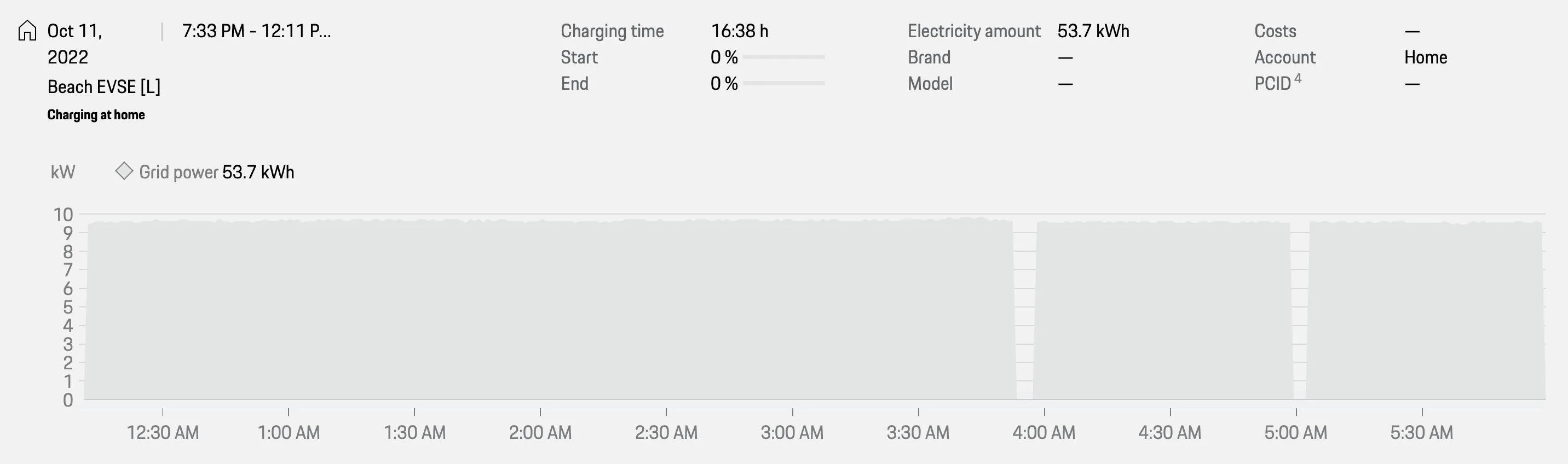
below is the graph of my charging session when home from my road trip this past week - pull in at 20% SOC - charge to 85% (65% battery capacity - for 54 kWh) - NOTE the relentless 9.6 kW power draw from 11 pm until about 6 am - with only two breaks (Porsche and the PMCC are unique in this space, other EVSE's don't have the drop outs) - but the charge session RAN FULL TILT for 8 hours - stressing the wire, the socket, the breaker and the EVSE…

Porsche Taycan Need a Class Action Lawsuit - Porsche Mobile Charger Screen Shot 2022-10-13 at 3.27.29 PM


the charging session above ran 194,400 kilojoules through this circuit in 8 hours - that is simply amazing in my opinion -and demands the best quality parts and materials.

Porsche Taycan Need a Class Action Lawsuit - Porsche Mobile Charger Screen Shot 2022-10-13 at 3.44.16 PM


other 240V home appliances and devices use a lot of power, but not continuously like an EVSE - they cycle on/off and have periods of low usage and then grab some power, relax, grab some power, relax - EVSEs take no breaks and will simply pump full capacity until the vehicle tells them stop - at which point they promptly drop to zero…

specify require and demand and pay for the highest quality components in this particular electrical circuit in your home. To do otherwise risks some nasty failures or best case some faults or melting.
  • Industrial grade plugs - like the Hubble
  • copper wire
    • (over spec if building code requires 8 gauge, ask for 6 gauge)
  • industrial quality breaker
  • correct install and make sure all the boxes and junctions are tight and sealed to avoid sparks escaping.
no cheaping out!!!
 
Last edited:

Loltheinternet

Well-Known Member
Joined
Feb 22, 2022
Threads
1
Messages
110
Reaction score
92
Location
Austin
Vehicles
Land Rover Range Rover L405, 2020 Taycan Turbo
Country flag
Is there an easy way to tell from the outside of the plug if it is said "high quality"? (Other than just looking for the Hubbell brand name of course)

My 14-50 plug was installed before we moved into the home so I am not sure the particular outlet product used during installation.
 

daveo4EV

Well-Known Member
First Name
David
Joined
Jan 28, 2019
Threads
192
Messages
7,007
Reaction score
10,478
Location
Santa Cruz
Vehicles
Cayenne Hybrid, 911(s) GT3/Convertable
Country flag
Is there an easy way to tell from the outside of the plug if it is said "high quality"? (Other than just looking for the Hubbell brand name of course)

My 14-50 plug was installed before we moved into the home so I am not sure the particular outlet product used during installation.
maybe - should be on the plug face - if it's not - assume it's fairly generic and normal grade - I'd consider getting a quote to swap it out - might be more than expected - the Hubble plugs are deeper than normal plugs and electrician's normally put them in a slight bigger junction box to have more room given their greater volume & depth…

but other than what you can see from the face plate there is no way to tell - if you disassemble the plug then there might be part numbers or manufacturer info on the back of the unit - but that's a lot of work - and by the time you've taken it all apart you can just reassemble it with a Hubble (or equivalent)

apologies - but I think that's the best you can do.
 

daveo4EV

Well-Known Member
First Name
David
Joined
Jan 28, 2019
Threads
192
Messages
7,007
Reaction score
10,478
Location
Santa Cruz
Vehicles
Cayenne Hybrid, 911(s) GT3/Convertable
Country flag
you can save a little bit of money if you order the Hubble off amazon - that way the electrician won't add their mark up - so they show up - you hand them the plug-socket - and point to where you want it installed…unless there are serious space issue with the physical box the plug is already in - you can swap one of these in way less than an hour…
Sponsored

 
Status
Not open for further replies.


Top