Tooney
Well-Known Member
- Joined
- Aug 14, 2021
- Threads
- 746
- Messages
- 4,470
- Reaction score
- 3,651
- Location
- Ohio
- Vehicles
- 2022 Taycan 4S

- Thread starter
- #1
Some excerpts:
Electrify America publishes this quarterly report to share the progress and impact of its investments in California during the second quarter of 2022.
https://media.electrifyamerica.com/...-Q22022ElectrifyAmericaReporttoCARBPublic.pdf
During the quarter, Electrify America’s accomplishments included:
Delivering more than 500,000 charging sessions in California, a more than three-fold increase from Q2 2021.
Opening 10 new ultra-fast charging stations in California

---
Electrify America opened ultra-fast charging stations at a rapid pace during Q2, despite continuing to face longstanding challenges and issues related to station permitting and new utility service. These two areas were again Electrify America’s primary cause for delay and undue station “soft costs” in California. It costs 45% more, on average, to design and construct an Electrify America station in California than it costs to build a station with the same number of chargers in another state. This higher cost per station results in California receiving fewer stations per dollar invested by Electrify America, and these higher costs are primarily driven by permitting delays and utility site energization delays.
----
The second longstanding challenge regards new utility service. The local electric utility typically has four essential responsibilities: (1) validating power availability, (2) designing the new utility service, (3) creating easements and securing permits for the new service line extension and equipment, and (4) scheduling construction crews to build the line extension, install a new transformer, inspect the station, and energize the site. As of the end of Q2 2022, the new service utility interconnection process for Electrify America stations averaged 38 weeks, or nearly nine months, in California. Critically, California’s utilities have not completed construction, inspection, and energization of the new utility service until, on average, 32 weeks, or approximately seven months, after Electrify America completed construction of its charging stations.

----
Finally, in Q2 Electrify America continued to encounter process challenges in deploying behind-the-meter, non-export battery energy storage systems (BESS) at ultra-fast charging stations. For example, some utilities considered the storage to be added load or generation. These battery systems are designed to reduce peak load and lower demands on the distribution system. Treating batteries as new load – in addition to the EV charging station load – serves as a barrier to rapid deployment efforts, and frequently leads to rigorous, time-intensive interconnection studies.
The CPUC-approved Rule 21 interconnection processes allow utilities to require supplemental reviews that may span months and add tens of thousands of dollars in cost, and California’s utilities are asking for supplemental reviews more frequently this year. In one such instance, receiving interconnection approval took 11 months from Electrify America’s initial application submittal, as the project was required to undergo Rule 21’s Supplemental Review (SR), Electrical Independent Test (EIT), and System Impact Study (SIS) processes due to unrelated pre-existing grid system conditions – a potentially undue burden to assess the BESS acting solely behind the meter. These additional processes are leading to longer timelines and material cost and overhead increases that may result in decreased investment in such systems moving forward despite the proven grid benefits of such assets
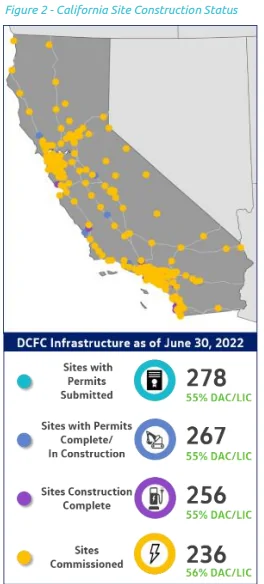
Electrify America publishes this quarterly report to share the progress and impact of its investments in California during the second quarter of 2022.
https://media.electrifyamerica.com/...-Q22022ElectrifyAmericaReporttoCARBPublic.pdf
During the quarter, Electrify America’s accomplishments included:
Delivering more than 500,000 charging sessions in California, a more than three-fold increase from Q2 2021.
Opening 10 new ultra-fast charging stations in California
---
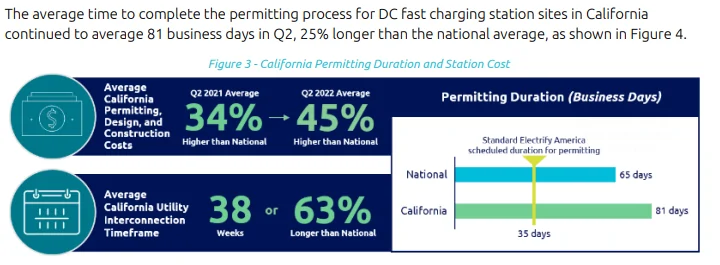
Electrify America opened ultra-fast charging stations at a rapid pace during Q2, despite continuing to face longstanding challenges and issues related to station permitting and new utility service. These two areas were again Electrify America’s primary cause for delay and undue station “soft costs” in California. It costs 45% more, on average, to design and construct an Electrify America station in California than it costs to build a station with the same number of chargers in another state. This higher cost per station results in California receiving fewer stations per dollar invested by Electrify America, and these higher costs are primarily driven by permitting delays and utility site energization delays.
----
The second longstanding challenge regards new utility service. The local electric utility typically has four essential responsibilities: (1) validating power availability, (2) designing the new utility service, (3) creating easements and securing permits for the new service line extension and equipment, and (4) scheduling construction crews to build the line extension, install a new transformer, inspect the station, and energize the site. As of the end of Q2 2022, the new service utility interconnection process for Electrify America stations averaged 38 weeks, or nearly nine months, in California. Critically, California’s utilities have not completed construction, inspection, and energization of the new utility service until, on average, 32 weeks, or approximately seven months, after Electrify America completed construction of its charging stations.
----
Finally, in Q2 Electrify America continued to encounter process challenges in deploying behind-the-meter, non-export battery energy storage systems (BESS) at ultra-fast charging stations. For example, some utilities considered the storage to be added load or generation. These battery systems are designed to reduce peak load and lower demands on the distribution system. Treating batteries as new load – in addition to the EV charging station load – serves as a barrier to rapid deployment efforts, and frequently leads to rigorous, time-intensive interconnection studies.
The CPUC-approved Rule 21 interconnection processes allow utilities to require supplemental reviews that may span months and add tens of thousands of dollars in cost, and California’s utilities are asking for supplemental reviews more frequently this year. In one such instance, receiving interconnection approval took 11 months from Electrify America’s initial application submittal, as the project was required to undergo Rule 21’s Supplemental Review (SR), Electrical Independent Test (EIT), and System Impact Study (SIS) processes due to unrelated pre-existing grid system conditions – a potentially undue burden to assess the BESS acting solely behind the meter. These additional processes are leading to longer timelines and material cost and overhead increases that may result in decreased investment in such systems moving forward despite the proven grid benefits of such assets
Sponsored