mrmax
Active Member
- First Name
- Max
- Joined
- Oct 7, 2024
- Threads
- 4
- Messages
- 37
- Reaction score
- 110
- Location
- Palo Alto
- Vehicles
- 25 Taycan TurboGT, 25 Cayenne EHybrid, 23 Bronco Badlands

- Thread starter
- #1
I just did my first road trip in the Turbo GT.
I drove from Menlo Park to Truckee and I was *thrilled* with the range under the circumstances.
Trip: 220 miles and 5600 feet of elevation gain
Weather: mostly 50s for the first ~150 miles, then dropping fairly quickly to 30s and eventually high 20s
Traffic conditions: heavy traffic for the first couple hours, stop and go at times; rarely able to drive > 70mph. Lots of time in the 60s, but the stop and go kept the average to 45mph
Road conditions: mostly dry but some wet roads, as well as some salt and very few light bits of snow over the last ~50 miles
Other consumption: minimal climate control needed for the first 3.5 hours; heated to 66 with seat heaters on low for the last 1.5 hours; fairly loud music through most of the trip
Settings: range mode, mostly low height
Tires and wheels: BBS FI-R 21 inch, 9.5 and 11.5 width, 58mm offset front and 60mm rear are slightly outboard of stock. Tires were PS4AS Panamera fitment (ND0), 275/35 front and 325/30 rear. Inflated to ~comfort pressures - 38 PSI “cold” (~70 degrees). ~40 PSI “hot” for much of the trip (~90 degrees).
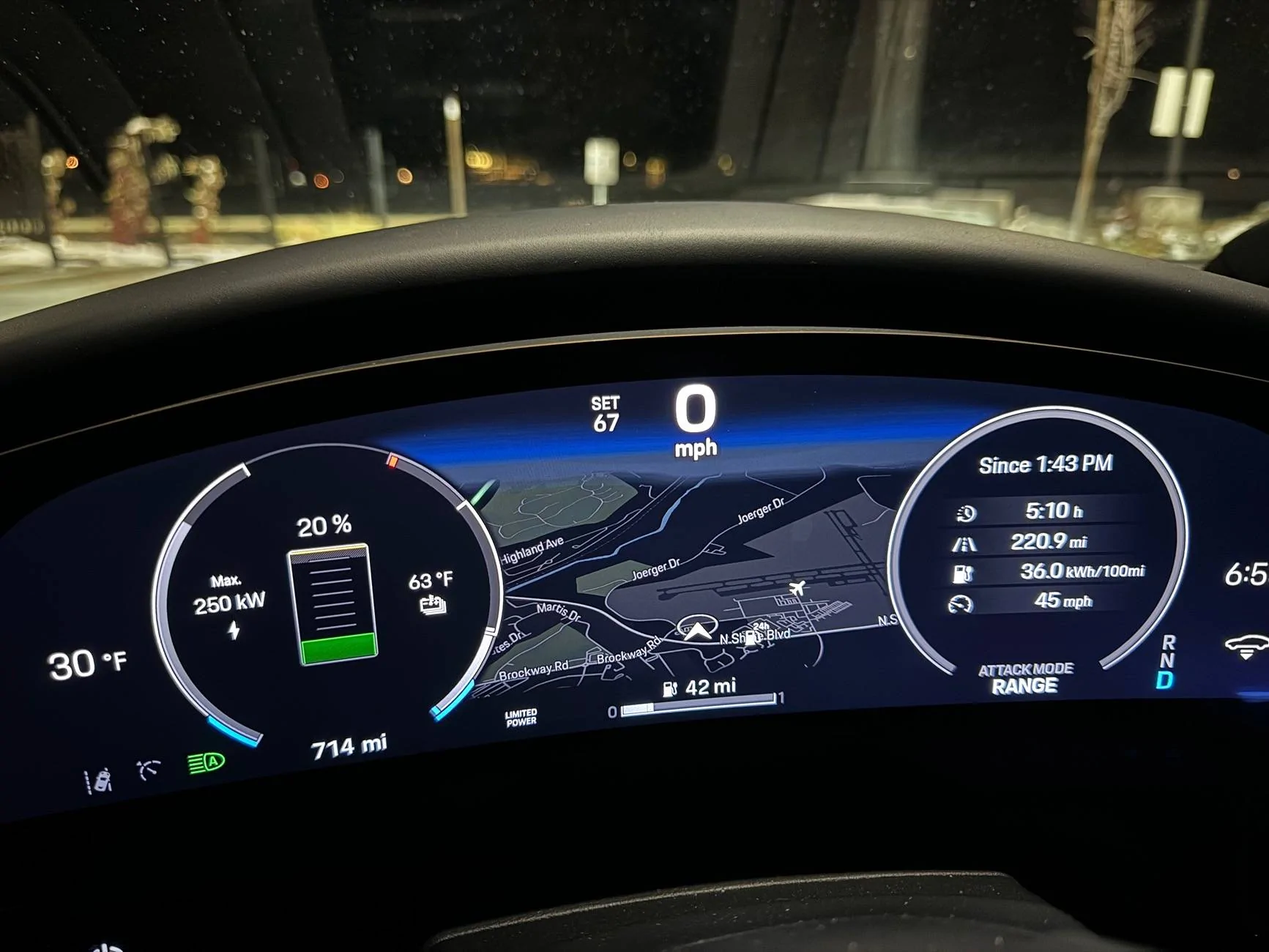
Results: Starting at 99% charge (3 mile drive to work after charging), I arrived with 20% charge(!).
Analysis: climbing 5600 feet in a 5500 lb car (including driver and luggage) requires about 42 mega joules of gravitational potential energy, or 11.5 kWh/12% of battery capacity assuming perfect efficiency. If I take out the 12% consumed to overcome gravity, then the 220 miles of drag, rolling resistance, and misc operating consumption used 67% of my battery/this equates to a range of 330 miles on flat terrain, despite the cold weather.
Other observations and questions
1. It seems that either a) the car is slightly over-reporting power usage b) the battery has slightly more usable capacity than claimed or c) the remaining charge is slightly optimistic. 220.9 miles at 36 kWh/100 miles should burn 79.5 kWh. I had already burned close to 1.5 kWh to get to work (3.4 miles uphill) so having burnt 81 kWh of 97 kWh usable I should have had 16.5% remaining? The amount remaining is consistent with a usable capacity of 101 kWh if the consumption is accurate.
2. I was very curious how the temperature would affect range. The expected range on arrival dropped 1% when I switched from max eco to eco as it got cold, but otherwise held steady as the temperature dropped. The last 68 miles - from Auburn - burned 34% of the battery but at least 10% of that was for elevation gain so that equates to a at least a 283 mile range equivalent for that part of the trip without the elevation gain… but that portion of the trip was with far less traffic so I got close to 80 mph for stretches, and the road was wet for significant stretches and otherwise crappy (salt, tiny bits of snow, much more worn) so I would not have expected to be nearly as efficient as on the first part of the trip.
3. Further re temperature, the battery temperature stayed mostly in the high 60s even when it dropped into the 20s outside. I don’t know the extent to which the car was deliberately heating the battery or the usage of the battery to power the motors (then regenerate on one downhill section) kept it warm. The temperature dropped a few degrees at the end, which coincided with slow/flat section in town that required less battery usage.
As a point of comparison, the same trip in my 2022 GTS Sport Turismo would forecast requiring ~114% of battery capacity vs the 79% I used in the new car… so based on this trip it looks like I am getting 38% more range, and about 19% more efficiency/range per kWh. I do think traffic conditions helped, but the cold weather and poor road conditions at least significantly offset the increased efficiency from driving slower. In any case I would be surprised if I don’t wind up seeing something like 30% more range in like-for-like conditions.
Porsche, thank you for all the efficiency improvements - even on most performance oriented / less efficient variant - as well as the increased (perhaps to more than promised? 101 kWh?) battery capacity.

I drove from Menlo Park to Truckee and I was *thrilled* with the range under the circumstances.
Trip: 220 miles and 5600 feet of elevation gain
Weather: mostly 50s for the first ~150 miles, then dropping fairly quickly to 30s and eventually high 20s
Traffic conditions: heavy traffic for the first couple hours, stop and go at times; rarely able to drive > 70mph. Lots of time in the 60s, but the stop and go kept the average to 45mph
Road conditions: mostly dry but some wet roads, as well as some salt and very few light bits of snow over the last ~50 miles
Other consumption: minimal climate control needed for the first 3.5 hours; heated to 66 with seat heaters on low for the last 1.5 hours; fairly loud music through most of the trip
Settings: range mode, mostly low height
Tires and wheels: BBS FI-R 21 inch, 9.5 and 11.5 width, 58mm offset front and 60mm rear are slightly outboard of stock. Tires were PS4AS Panamera fitment (ND0), 275/35 front and 325/30 rear. Inflated to ~comfort pressures - 38 PSI “cold” (~70 degrees). ~40 PSI “hot” for much of the trip (~90 degrees).
Results: Starting at 99% charge (3 mile drive to work after charging), I arrived with 20% charge(!).
Analysis: climbing 5600 feet in a 5500 lb car (including driver and luggage) requires about 42 mega joules of gravitational potential energy, or 11.5 kWh/12% of battery capacity assuming perfect efficiency. If I take out the 12% consumed to overcome gravity, then the 220 miles of drag, rolling resistance, and misc operating consumption used 67% of my battery/this equates to a range of 330 miles on flat terrain, despite the cold weather.
Other observations and questions
1. It seems that either a) the car is slightly over-reporting power usage b) the battery has slightly more usable capacity than claimed or c) the remaining charge is slightly optimistic. 220.9 miles at 36 kWh/100 miles should burn 79.5 kWh. I had already burned close to 1.5 kWh to get to work (3.4 miles uphill) so having burnt 81 kWh of 97 kWh usable I should have had 16.5% remaining? The amount remaining is consistent with a usable capacity of 101 kWh if the consumption is accurate.
2. I was very curious how the temperature would affect range. The expected range on arrival dropped 1% when I switched from max eco to eco as it got cold, but otherwise held steady as the temperature dropped. The last 68 miles - from Auburn - burned 34% of the battery but at least 10% of that was for elevation gain so that equates to a at least a 283 mile range equivalent for that part of the trip without the elevation gain… but that portion of the trip was with far less traffic so I got close to 80 mph for stretches, and the road was wet for significant stretches and otherwise crappy (salt, tiny bits of snow, much more worn) so I would not have expected to be nearly as efficient as on the first part of the trip.
3. Further re temperature, the battery temperature stayed mostly in the high 60s even when it dropped into the 20s outside. I don’t know the extent to which the car was deliberately heating the battery or the usage of the battery to power the motors (then regenerate on one downhill section) kept it warm. The temperature dropped a few degrees at the end, which coincided with slow/flat section in town that required less battery usage.
As a point of comparison, the same trip in my 2022 GTS Sport Turismo would forecast requiring ~114% of battery capacity vs the 79% I used in the new car… so based on this trip it looks like I am getting 38% more range, and about 19% more efficiency/range per kWh. I do think traffic conditions helped, but the cold weather and poor road conditions at least significantly offset the increased efficiency from driving slower. In any case I would be surprised if I don’t wind up seeing something like 30% more range in like-for-like conditions.
Porsche, thank you for all the efficiency improvements - even on most performance oriented / less efficient variant - as well as the increased (perhaps to more than promised? 101 kWh?) battery capacity.
Sponsored