Crick
Well-Known Member
- First Name
- Crick
- Joined
- Jan 30, 2021
- Threads
- 6
- Messages
- 183
- Reaction score
- 148
- Location
- Palo Alto, CA
- Vehicles
- 2018 Volt, 2009 BMW X5D, 2021 Taycan Turbo S

- Thread starter
- #1
I asked Claude to do an analysis. This is what came back (public link):
Overview
This post tracks the estimated mean market value of 2021 model year Taycan sedans — Base, 4S, Turbo, and Turbo S — from new-car purchase through mid-2026, with a focus on San Francisco Bay Area pricing. Values are calibrated against Kelley Blue Book private-party data, CarGurus Bay Area listings, and reported dealer and private sales. Mean pricing is used throughout to smooth out the wide variation that options packages introduce.
Summary

Depreciation Table: Estimated Market Value by Year
2021 model year sedans · Mean pricing · Assumes ~12,000 miles/year · Bay Area
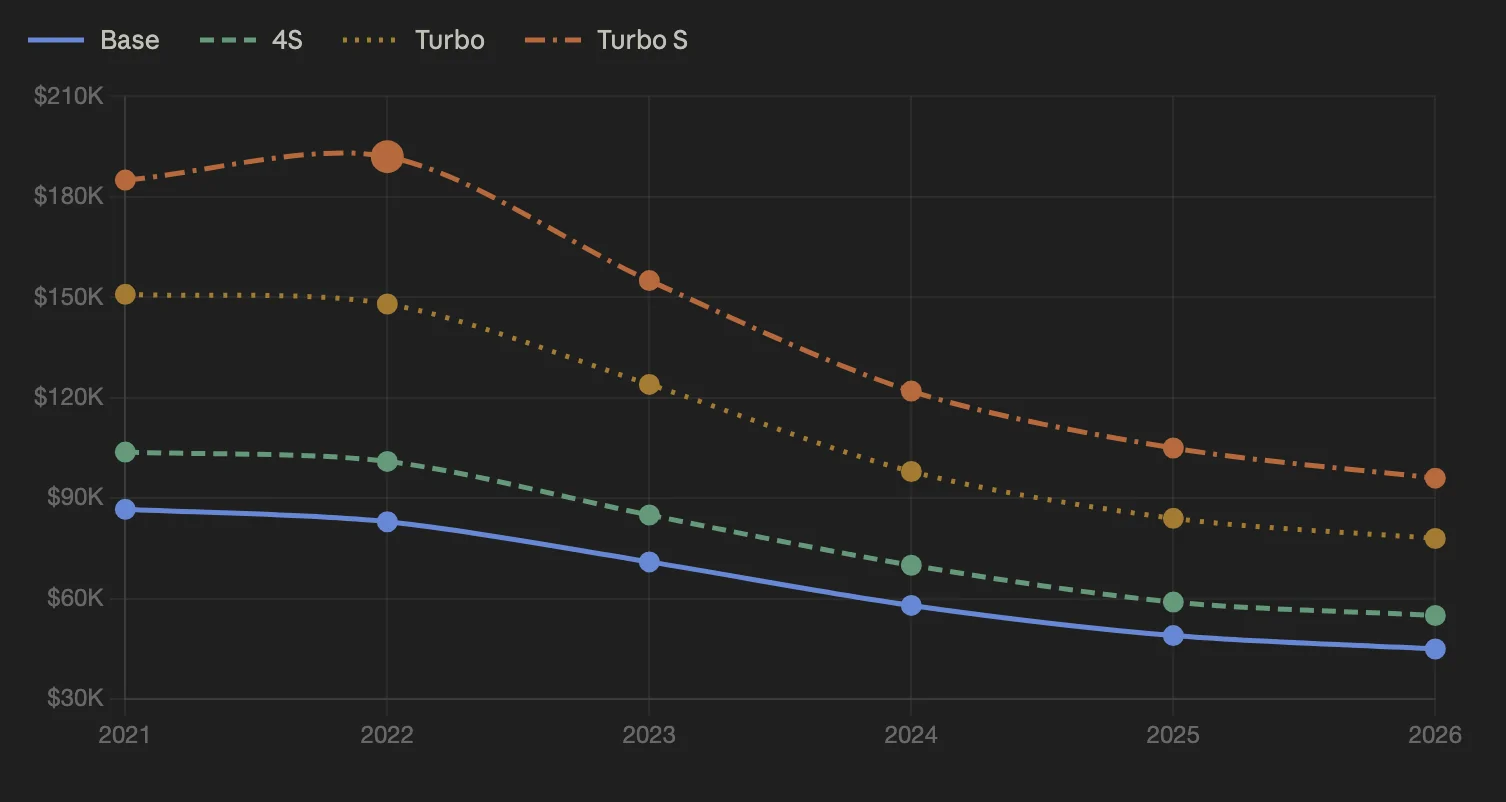
▲ The Turbo S briefly traded above MSRP in 2022 due to chip-shortage supply constraints and strong secondary market demand — the only period of observed appreciation in the Taycan's used-market history.
Key Findings
Why Taycans depreciate faster than traditional Porsches
The short version: technology obsolescence. Unlike a 911 or Boxster — where the powertrain technology is mature and stable — the Taycan competes against a moving target. Every model year brings meaningfully longer range, faster charging, and more efficient cells. A 2021 Turbo S was extraordinary when it launched. Measured against a 2025 model that charges twice as fast and goes 50+ miles further on a charge, it feels like a previous generation of tech. That narrative, fairly or not, gets priced into the used market quickly.
The other factor is options pricing. The Taycan's option catalog is genuinely ruthless — it's easy to build a $160K car into a $220K car. The used market does not give back full dollar credit for that spend. A Turbo S with $40K in options will not sell for $40K more than a lightly-optioned one. Heavy option loading accelerates absolute dollar loss on the way down.
Sources and methodology: Kelley Blue Book private-party values and depreciation tables (2022–2024 model years); CarGurus Bay Area listings and price trend data; EV Depreciation; Recharged; Carbuzz; Porsche Taycan Forum transaction reports; Hendrick Porsche MSRP archive; KBB Cost to Own data. All values represent estimated mean market prices for vehicles in average condition at approximately 12,000 miles/year. Actual transaction prices vary by mileage, battery health, option content, and condition. This is informational analysis, not an appraisal or offer to buy/sell.
Porsche Taycan Depreciation Report: San Francisco Bay Area (2021–2026)
Market Analysis · Q2 2026 · Mean pricing across common option configurations
Market Analysis · Q2 2026 · Mean pricing across common option configurations
Overview
This post tracks the estimated mean market value of 2021 model year Taycan sedans — Base, 4S, Turbo, and Turbo S — from new-car purchase through mid-2026, with a focus on San Francisco Bay Area pricing. Values are calibrated against Kelley Blue Book private-party data, CarGurus Bay Area listings, and reported dealer and private sales. Mean pricing is used throughout to smooth out the wide variation that options packages introduce.
Summary
| Metric | Value |
| 2021 MSRP range (4 trims) | $86,700 – $185,000 |
| 2026 used market range | $45,000 – $96,000 |
| Average 5-year depreciation | ~48% |
| Bay Area avg listing (all years, all trims) | $82,700 |
Depreciation Table: Estimated Market Value by Year
2021 model year sedans · Mean pricing · Assumes ~12,000 miles/year · Bay Area
| Calendar Year | Base | 4S | Turbo | Turbo S |
| 2021 — new (MSRP) | $86,700 | $103,800 | $150,900 | $185,000 |
| 2022 | $83,000 | $101,000 | $148,000 | $192,000 ▲ |
| 2023 | $71,000 | $85,000 | $124,000 | $155,000 |
| 2024 | $58,000 | $70,000 | $98,000 | $122,000 |
| 2025 | $49,000 | $59,000 | $84,000 | $105,000 |
| 2026 — current | $45,000 | $55,000 | $78,000 | $96,000 |
| 5-year loss | −$41,700 (−48%) | −$48,800 (−47%) | −$72,900 (−48%) | −$89,000 (−48%) |
▲ The Turbo S briefly traded above MSRP in 2022 due to chip-shortage supply constraints and strong secondary market demand — the only period of observed appreciation in the Taycan's used-market history.
Key Findings
- Near-flat values in 2021–22. Chip-shortage inventory constraints and strong post-launch EV demand kept all four trims at or near MSRP through the first year. The Turbo S was the outlier, briefly trading above sticker in the secondary market. If you bought in 2021 and were tempted to flip in early 2022, you were briefly in the money.
- Sharpest decline in 2022–24. Rising interest rates, a broad EV market correction, expiring federal incentives, and a surge in used inventory combined to produce double-digit annual declines. This was the steepest drawdown phase — a 2022 Taycan base lost roughly $17,000 in value in 2024 alone.
- The 2025 refresh accelerated the used-price slide. Porsche's mid-cycle update added a 105 kWh battery, up to 320 kW DC fast charging, and a light visual restyle. This made pre-2025 cars feel a generation behind on the spec sheet and amplified downward pressure on used values heading into 2025.
- Trim level doesn't change the percentage curve. All four trims shed roughly 47–48% of original MSRP over five years. The Turbo S takes the largest absolute hit (~$89K gone), but the rate of loss is nearly identical to the Base. If depreciation percentage is your concern, the trim you choose barely matters.
- Bay Area is slightly better than the national average — but not dramatically so. Bay Area Taycan listings currently run about 3–5% above national KBB benchmarks, reflecting strong local EV adoption and higher household incomes. The underlying depreciation trajectory, however, is shaped by the same macro forces everywhere. CarGurus shows 157 Taycans currently listed in the SF Bay Area, ranging from $44,813 to $207,344, with an average of $82,700.
- Signs of stabilization in 2025–26. Annual declines have moderated to mid-single digits as inventory normalizes and the used EV market finds a floor. Well-maintained examples with documented battery health and desirable configurations are holding better. The panic-selling phase appears to be behind us.
Why Taycans depreciate faster than traditional Porsches
The short version: technology obsolescence. Unlike a 911 or Boxster — where the powertrain technology is mature and stable — the Taycan competes against a moving target. Every model year brings meaningfully longer range, faster charging, and more efficient cells. A 2021 Turbo S was extraordinary when it launched. Measured against a 2025 model that charges twice as fast and goes 50+ miles further on a charge, it feels like a previous generation of tech. That narrative, fairly or not, gets priced into the used market quickly.
The other factor is options pricing. The Taycan's option catalog is genuinely ruthless — it's easy to build a $160K car into a $220K car. The used market does not give back full dollar credit for that spend. A Turbo S with $40K in options will not sell for $40K more than a lightly-optioned one. Heavy option loading accelerates absolute dollar loss on the way down.
Sources and methodology: Kelley Blue Book private-party values and depreciation tables (2022–2024 model years); CarGurus Bay Area listings and price trend data; EV Depreciation; Recharged; Carbuzz; Porsche Taycan Forum transaction reports; Hendrick Porsche MSRP archive; KBB Cost to Own data. All values represent estimated mean market prices for vehicles in average condition at approximately 12,000 miles/year. Actual transaction prices vary by mileage, battery health, option content, and condition. This is informational analysis, not an appraisal or offer to buy/sell.
Sponsored