Alib
Active Member
- Joined
- Jun 27, 2025
- Threads
- 3
- Messages
- 34
- Reaction score
- 20
- Location
- Santa Monica/Scottsdale
- Vehicles
- Fully Loded 2023 Taycan 4S

- Thread starter
- #1
I purchased a fully loaded Jet Black 4S in late July and had it shipped from Virginia. Upon its arrival, it had a coolant leak due to an improper jack position, resulting in a burst pipe. $58K later, I received a new J1.2 battery pack and an insurance claim against the shipper. The vehicle arrived with a Turbo GT emblem, and I began to explore the cost of upgrading to a Turbo GT feature by feature.
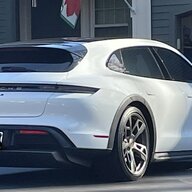
Rear: The only difference I can appreciate in the rear is the two non-functional vents to the turbo-style rear bumper. This seems like an easy graft, not even requiring new paint for around $1,000. A Weissach “style” fixed wing can easily be had for under $500, with many knock-offs being under $200, which I will paint to match. I am a fan of the look of carbon fiber. I am also not a fan of fixed-wing support and drilling holes into the trunk to mount them. I am leaning towards a more active aerodynamics with an active 911.1 Turbo style raising wing (although the 922.2 air brake feature is interesting), for $2,000 which would come through the existing wing which would remain in a fixed closed position with modification and paint for $1,250 to $1,500.
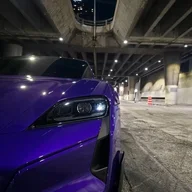
Front: Cosmetically, the facelift is most apparent in the front bumper cover, which can be replaced with a Trubo J1.2 front bumper cover for $1,400 plus potentially some tweaking given the different sensor locations. The two turbo inserts (4 total) will cost $1,500, and a turbo front spoiler will cost $1,000. I intend to keep the J1 fenders that are more aggressive than the more tapered J1.2. I will upgrade from the current LED Matrix headlights by using its single projector, but placing it in a J1.2 housing at a cost of around $1,500. Paint and modifications will cost an additional $1,500.
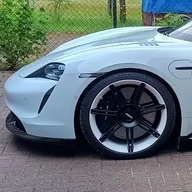
Wheels and brakes: I already have 21” Carbon Fiber Areostyle wheels, which are already Turbo GT appropriate, but I will take the opportunity to protect the leading carbon blades by applying glossy black PPF for $900 to $1,200. The most expensive single upgrade will require the purchase of a used salvaged PCCB rotors and calipers at around $9,000. Because Taycans rely heavily on regenerative braking, even the purchase of used rotors should last the life of the vehicle. I am leaning towards keeping the classic yellow calipers, although the Turbo GT black might be more appropriate.
Interior: There are not many distinctive changes between the J.1 and J1.2; however, three main distinctive features make it a Turbo GT. The first is signage at the door sills, and the Taycan insert above the center screen with “Turbo GT” is slightly off-white lettering. I purchased carbon fiber sill overlays for the sills for $150, which will be wrapped in matte black, matching the existing plastic, with off-white lettering applied on top and covered with clear PPF to protect the sills from scuff marks. Similarly, the small rectangle will receive the same treatment, all for $750. The only remaining distinctive change will require the addition of he paddle shifters currently unique to the Turbo GT. I anticipate grafting the paddle shifters onto the existing steering wheel, leaving the change non-functional for $500. I am hopeful that one day, push to pass or Attack mode in a GT using the right paddle might be an option, but it seems very unlikely without an inventive tuner. With the addition of a raising wing further limiting the view of the rear view mirror, a rear view mirror dashcam with a rear camera will replace the view with a 2K LCD monitor, as well as function as a front and rear dash cam for $300.
Tuning: While there is no way to increase available horsepower to match the 1,000+ Turbo GT without fitting a Turbo motor, inverter, etc. Tuners do offer a modest 100 to 140 HP tuning boost for $1,500 - $2,000. To date, no tuner has offered the boost as available on demand (like push-to-pass), but it would be an interesting option. Volkswagen already provides an upgrade to remove the limits on its upgraded battery pack, and I hope that Porsche similarly offers the upgrade at a reasonable price.
The cost of the conversion is approximately $23,000. The net cost will be less, as most of the existing parts, like the glacial blue headlights and rear reflector, front bumper cover, brakes, etc., might generate as much as $6,800 in savings, bringing the build to $16,200. There are at best 400 Turbo GTs that will be produced yearly, with a list price of over $250,000 with similar options. An expenditure of $16,200 to more than double the perceived value of a 2023 4S to a 2025 Turbo GT appears to be a somewhat reasonable investment. As I step into this project, I can only hope that forum members will chime in on each feature upgrade.
Rear: The only difference I can appreciate in the rear is the two non-functional vents to the turbo-style rear bumper. This seems like an easy graft, not even requiring new paint for around $1,000. A Weissach “style” fixed wing can easily be had for under $500, with many knock-offs being under $200, which I will paint to match. I am a fan of the look of carbon fiber. I am also not a fan of fixed-wing support and drilling holes into the trunk to mount them. I am leaning towards a more active aerodynamics with an active 911.1 Turbo style raising wing (although the 922.2 air brake feature is interesting), for $2,000 which would come through the existing wing which would remain in a fixed closed position with modification and paint for $1,250 to $1,500.
Front: Cosmetically, the facelift is most apparent in the front bumper cover, which can be replaced with a Trubo J1.2 front bumper cover for $1,400 plus potentially some tweaking given the different sensor locations. The two turbo inserts (4 total) will cost $1,500, and a turbo front spoiler will cost $1,000. I intend to keep the J1 fenders that are more aggressive than the more tapered J1.2. I will upgrade from the current LED Matrix headlights by using its single projector, but placing it in a J1.2 housing at a cost of around $1,500. Paint and modifications will cost an additional $1,500.
Wheels and brakes: I already have 21” Carbon Fiber Areostyle wheels, which are already Turbo GT appropriate, but I will take the opportunity to protect the leading carbon blades by applying glossy black PPF for $900 to $1,200. The most expensive single upgrade will require the purchase of a used salvaged PCCB rotors and calipers at around $9,000. Because Taycans rely heavily on regenerative braking, even the purchase of used rotors should last the life of the vehicle. I am leaning towards keeping the classic yellow calipers, although the Turbo GT black might be more appropriate.
Interior: There are not many distinctive changes between the J.1 and J1.2; however, three main distinctive features make it a Turbo GT. The first is signage at the door sills, and the Taycan insert above the center screen with “Turbo GT” is slightly off-white lettering. I purchased carbon fiber sill overlays for the sills for $150, which will be wrapped in matte black, matching the existing plastic, with off-white lettering applied on top and covered with clear PPF to protect the sills from scuff marks. Similarly, the small rectangle will receive the same treatment, all for $750. The only remaining distinctive change will require the addition of he paddle shifters currently unique to the Turbo GT. I anticipate grafting the paddle shifters onto the existing steering wheel, leaving the change non-functional for $500. I am hopeful that one day, push to pass or Attack mode in a GT using the right paddle might be an option, but it seems very unlikely without an inventive tuner. With the addition of a raising wing further limiting the view of the rear view mirror, a rear view mirror dashcam with a rear camera will replace the view with a 2K LCD monitor, as well as function as a front and rear dash cam for $300.
Tuning: While there is no way to increase available horsepower to match the 1,000+ Turbo GT without fitting a Turbo motor, inverter, etc. Tuners do offer a modest 100 to 140 HP tuning boost for $1,500 - $2,000. To date, no tuner has offered the boost as available on demand (like push-to-pass), but it would be an interesting option. Volkswagen already provides an upgrade to remove the limits on its upgraded battery pack, and I hope that Porsche similarly offers the upgrade at a reasonable price.
The cost of the conversion is approximately $23,000. The net cost will be less, as most of the existing parts, like the glacial blue headlights and rear reflector, front bumper cover, brakes, etc., might generate as much as $6,800 in savings, bringing the build to $16,200. There are at best 400 Turbo GTs that will be produced yearly, with a list price of over $250,000 with similar options. An expenditure of $16,200 to more than double the perceived value of a 2023 4S to a 2025 Turbo GT appears to be a somewhat reasonable investment. As I step into this project, I can only hope that forum members will chime in on each feature upgrade.
Sponsored
Last edited: