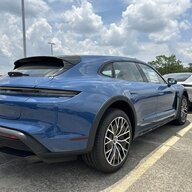
this is no secret. However some people still treat EVs like gasoline cars and only "fill up when needed" and not every night at home. The whole point of EV ownership is to abandon gasoline habits, meaning leaving home every morning with a "full" charge and not waiting until you're down to 10% before finally deciding to charge.
Obviously the faster you charge, the more degradation on the battery but it seems to me there's a grey area about what is fast charging.
In my old RC heli days, we considered any charge rate at or above 1C (equivalent to the pack's capacity) as fast charging and anything below as normal charging.
A Taycan with a PB+ battery has gross 93kwh capacity. If you charge it at 0.5C (50kw) is this still fast charging?
What about a Nissan Leaf? It's "extended" battery has 60kwh (standard is 40kwh). In this scenario, a 50kw charger station would indeed be considered "fast charge" for the standard battery and "close to fast" with the extended one.
Bottom line, I believe studies like the one reported in the article should also provide data of what they consider fast charging.
Here, government classifies fast charging as 25kw+ which might hold true for the zoe's out there but not for larger capacity vehicles (unless waiting 2h+ for a charge is fast now).