Jonathan S.
Well-Known Member
- First Name
- Jonathan
- Joined
- Jan 19, 2023
- Threads
- 43
- Messages
- 2,094
- Reaction score
- 1,917
- Location
- Amherst MA & Twin Mtn NH
- Website
- tinyurl.com
- Vehicles
- '22 4CT, '22 Audi A6 Allroad, '23 BMW i4 M50

Who me, an analytical kind of guy?
(My graduate school areas of concentration were Government & Business and Energy & Environmental Policy. I also cross-registered for two courses at MIT in energy analysis, from which I learned that electricity is generated from magic fairy dust and has zero environmental drawbacks ... or am not remembering those two courses correctly?)
Although I would love to have a decent budget for a real consulting engagement and research all this in depth, barring that, I suspect it's an intensification of the same problems as elsewhere:
The answer reminds me a little bit of this book I'm listening to just now: https://en.wikipedia.org/wiki/Why_Nations_Fail (and in case you're wondering what an economist does for fun, the answer is more economics, just for fun!)
(My graduate school areas of concentration were Government & Business and Energy & Environmental Policy. I also cross-registered for two courses at MIT in energy analysis, from which I learned that electricity is generated from magic fairy dust and has zero environmental drawbacks ... or am not remembering those two courses correctly?)
Although I would love to have a decent budget for a real consulting engagement and research all this in depth, barring that, I suspect it's an intensification of the same problems as elsewhere:
- Higher population density and miles travelled along the major highway corridors, so the more use, the more these break.
- Probably higher EV adoption on a per-capita basis, so more of the above.
- Temperature swings from 100F+ to negative F probably don't help with reliability, and we can go through that range in a single day.
- Ditto re rain and snow.
The answer reminds me a little bit of this book I'm listening to just now: https://en.wikipedia.org/wiki/Why_Nations_Fail (and in case you're wondering what an economist does for fun, the answer is more economics, just for fun!)
- EA has lots of lousy little four-charger stations (including the OG EA, ~30min from my house, which I might visit sometime just to pay privilege to where this failure first started, installed in May 2018, undermining claims that EA just needs more time), but that quantity deters market entrants from supplying something better, especially given the free charging and otherwise low rates (kind of like when I was an alpine race coach, mainly for fun, with the perverse effect of hurting the labor market for career coaches, and same thing now as a volunteer ski patroller).
- For VT specifically, the state appropriated money in 2019 and 2020 (only now being spent), so why bother building stations with your own money when a competitor is getting Mo Money.
- Ditto re the 2021 NEVI $.
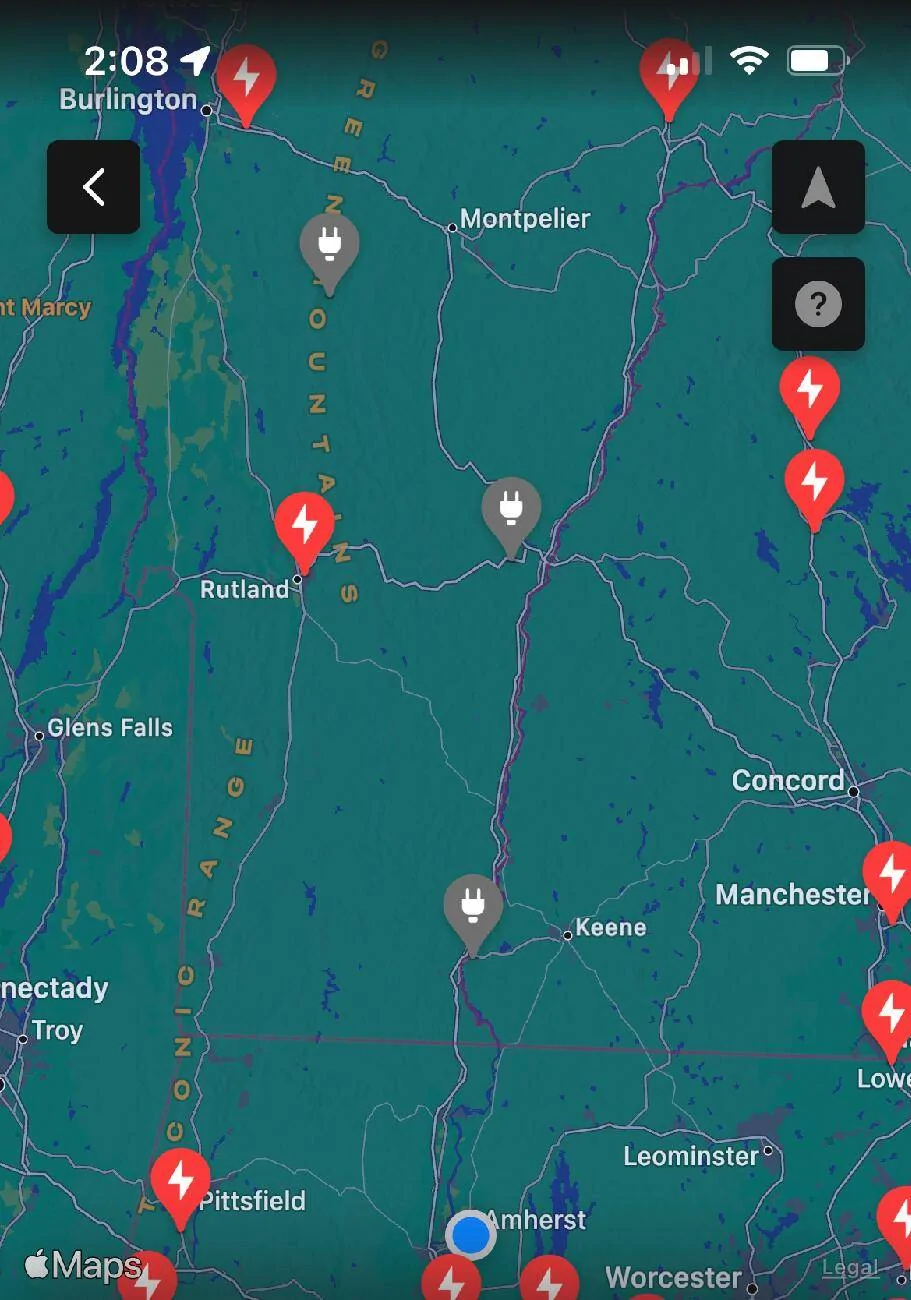
- And starting with the announcements in spring 2023, why bother trying to compete with TSCN (which has exactly the kind of comprehensive network that would be expected, especially in VT & NH, unlike all the scattershot one- and two-charger CCS1 stations, which might be the subject of an upcoming thread entitled CCS1 Locations that Make No Sense).
- Higher electricity prices, I don't think that should affect DCFC (as opposed to EV adoption in general), since the cost from the driver perspective is all relative to home charging, and we pay $0.37/kWh at home (Eversource), so even the Magic Dock rate of about 50 cents is a bargain given the convenience factor. (My brother-in-law pays
- Aversion to adding electric transmission lines/ NG lines, my general impression is that the grid here is in good shape, although I could ask an economist friend who used to work for ISO NE England, and it certainly hasn't impeded a robust TSCN here.
- Land costs, we have plenty of big box retailer strip malls with monster parking lots, which often host both a typical 4-charger EA and a 16-charger TSCN.
- Homes still heated with oil, yes, that does seem archaic, but I suspect part of that is that tank removal can incur big environmental cleanup costs if anything goes wrong, so best to just keep using it. (When I sold my childhood home in 2021, although my parents had decades ago switched away from oil heating, that 1951 oil tank was still in the basement!)
Sponsored