Sponsored

GM follows Ford with NACS Tesla charge port adoption -- time to ditch CCS1 (at least the physcial design)

OP
OP
daveo4EV

daveo4EV

Well-Known Member
First Name
David
Joined
Jan 28, 2019
Threads
192
Messages
7,007
Reaction score
10,478
Location
Santa Cruz
Vehicles
Cayenne Hybrid, 911(s) GT3/Convertable
Country flag
It is not a technical limitation, it's a business decision by Tesla. From a technical point of view magic dock proved that Tesla could have just enabled access to all via a portable magic dock (a $230 adapter), but they did not and are not.

This is just me speculating here, but I suspect Elon is both on a power trip and on hunt for data. Perhaps the update requires some Tesla specific CCS protocol extension to give Tesla battery health data per model for example. He might have gotten this one by the desperate automakers as "necessary data for safety of charging". One of Tesla's valuable assets and competitive advantages is all the battery telemetry they've collected on Teslas so far.
just re-read the VW/Audi/Porsche/Scout press release…

https://newsroom.porsche.com/en_US/...andard_in_future_electric_vehicles-34786.html

To enable existing customers with a Combined Charging System (CCS) charging port to access the Tesla Supercharger network—which would greatly expand charging provider choice—the brands are exploring adapter solutions for existing vehicles
there is what we know - but they clearly call out "existing" vehicle's - but waffle on access - so we'll see.

other vendors were more definitive that existing vehicles "would work"…why is Porsche making this soooo hard?
Sponsored


 

whitex

Well-Known Member
Joined
Jul 30, 2021
Threads
87
Messages
8,221
Reaction score
7,255
Location
WA, USA
Vehicles
2023 Taycan TCT, 2024 Q8 eTron P+
Country flag
just re-read the VW/Audi/Porsche/Scout press release…

https://newsroom.porsche.com/en_US/...andard_in_future_electric_vehicles-34786.html


there is what we know - but they clearly call out "existing" vehicle's - but waffle on access - so we'll see.

other vendors were more definitive that existing vehicles "would work"…why is Porsche making this soooo hard?
I suspect Porsche onboard charger is the most expensive to update. Most, if not all, other brands can OTA or at most re-flash at the dealer. Not the original Taycan apparently. Perhaps new Taycan will be easier updatable to Tesla adapter access.
 
OP
OP
daveo4EV

daveo4EV

Well-Known Member
First Name
David
Joined
Jan 28, 2019
Threads
192
Messages
7,007
Reaction score
10,478
Location
Santa Cruz
Vehicles
Cayenne Hybrid, 911(s) GT3/Convertable
Country flag
I suspect Porsche onboard charger is the most expensive to update. Most, if not all, other brands can OTA or at most re-flash at the dealer. Not the original Taycan apparently. Perhaps new Taycan will be easier updatable to Tesla adapter access.
so you're speculation is that Tesla requires vendors to do some minimal updates on the CCS1 "vehicle meta-data" - and that given Porsche's excellent software engineering this may "thwart" legacy models from being compatible given the expense/complexity/incompetence to conform to the minimal supercharger meta-data requirements?

NOTE: these "minimal" changes would fall short of full plug&charge/billing support, but fit with in the "optional" existing CCS1 accommodations for meta-data over a conforming CCS1 vehicle. As with all standards CCS1 has a "basic" it must work level of conformance, and then there is always room for "optional" CCS1 protocol support - Tesla could be requiring some additional data fully allowed by CCS1, but not "required" by any other CCS1 FastDC charger…

Tesla having these requirements would be purely for "control" because we know that MagicDock sites "just work" - and this all works in Europe with most/all existing CCS2 vehicles - so any "requirements" from Tesla for an update to existing CCS1 vehicles would be more in the realm of "authorization" management vs. pure-simple charging support.

it's a policy of Tesla to not support certain CCS1 vehicles - not a lack of compatibility.

magicdock sites will "work" because they obviously are designed to be "universal" with no conformance requirements on any CCS1 meta-data vehicle information…

I can see this all being true - insert {big-heavy-sigh} here…
 
Last edited:

Jonathan S.

Well-Known Member
First Name
Jonathan
Joined
Jan 19, 2023
Threads
43
Messages
2,101
Reaction score
1,918
Location
Amherst MA & Twin Mtn NH
Website
tinyurl.com
Vehicles
'22 4CT, '22 Audi A6 Allroad, '23 BMW i4 M50
Country flag
Should we start to panic over how not only is the Taycan missing from the Tesla drop-down menu but also the Audi etron GT (yet not the Q4 and Q6)?
 

whitex

Well-Known Member
Joined
Jul 30, 2021
Threads
87
Messages
8,221
Reaction score
7,255
Location
WA, USA
Vehicles
2023 Taycan TCT, 2024 Q8 eTron P+
Country flag
so you're speculation is that Tesla requires vendors to do some minimal updates on the CCS1 "vehicle meta-data" - and that given Porsche's excellent software engineering this may "thwart" legacy models from being compatible given the expense/complexity/incompetence to conform to the minimal supercharger meta-data requirements?

NOTE: these "minimal" changes would fall short of full plug&charge/billing support, but fit with in the "optional" existing CCS1 accommodations for meta-data over a conforming CCS1 vehicle. As with all standards CCS1 has a "basic" it must work level of conformance, and then there is always room for "optional" CCS1 protocol support - Tesla could be requiring some additional data fully allowed by CCS1, but not "required" by any other CCS1 FastDC charger…

Tesla having these requirements would be purely for "control" because we know that MagicDock sites "just work" - and this all works in Europe with most/all existing CCS2 vehicles - so any "requirements" from Tesla for an update to existing CCS1 vehicles would be more in the realm of "authorization" management vs. pure-simple charging support.

it's a policy of Tesla to not support certain CCS1 vehicles - not a lack of compatibility.

magicdock sites will "work" because they obviously are designed to be "universal" with no conformance requirements on any CCS1 meta-data vehicle information…

I can see this all being true - insert {big-heavy-sigh} here…
What you summarized above is pretty much what I'm speculating is happening. Elon is a smart guy, requiring the optional additional parameters within CCS protocol gives Tesla:
  1. Ability to control which cars can use the Supercharger network. Any car which is causing problems, whether charging issues (implementation bugs), congestion issues (too slow), payment or compliance issues (manufacturer refuses to pay Tesla tax or comply with Elon's requests, which could be technical changes or non-technical ones), or safety issues (e.g. totaled cars) can be easily excluded from the network. Tesla is very aggressive today for example excluding any officially totaled Tesla.
  2. Data collection - I've mentioned it earlier, battery health telemetry is a huge competitive advantage that Tesla already has on the competition. This would give Tesla competitor data (possibly more data than competitors capture on their own cars) to help with Tesla's battery business.
I don't think Elon has any ill will towards Porsche. I think Porsche got screwed by their own poor engineering sourcing decision to not require their supplier to provide a way for the Taycan to update the onboard charger firmware. They of course knew of this problem after the initial Taycans went out without plug-and-charge and the only way to enable it post production was an expensive replacement of the onboard charger, BUT they chose not to do anything about it until at least the refresh (common traditional automaker strategy - change as little as possible until refresh/new model).

It is also possible that Porsche greed played a role here too - by not making the 150KW DC charging upgrade standard, the base Taycan configuration of all trims, from RWD to Turbo S, can only charge up to 50KW at Tesla superchargers. It is possible that Elon is specifically against allowing slow charging EVs on his network (underlining the importance of #1 above). I suspect it would be bad PR for Porsche to announce that only cars which purchased the 150KW upgrade are allowed on Tesla's supercharger network. $200K+ Turbo S with no $500 option - not allowed on Tesla network as too slow charger. Notice that the 150KW is now standard on the refresh.

So between the poor engineering choices of not having the ability to update the onboard charger firmware, and the cost associated with writing and validating the new update for old chargers, no ROI as that would be investment for old cars only, and the greedy marketing decision to make 150KW a profit source, it may really make most sense for Porsche to just abandon old Taycans when it comes to Supercharger access. :-(
 
Last edited:


OP
OP
daveo4EV

daveo4EV

Well-Known Member
First Name
David
Joined
Jan 28, 2019
Threads
192
Messages
7,007
Reaction score
10,478
Location
Santa Cruz
Vehicles
Cayenne Hybrid, 911(s) GT3/Convertable
Country flag
What you summarized above is pretty much what I'm speculating is happening. Elon is a smart guy, requiring the optional additional parameters within CCS protocol gives Tesla:
  1. Ability to control which cars can use the Supercharger network. Any car which is causing problems, whether charging issues (implementation bugs), congestion issues (too slow), or safety issues (e.g. totaled cars) can be easily excluded from the network. Tesla is very aggressive today for example excluding any officially totaled Tesla.
  2. Data collection - I've mentioned it earlier, battery health telemetry is a huge competitive advantage that Tesla already has on the competition. This would give competitor data (possibly more data than competitors capture on their own cars) to help with Tesla's battery business.
I don't think Elon has any ill will towards Porsche. I think Porsche got screwed by their poor engineering sourcing decision to not require their supplier to provide a way for the Taycan to update the onboard charger firmware. They of course knew of this problem after the initial Taycans went out without plug-and-charge and the only way to enable it post production was an expensive replacement of the onboard charger, BUT they chose not to do anything about it until at least the refresh (common traditional automaker strategy - change as little as possible until refresh/new model).

It is also possible that Porsche greed played a role here too - by not making the 150KW DC charging upgrade standard, the base Taycan configuration of all trims, from RWD to Turbo S, can only charge up to 50KW at Tesla superchargers. It is possible that Elon is specifically against allowing slow charging EVs on his network (underlining the importance of #1 above). I suspect it would be bad PR for Porsche to announce that only cars which purchased the 150KW upgrade are allowed on Tesla's supercharger network. $200K+ Turbo S with no $500 option - not allowed on Tesla network as too slow charger. Notice that the 150KW is now standard on the refresh.

So between the poor engineering choices of not having the ability to update the onboard charger firmware (and the cost associated with writing and validating the new update for old chargers, no ROI as that would be investment for old cars only), and the greedy marketing decision to make 150KW a profit source, it may really makes most sense for Porsche to just abandon old Taycans when it comes to Supercharger access. :-(
yeah I think we pretty much agree here…we'll have to see how this plays out.
 

Tooney

Well-Known Member
Joined
Aug 14, 2021
Threads
746
Messages
4,471
Reaction score
3,651
Location
Ohio
Vehicles
2022 Taycan 4S
Country flag
Tom Moloughney: Watch A Ford F-150 Lightning Charge Perfectly At A Tesla Supercharger
So how did the adapter perform? Tom pulled up to the Tesla station with a 27% state of charge (SOC) on his Lightning. During that time, the Supercharger delivered as much as 173 kW of power (and more than his Extended-range Lightning battery is officially capable of) with an "initial boost" that came very quickly. It eventually tapered off to a rate of about 140 kW, which is typical, but it still bumped Tom's truck to 47% SOC after just 10 minutes.

Reliable, fast, seamless—just like you'd expect at a Tesla Supercharger. "I'm super impressed with this," Tom said. "This really is going to liberate Ford electric vehicle owners."

In the meantime, Christmas came in February for Ford's EV owners, because they now have 15,000 additional and very good DC fast charging stations to use. And it's the start of every other type of EV being able to have the same kind of convenience and minimal range anxiety as Tesla owners.

"This is a good day for electric vehicles in America," Tom said. "Once the dust settles in a few years, we're going to be a lot better off."

https://insideevs.com/news/710764/ford-lightning-tesla-tom-moloughney/


Tooney

Well-Known Member
Joined
Aug 14, 2021
Threads
746
Messages
4,471
Reaction score
3,651
Location
Ohio
Vehicles
2022 Taycan 4S
Country flag
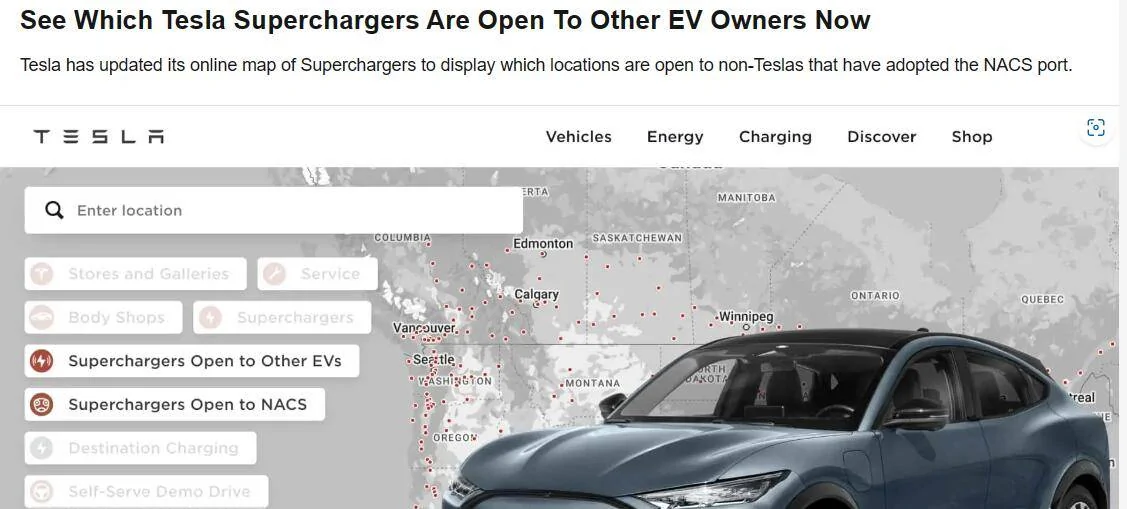
Following months of anticipation, Tesla's industry-leading Supercharger network opened up to non-Tesla drivers on Thursday, starting with Ford vehicles. Now we're starting to understand some of the nitty-gritty details of how Supercharging will work for outsiders—including how much it will cost.

Tesla is charging owners of other EVs roughly 35% more per kilowatt-hour (kWh), according to rates listed on the company's app. Supercharging rates vary widely by location and time of day (some stations offer lower prices during off-peak hours), so that's just a ballpark.


Tesla Superchargers Cost More For Other EVs, Unless You Buy A Membership
 

Tooney

Well-Known Member
Joined
Aug 14, 2021
Threads
746
Messages
4,471
Reaction score
3,651
Location
Ohio
Vehicles
2022 Taycan 4S
Country flag
Tesla's website reads:

n some cases you might have to park over the line in order to charge comfortably. Avoid parking diagonally to reach the cable and try to obstruct as few charge posts as possible. Charge port locations vary by EV model, which requires cable sharing between adjacent stalls at many sites.


It's important to note that Tesla is working to resolve this problem with its new "v4" Superchargers. These chargers have longer cables positioned on the outside of the charging unit which allows the charger to swing to either side of the stall This makes it possible for non-Tesla EVs to easily plug in. However, as of yesterday, Tesla is still opening new Supercharging locations with its existing "v3" Superchargers in the U.S. Certain new locations in Europe appear to be receiving the v4 Superchargers in February.


Tesla: It's Okay to Double-Park At Supercharger Stalls In A Non-Tesla
 

whitex

Well-Known Member
Joined
Jul 30, 2021
Threads
87
Messages
8,221
Reaction score
7,255
Location
WA, USA
Vehicles
2023 Taycan TCT, 2024 Q8 eTron P+
Country flag
I think Kyle is off as far as reasons. If all it takes is an ISO15118 certificate, any plug-and-charge enabled car would work. Now, it it has to be Tesla signed cert, different story.

An interesting experiment would be to try a non-Ford with a NACS-CCS adapter on a Magic Doc equipped supercharger but using the NACS connector.
 

Tooney

Well-Known Member
Joined
Aug 14, 2021
Threads
746
Messages
4,471
Reaction score
3,651
Location
Ohio
Vehicles
2022 Taycan 4S
Country flag
We Tried Charging A Rivian And Chevy Bolt With Ford's Tesla Adapter Spoiler alert: It didn't work. Here's why.

Naturally, Tom did what anyone would do in this situation: he tried his Ford adapter out on some other cars. Since the FordPass app is now designed to work natively with Tesla chargers, Tom used the Tesla app on his Rivian instead, to try and "trick" the Supercharger into thinking it was actually a Tesla.

When he did, the charger and adapter locked into his Rivian just fine, but then he got an "unauthorized vehicle" error message on the app. "Your vehicle is not able to charge at Superchargers at this time," it said.
. . .
In other words, this isn't a hardware issue when it comes to charging—it's a software issue. Until Tesla authenticates more vehicles to work on its network, those won't be allowed to charge there. Womp womp.
 
OP
OP
daveo4EV

daveo4EV

Well-Known Member
First Name
David
Joined
Jan 28, 2019
Threads
192
Messages
7,007
Reaction score
10,478
Location
Santa Cruz
Vehicles
Cayenne Hybrid, 911(s) GT3/Convertable
Country flag
multiple reports now confirm that Tesla can successfully block/filter based on vehicle - so as a business policy they are not allowing you to charge at Superchargers until your specific vehicle is supported by your manufacturer and them - there is _NO_ technical reason this can not work - but there are business policy reasons that your Taycan will be prevented from charging - you will not gain authorization to start the charging session until both Tesla and Porsche commence their agreement with each other

as to what if any "updates" at required (software hardware) for existing Taycans to be able to change via a Porsche or generic adatper - all of that is TBD and we will not find out until 2025 according to Porsche's original PR release…

I no reason to believe that your Taycan will be prevented from using "magicDock" equipped sites in North American - since the stated purpose of MagicDock sites is to allow any EV to charge there - so you have some access to a limited number of supercharger sites _TODAY_ where the business policy is not "filtering" for specific vehicle types - I know for a fact this works for my 2020 Taycan @ Scotts valley, CA MagicDock site…and have no reason to suspect any different at any other MagicDock sites - YMMV…

looks like we have to wait until 2025 with Porsche/Tesla's blessing before we can use non-MagicDock V3/V4 sites…

this can change at _ANY_ moment if Tesla chooses to change their business policy and relax their authorization requirements - I don't foresee that happening, but let's be there - there is no _TECHNICAL_ reason this can't work, but the business partners are currently choosing to control network access…which is of course their prerogative…

because I "own" my mistakes - I'll have kept my "inaccurate" speculation listed below in an inline spoiler - but it turns out this speculation is in fact inaccurate due to Tesla's choice of business policy and their authorization enforcement.

see my original post below…

as I speculated months ago - so far I see nothing that would prevent you from:
  • bringing your own adapter
  • lying about what kind of car you have
  • starting a charging session with the Tesla app
when I get my adapter from Lectron I'll test…

any "support" or "updates" from the various non-Tesla vehicle manufacturers would be to support plug&charge, in car navigation (pre-conditioning), and/or better charging status in the vehicle's infotainment and updates to vendor apps for charging support and status - there is very little to actually prevent someone from charging if they have an adapter & an app (Tesla in this case) to activate a charging session…

actually charging your vehicle may be as simple as: adapter + activate via Tesla app…with "better integration" being the stuff that's on the road map for future support…

I'm willing to bet I can charge my 2020 Taycan at my local V3/V4 superchargers once I get my adapter from Lectron…

I'll report status once I have something to share.
I was wrong and I'll own that…please see original updated post {sigh}

we'll have to wait for 2025 to see what if any support CCS1 Taycan will have in terms of access with or without an adatper, hardware updates? or software updates?
Sponsored


Top