Sponsored

Is it better to wait for %20 and charge ? Is it good have less charging cycles?

Kaan34

Well-Known Member
First Name
Kaan
Joined
Jun 9, 2023
Threads
10
Messages
92
Reaction score
15
Location
Istanbul
Vehicles
Taycan 4S
Country flag
Hi everyone,
I’m little confused with something…We know that it is good to keep battery between 20-80/85.. Sometimes I don’t need too much range in city

Is it better to wait for %20 and charge or not? I can wait till 20 and have less charging cycles..
Do you think is it better to keep the battery between 50-80 and charge more frequently?
I have no idea which one is better..
Sponsored
 

or1

Well-Known Member
First Name
O
Joined
Apr 27, 2019
Threads
10
Messages
290
Reaction score
545
Location
Norway
Vehicles
Taycan GTS ST
Country flag
I have no scientific knowledge on this. Still I am quite sure that there is no point in waiting until 20% before charging. Avoiding the lowest and highest 10% or something of the SoC scale (maybe less at the bottom and more at the top) is worthwhile. But in between there, charging 50-80 counts as half of 20-80 cycle-wise and is no problem AFAIK.
 

Scandinavian

Well-Known Member
First Name
Peter
Joined
Nov 3, 2019
Threads
52
Messages
3,904
Reaction score
3,549
Location
France
Vehicles
Taycan T, Aston Martin DB9, Porsche 996 C4 Cab, i4
Country flag
If you charge by using AC there is no harm to charge when you can. The battery life is depending on the total number of complete charge cycles, ie charging from 0 to 100%. Obviously you do not charge to these extreme levels anyway. So charging from 20% to 80% equals a 0.6 charge cycle.
 

daveo4EV

Well-Known Member
First Name
David
Joined
Jan 28, 2019
Threads
192
Messages
7,003
Reaction score
10,473
Location
Santa Cruz
Vehicles
Cayenne Hybrid, 911(s) GT3/Convertable
Country flag
Hi everyone,
I’m little confused with something…We know that it is good to keep battery between 20-80/85.. Sometimes I don’t need too much range in city

Is it better to wait for %20 and charge or not? I can wait till 20 and have less charging cycles..
Do you think is it better to keep the battery between 50-80 and charge more frequently?
I have no idea which one is better..
8 year/100,000 mile warranty don't worry about it

the car manages the battery - there is nothing _YOU_ can do to harm it or make it better

if you think you are charging the battery you are not paying attention to the 10's of thousands of lines of software code between you and the battery that are designed to manage the battery so that it meets the warranty claims

home L2 AC charging is not hard on the battery

as noted by @Scandinavian LiON battery life is estimated in terms of full charging cycles - any charging cycle that is not 0% to 100% is considered a fractional charging cycle (the exact fraction for any given charging cycle is mostly a SWAG affair (Scientific Wild Ass Guess) …in terms of overall battery life.)

industry standard "life time" estimates for LiON battery cells range from 800-3000 "full charging" cycles for the expected "life" of a LiON cell. This is based on environment, cell chemistry, manufacturing methods, charging process, charge rate, discharge rate, battery age, temperature, and number of pigons on the Statue's around Stuttgart at any given moment…Porsche has not disclosed _ANY_ of these facts about their particular combination of LiON cell chemistry or it's expected life time full charge cycles - with out this information there is no way for anyone outside of Porsche to know/estimate the actual impact of any given charging cycle from A% to B%…these sorts of facts are closely guarded industry secrets and one of the few remaining "differences" between EV vendors and company confidential.

the 100,000 miles warranty is the closest we get to some sort of "insight" into Porsche's confidence in battery longevity. Taycan is anywere from a 2.5 mile/kWh to 3.2 mile/kWh vehicle - so given 100,00 miles we can calculate the amount of kWh's "run through" the battery for 100,000 miles…

100,000 miles / 2.5 miles = 40,000 kWh's
100,000 miles / 3.2 miles = 31,250 kWh's

this tells me that Porsche has confidence that their battery chemistry will not fail/fall-below warranty standards for at least 45,000 kWh's of power "run through" the battery.

Daily driving is typically 60 miles or less - and most cars are driven 5 days a week 42 weeks year - that's a fractional charge cycle 210 times a year (assuming the car is not in fact driven _EVERY_ day).

60 miles of driving = 24 to 18 kWh for the daily charge cycle…let's call it 22 kwh on average for the daily charge…

45,000 kWh / 22 kWh = 2045 "dailiy charge cycles"
2045 daily charge cycles / 210 charge cycles a year = 9.7 years expected life of the battery

I think we'll all be good/fine

the only fact's I've found/seen regarding battery life management and longevity in 12+ years of EV driving are:
  • letting the battery get close to zero is "hard" on the battery - the closer to zero% you are the harder it is on the charge cycle count - the exact impact of getting to 1% vs. 4% (as an example) is a giant SWAG…and hard to quantify
  • charging the battery to 100% and letting it "sit there" is hard on the LiON cells - but charging to 100% and then promptly discharging the battery (by driving it) it quite a bit "less hard" on the battery - the exact amount of "hard" is another SWAG that is hard to find anyone to quantify
  • fast charging (50-70 kW or more charge rate) is "harder" on the battery than slower charging - the exact impact SWAG's are more definative in this space, and Porsche itself even indirectly communicates this with an option to limit fast charging to 200 kW max rate…
    • this is as close as Porsche has come to "documenting" their battery life expectations and impact of charging on battery life - and they are still "vauge" as to the expected improvement in limiting fast charging.
    • less fast charging is good for the battery, more fast charging is "worse" for the battery - again the exact differences and expected "impact" would be a SWAG - and even that SWAG is confidential
Porsche can not deny a warranty claim even if you fast charged every day for 8 years/100,000 miles - they place no such limits on the warranty…

so reading between the lines - if you charge 45,000 kWh's @ 270 kW charge rate for the entire 45,000 kWh's and the battery "fails" or falls below warranty specifications Porsche is on the hook to fix/repair/replace your Taycan battery. After 45,000 kWh's (which is well over 100,000 miles driven) you're on your own for the battery.

so me thinks…charging 20'ish kWh's over night @ 9.6 kW charge rate 210 times years and occasionally more (60-70 kWh's) is probably statistical noise in the grand scheme of things - and if your battery "fails" there was nothing _YOU_ did to cause that - it just happens that your battery was one of the statistically expected failures foreseen by the internal, secret, confidential SWAGs Porsche used to design the vehicle, it charging systems, it's charging software and part of the agreements it has with it's LiON cell providers.

use the car
charge the car
keep it ready to be used
enjoy driving it
the battery is outside of your control
porsche is 100% in control of the battery - you are not

in my opinion one of the small joy's of owning an EV - is getting home - plugging it in - and knowing that the car will be "fully" charged (85% most of the time) and ready next time I get into the vehicle - having the "ready" at all times and at it's ideal/common max range is what makes EV's better than gasoline vehicles, because I rarely have to worry about charging the car when I'm driving it - cause it's always "full" when it get into it - that means I don't worry about when to plug it in - I always plug it in and I always charge it so that it's ready for me next time my butt is in the seat.

and let the warranty given you the confidence to not sweat the battery - because at the end of the day there 100% nothing you can do - you were never in control of it anyways - and it's going to do what it's going to do irregardless of your actions (short of charging from 1% to 100% @ 270 kW every day) - anything less than that and you're not the reason for any issue.

enjoy the car, don't worry about it - it's why you went with a world class company that stands behind their products (or at least typically do so).
 
Last edited:
OP
OP
Kaan34

Kaan34

Well-Known Member
First Name
Kaan
Joined
Jun 9, 2023
Threads
10
Messages
92
Reaction score
15
Location
Istanbul
Vehicles
Taycan 4S
Country flag
8 year/100,000 mile warranty don't worry about it

the car manages the battery - there is nothing _YOU_ can do to harm it or make it better

if you think you are charging the battery you are not paying attention to the 10's of thousands of lines of software code between you and the battery that are designed to manage the battery so that it meets the warranty claims

home L2 AC charging is not hard on the battery

as noted by @Scandinavian LiON battery life is estimated in terms of full charging cycles - any charging cycle that is not 0% to 100% is considered a fractional charging cycle (the exact fraction for any given charging cycle is mostly a SWAG affair (Scientific Wild Ass Guess) …in terms of overall battery life.)

industry standard "life time" estimates for LiON battery cells range from 800-3000 "full charging" cycles for the expected "life" of a LiON cell. This is based on environment, cell chemistry, manufacturing methods, charging process, charge rate, discharge rate, battery age, temperature, and number of pigons on the Statue's around Stuttgart at any given moment…Porsche has not disclosed _ANY_ of these facts about their particular combination of LiON cell chemistry or it's expected life time full charge cycles - with out this information there is no way for anyone outside of Porsche to know/estimate the actual impact of any given charging cycle from A% to B%…these sorts of facts are closely guarded industry secrets and one of the few remaining "differences" between EV vendors and company confidential.

the 100,000 miles warranty is the closest we get to some sort of "insight" into Porsche's confidence in battery longevity. Taycan is anywere from a 2.5 mile/kWh to 3.2 mile/kWh vehicle - so given 100,00 miles we can calculate the amount of kWh's "run through" the battery for 100,000 miles…

100,000 miles / 2.5 miles = 40,000 kWh's
100,000 miles / 3.2 miles = 31,250 kWh's

this tells me that Porsche has confidence that their battery chemistry will not fail/fall-below warranty standards for at least 45,000 kWh's of power "run through" the battery.

Daily driving is typically 60 miles or less - and most cars are driven 5 days a week 42 weeks year - that's a fractional charge cycle 210 times a year (assuming the car is not in fact driven _EVERY_ day).

60 miles of driving = 24 to 18 kWh for the daily charge cycle…let's call it 22 kwh on average for the daily charge…

45,000 kWh / 22 kWh = 2045 "dailiy charge cycles"
2045 daily charge cycles / 210 charge cycles a year = 9.7 years expected life of the battery

I think we'll all be good/fine

the only fact's I've found/seen regarding battery life management and longevity in 12+ years of EV driving are:
  • letting the battery get close to zero is "hard" on the battery - the closer to zero% you are the harder it is on the charge cycle count - the exact impact of getting to 1% vs. 4% (as an example) is a giant SWAG…and hard to quantify
  • charging the battery to 100% and letting it "sit there" is hard on the LiON cells - but charging to 100% and then promptly discharging the battery (by driving it) it quite a bit "less hard" on the battery - the exact amount of "hard" is another SWAG that is hard to find anyone to quantify
  • fast charging (50-70 kW or more charge rate) is "harder" on the battery than slower charging - the exact impact SWAG's are more definative in this space, and Porsche itself even indirectly communicates this with an option to limit fast charging to 200 kW max rate…
    • this is as close as Porsche has come to "documenting" their battery life expectations and impact of charging on battery life - and they are still "vauge" as to the expected improvement in limiting fast charging.
    • less fast charging is good for the battery, more fast charging is "worse" for the battery - again the exact differences and expected "impact" would be a SWAG - and even that SWAG is confidential
Porsche can not deny a warranty claim even if you fast charged every day for 8 years/100,000 miles - they place no such limits on the warranty…

so reading between the lines - if you charge 45,000 kWh's @ 270 kW charge rate for the entire 45,000 kWh's and the battery "fails" or falls below warranty specifications Porsche is on the hook to fix/repair/replace your Taycan battery. After 45,000 kWh's (which is well over 100,000 miles driven) you're on your own for the battery.

so me thinks…charging 20'ish kWh's over night @ 9.6 kW charge rate 210 times years and occasionally more (60-70 kWh's) is probably statistical noise in the grand scheme of things - and if your battery "fails" there was nothing _YOU_ did to cause that - it just happens that your battery was one of the statistically expected failures foreseen by the internal, secret, confidential SWAGs Porsche used to design the vehicle, it charging systems, it's charging software and part of the agreements it has with it's LiON cell providers.

use the car
charge the car
keep it ready to be used
enjoy driving it
the battery is outside of your control
porsche is 100% in control of the battery - you are not

in my opinion one of the small joy's of owning an EV - is getting home - plugging it in - and knowing that the car will be "fully" charged (85% most of the time) and ready next time I get into the vehicle - having the "ready" at all times and at it's ideal/common max range is what makes EV's better than gasoline vehicles, because I rarely have to worry about charging the car when I'm driving it - cause it's always "full" when it get into it - that means I don't worry about when to plug it in - I always plug it in and I always charge it so that it's ready for me next time my butt is in the seat.

and let the warranty given you the confidence to not sweat the battery - because at the end of the day there 100% nothing you can do - you were never in control of it anyways - and it's going to do what it's going to do irregardless of your actions (short of charging from 1% to 100% @ 270 kW every day) - anything less than that and you're not the reason for any issue.

enjoy the car, don't worry about it - it's why you went with a world class company that stands behind their products (or at least typically do so).
Thanks for the detailed answer…


tchavei

Well-Known Member
Joined
Dec 3, 2022
Threads
33
Messages
1,302
Reaction score
1,369
Location
Portugal
Vehicles
Too many to list. Includes a MY23 Taycan RWD
Country flag
8 year/100,000 mile warranty don't worry about it

the car manages the battery - there is nothing _YOU_ can do to harm it or make it better

if you think you are charging the battery you are not paying attention to the 10's of thousands of lines of software code between you and the battery that are designed to manage the battery so that it meets the warranty claims

home L2 AC charging is not hard on the battery

as noted by @Scandinavian LiON battery life is estimated in terms of full charging cycles - any charging cycle that is not 0% to 100% is considered a fractional charging cycle (the exact fraction for any given charging cycle is mostly a SWAG affair (Scientific Wild Ass Guess) …in terms of overall battery life.)

industry standard "life time" estimates for LiON battery cells range from 800-3000 "full charging" cycles for the expected "life" of a LiON cell. This is based on environment, cell chemistry, manufacturing methods, charging process, charge rate, discharge rate, battery age, temperature, and number of pigons on the Statue's around Stuttgart at any given moment…Porsche has not disclosed _ANY_ of these facts about their particular combination of LiON cell chemistry or it's expected life time full charge cycles - with out this information there is no way for anyone outside of Porsche to know/estimate the actual impact of any given charging cycle from A% to B%…these sorts of facts are closely guarded industry secrets and one of the few remaining "differences" between EV vendors and company confidential.

the 100,000 miles warranty is the closest we get to some sort of "insight" into Porsche's confidence in battery longevity. Taycan is anywere from a 2.5 mile/kWh to 3.2 mile/kWh vehicle - so given 100,00 miles we can calculate the amount of kWh's "run through" the battery for 100,000 miles…

100,000 miles / 2.5 miles = 40,000 kWh's
100,000 miles / 3.2 miles = 31,250 kWh's

this tells me that Porsche has confidence that their battery chemistry will not fail/fall-below warranty standards for at least 45,000 kWh's of power "run through" the battery.

Daily driving is typically 60 miles or less - and most cars are driven 5 days a week 42 weeks year - that's a fractional charge cycle 210 times a year (assuming the car is not in fact driven _EVERY_ day).

60 miles of driving = 24 to 18 kWh for the daily charge cycle…let's call it 22 kwh on average for the daily charge…

45,000 kWh / 22 kWh = 2045 "dailiy charge cycles"
2045 daily charge cycles / 210 charge cycles a year = 9.7 years expected life of the battery

I think we'll all be good/fine

the only fact's I've found/seen regarding battery life management and longevity in 12+ years of EV driving are:
  • letting the battery get close to zero is "hard" on the battery - the closer to zero% you are the harder it is on the charge cycle count - the exact impact of getting to 1% vs. 4% (as an example) is a giant SWAG…and hard to quantify
  • charging the battery to 100% and letting it "sit there" is hard on the LiON cells - but charging to 100% and then promptly discharging the battery (by driving it) it quite a bit "less hard" on the battery - the exact amount of "hard" is another SWAG that is hard to find anyone to quantify
  • fast charging (50-70 kW or more charge rate) is "harder" on the battery than slower charging - the exact impact SWAG's are more definative in this space, and Porsche itself even indirectly communicates this with an option to limit fast charging to 200 kW max rate…
    • this is as close as Porsche has come to "documenting" their battery life expectations and impact of charging on battery life - and they are still "vauge" as to the expected improvement in limiting fast charging.
    • less fast charging is good for the battery, more fast charging is "worse" for the battery - again the exact differences and expected "impact" would be a SWAG - and even that SWAG is confidential
Porsche can not deny a warranty claim even if you fast charged every day for 8 years/100,000 miles - they place no such limits on the warranty…

so reading between the lines - if you charge 45,000 kWh's @ 270 kW charge rate for the entire 45,000 kWh's and the battery "fails" or falls below warranty specifications Porsche is on the hook to fix/repair/replace your Taycan battery. After 45,000 kWh's (which is well over 100,000 miles driven) you're on your own for the battery.

so me thinks…charging 20'ish kWh's over night @ 9.6 kW charge rate 210 times years and occasionally more (60-70 kWh's) is probably statistical noise in the grand scheme of things - and if your battery "fails" there was nothing _YOU_ did to cause that - it just happens that your battery was one of the statistically expected failures foreseen by the internal, secret, confidential SWAGs Porsche used to design the vehicle, it charging systems, it's charging software and part of the agreements it has with it's LiON cell providers.

use the car
charge the car
keep it ready to be used
enjoy driving it
the battery is outside of your control
porsche is 100% in control of the battery - you are not

in my opinion one of the small joy's of owning an EV - is getting home - plugging it in - and knowing that the car will be "fully" charged (85% most of the time) and ready next time I get into the vehicle - having the "ready" at all times and at it's ideal/common max range is what makes EV's better than gasoline vehicles, because I rarely have to worry about charging the car when I'm driving it - cause it's always "full" when it get into it - that means I don't worry about when to plug it in - I always plug it in and I always charge it so that it's ready for me next time my butt is in the seat.

and let the warranty given you the confidence to not sweat the battery - because at the end of the day there 100% nothing you can do - you were never in control of it anyways - and it's going to do what it's going to do irregardless of your actions (short of charging from 1% to 100% @ 270 kW every day) - anything less than that and you're not the reason for any issue.

enjoy the car, don't worry about it - it's why you went with a world class company that stands behind their products (or at least typically do so).
Wow... Excellent post.

I charge typically once a week at 45kW. Maybe one more time if I spend my weekend on trips. I'm pretty sure other components will fail well before the battery is ready for recycling.

Kudos
 

MrB

Well-Known Member
Joined
Jun 2, 2021
Threads
9
Messages
264
Reaction score
265
Location
Norfolk, UK
Vehicles
Taycan CT4S and Fiat 500e La Prima
Country flag
Of late I’ve exclusively charged the car at IONITY (probably for the last 12k miles out of 27k covered) so I’m definitely testing the battery life wrt to repeated high speed charges. As of now I’ve noticed no particular change in capacity etc - also often take it to 99%. As noted, it’s got a good battery warranty and I have faith that the car will essentially manage the charging as it sees fit.
 

Dave Birch

Well-Known Member
First Name
Dave
Joined
Jan 23, 2023
Threads
7
Messages
141
Reaction score
165
Location
Cornwall
Vehicles
Taycan 4s cross turismo
Country flag
8 year/100,000 mile warranty don't worry about it

the car manages the battery - there is nothing _YOU_ can do to harm it or make it better

if you think you are charging the battery you are not paying attention to the 10's of thousands of lines of software code between you and the battery that are designed to manage the battery so that it meets the warranty claims

home L2 AC charging is not hard on the battery

as noted by @Scandinavian LiON battery life is estimated in terms of full charging cycles - any charging cycle that is not 0% to 100% is considered a fractional charging cycle (the exact fraction for any given charging cycle is mostly a SWAG affair (Scientific Wild Ass Guess) …in terms of overall battery life.)

industry standard "life time" estimates for LiON battery cells range from 800-3000 "full charging" cycles for the expected "life" of a LiON cell. This is based on environment, cell chemistry, manufacturing methods, charging process, charge rate, discharge rate, battery age, temperature, and number of pigons on the Statue's around Stuttgart at any given moment…Porsche has not disclosed _ANY_ of these facts about their particular combination of LiON cell chemistry or it's expected life time full charge cycles - with out this information there is no way for anyone outside of Porsche to know/estimate the actual impact of any given charging cycle from A% to B%…these sorts of facts are closely guarded industry secrets and one of the few remaining "differences" between EV vendors and company confidential.

the 100,000 miles warranty is the closest we get to some sort of "insight" into Porsche's confidence in battery longevity. Taycan is anywere from a 2.5 mile/kWh to 3.2 mile/kWh vehicle - so given 100,00 miles we can calculate the amount of kWh's "run through" the battery for 100,000 miles…

100,000 miles / 2.5 miles = 40,000 kWh's
100,000 miles / 3.2 miles = 31,250 kWh's

this tells me that Porsche has confidence that their battery chemistry will not fail/fall-below warranty standards for at least 45,000 kWh's of power "run through" the battery.

Daily driving is typically 60 miles or less - and most cars are driven 5 days a week 42 weeks year - that's a fractional charge cycle 210 times a year (assuming the car is not in fact driven _EVERY_ day).

60 miles of driving = 24 to 18 kWh for the daily charge cycle…let's call it 22 kwh on average for the daily charge…

45,000 kWh / 22 kWh = 2045 "dailiy charge cycles"
2045 daily charge cycles / 210 charge cycles a year = 9.7 years expected life of the battery

I think we'll all be good/fine

the only fact's I've found/seen regarding battery life management and longevity in 12+ years of EV driving are:
  • letting the battery get close to zero is "hard" on the battery - the closer to zero% you are the harder it is on the charge cycle count - the exact impact of getting to 1% vs. 4% (as an example) is a giant SWAG…and hard to quantify
  • charging the battery to 100% and letting it "sit there" is hard on the LiON cells - but charging to 100% and then promptly discharging the battery (by driving it) it quite a bit "less hard" on the battery - the exact amount of "hard" is another SWAG that is hard to find anyone to quantify
  • fast charging (50-70 kW or more charge rate) is "harder" on the battery than slower charging - the exact impact SWAG's are more definative in this space, and Porsche itself even indirectly communicates this with an option to limit fast charging to 200 kW max rate…
    • this is as close as Porsche has come to "documenting" their battery life expectations and impact of charging on battery life - and they are still "vauge" as to the expected improvement in limiting fast charging.
    • less fast charging is good for the battery, more fast charging is "worse" for the battery - again the exact differences and expected "impact" would be a SWAG - and even that SWAG is confidential
Porsche can not deny a warranty claim even if you fast charged every day for 8 years/100,000 miles - they place no such limits on the warranty…

so reading between the lines - if you charge 45,000 kWh's @ 270 kW charge rate for the entire 45,000 kWh's and the battery "fails" or falls below warranty specifications Porsche is on the hook to fix/repair/replace your Taycan battery. After 45,000 kWh's (which is well over 100,000 miles driven) you're on your own for the battery.

so me thinks…charging 20'ish kWh's over night @ 9.6 kW charge rate 210 times years and occasionally more (60-70 kWh's) is probably statistical noise in the grand scheme of things - and if your battery "fails" there was nothing _YOU_ did to cause that - it just happens that your battery was one of the statistically expected failures foreseen by the internal, secret, confidential SWAGs Porsche used to design the vehicle, it charging systems, it's charging software and part of the agreements it has with it's LiON cell providers.

use the car
charge the car
keep it ready to be used
enjoy driving it
the battery is outside of your control
porsche is 100% in control of the battery - you are not

in my opinion one of the small joy's of owning an EV - is getting home - plugging it in - and knowing that the car will be "fully" charged (85% most of the time) and ready next time I get into the vehicle - having the "ready" at all times and at it's ideal/common max range is what makes EV's better than gasoline vehicles, because I rarely have to worry about charging the car when I'm driving it - cause it's always "full" when it get into it - that means I don't worry about when to plug it in - I always plug it in and I always charge it so that it's ready for me next time my butt is in the seat.

and let the warranty given you the confidence to not sweat the battery - because at the end of the day there 100% nothing you can do - you were never in control of it anyways - and it's going to do what it's going to do irregardless of your actions (short of charging from 1% to 100% @ 270 kW every day) - anything less than that and you're not the reason for any issue.

enjoy the car, don't worry about it - it's why you went with a world class company that stands behind their products (or at least typically do so).
A very comprehensive reply. You must be an expert on charging so do you have an opinion about slow charging via solar panels, typically 3.5 kw/hr on nice sunny days.


daveo4EV

Well-Known Member
First Name
David
Joined
Jan 28, 2019
Threads
192
Messages
7,003
Reaction score
10,473
Location
Santa Cruz
Vehicles
Cayenne Hybrid, 911(s) GT3/Convertable
Country flag
A very comprehensive reply. You must be an expert on charging so do you have an opinion about slow charging via solar panels, typically 3.5 kw/hr on nice sunny days.
I'm not an expert but I've in the past lunch'd with people who are. Charging speed is a major factor in battery life - faster charging reduces battery life, slower charging increases battery life…this is fact. But your definition of "fast" or "slow" may not match a LiON's cells' definition of "fast" or "slow"…

that being said - there can not possibly be any statistically significant difference between charging at 2 kW vs. 20 kW for a battery the size of our Taycan batteries - my little birdies tell me it's mostly when you start creeping into the range of 75 kW or more that you can start to measure any meaningful "difference" in longevity - and even then only if you are _ALWAYS_ charging at those higher speeds

MATH: the difference between 3 kW of power vs. 11 kW to each cell in the Taycan's pack is very very small in terms of magnitude - given range of 2 kW to 270 kW possible charge rate - the 2-11 kW "range" of fast/slow AC L2 charging is 3% of the _ENTIRE_ possible voltage/amp spectrum porsche allows…2 kW AC charge rate represents (2 / 270) .007% of possible charge rate capacity vs. (11 / 270) 4% of charge rate capacity or a spread of 0.5% to 4% in terms of maximum charge rate…

essentially charging semi-daily at 20 kW or less (9.6 is common) and sprinkling 100/150/200 kW charging sessions in 3-6 times every 2 months is inconsequential to overall battery life, and if your battery "degrades" it was due to a combination of all factors, vs. any charging speed behaviors…

I'll stick by my basic assertion:
There is virtually NOTHING you can do "TO" the battery by charging it short of always charging at 150 kW or more for 70-100% of it's lifetime charging sessions…and even then Porsche will honor the warranty if anything bad happens.
if the majority of your charging sessions are 11 kW or less - the difference between 3.6 kW charge rate and a full 11 kW charge rate is statistical noise if you're measuring for longevity impact.
 
Last edited:

daveo4EV

Well-Known Member
First Name
David
Joined
Jan 28, 2019
Threads
192
Messages
7,003
Reaction score
10,473
Location
Santa Cruz
Vehicles
Cayenne Hybrid, 911(s) GT3/Convertable
Country flag
8 year/100,000 mile warranty don't worry about it

the car manages the battery - there is nothing _YOU_ can do to harm it or make it better

if you think you are charging the battery you are not paying attention to the 10's of thousands of lines of software code between you and the battery that are designed to manage the battery so that it meets the warranty claims

home L2 AC charging is not hard on the battery

as noted by @Scandinavian LiON battery life is estimated in terms of full charging cycles - any charging cycle that is not 0% to 100% is considered a fractional charging cycle (the exact fraction for any given charging cycle is mostly a SWAG affair (Scientific Wild Ass Guess) …in terms of overall battery life.)

industry standard "life time" estimates for LiON battery cells range from 800-3000 "full charging" cycles for the expected "life" of a LiON cell. This is based on environment, cell chemistry, manufacturing methods, charging process, charge rate, discharge rate, battery age, temperature, and number of pigons on the Statue's around Stuttgart at any given moment…Porsche has not disclosed _ANY_ of these facts about their particular combination of LiON cell chemistry or it's expected life time full charge cycles - with out this information there is no way for anyone outside of Porsche to know/estimate the actual impact of any given charging cycle from A% to B%…these sorts of facts are closely guarded industry secrets and one of the few remaining "differences" between EV vendors and company confidential.

the 100,000 miles warranty is the closest we get to some sort of "insight" into Porsche's confidence in battery longevity. Taycan is anywere from a 2.5 mile/kWh to 3.2 mile/kWh vehicle - so given 100,00 miles we can calculate the amount of kWh's "run through" the battery for 100,000 miles…

100,000 miles / 2.5 miles = 40,000 kWh's
100,000 miles / 3.2 miles = 31,250 kWh's

this tells me that Porsche has confidence that their battery chemistry will not fail/fall-below warranty standards for at least 45,000 kWh's of power "run through" the battery.

Daily driving is typically 60 miles or less - and most cars are driven 5 days a week 42 weeks year - that's a fractional charge cycle 210 times a year (assuming the car is not in fact driven _EVERY_ day).

60 miles of driving = 24 to 18 kWh for the daily charge cycle…let's call it 22 kwh on average for the daily charge…

45,000 kWh / 22 kWh = 2045 "dailiy charge cycles"
2045 daily charge cycles / 210 charge cycles a year = 9.7 years expected life of the battery

I think we'll all be good/fine

the only fact's I've found/seen regarding battery life management and longevity in 12+ years of EV driving are:
  • letting the battery get close to zero is "hard" on the battery - the closer to zero% you are the harder it is on the charge cycle count - the exact impact of getting to 1% vs. 4% (as an example) is a giant SWAG…and hard to quantify
  • charging the battery to 100% and letting it "sit there" is hard on the LiON cells - but charging to 100% and then promptly discharging the battery (by driving it) it quite a bit "less hard" on the battery - the exact amount of "hard" is another SWAG that is hard to find anyone to quantify
  • fast charging (50-70 kW or more charge rate) is "harder" on the battery than slower charging - the exact impact SWAG's are more definative in this space, and Porsche itself even indirectly communicates this with an option to limit fast charging to 200 kW max rate…
    • this is as close as Porsche has come to "documenting" their battery life expectations and impact of charging on battery life - and they are still "vauge" as to the expected improvement in limiting fast charging.
    • less fast charging is good for the battery, more fast charging is "worse" for the battery - again the exact differences and expected "impact" would be a SWAG - and even that SWAG is confidential
Porsche can not deny a warranty claim even if you fast charged every day for 8 years/100,000 miles - they place no such limits on the warranty…

so reading between the lines - if you charge 45,000 kWh's @ 270 kW charge rate for the entire 45,000 kWh's and the battery "fails" or falls below warranty specifications Porsche is on the hook to fix/repair/replace your Taycan battery. After 45,000 kWh's (which is well over 100,000 miles driven) you're on your own for the battery.

so me thinks…charging 20'ish kWh's over night @ 9.6 kW charge rate 210 times years and occasionally more (60-70 kWh's) is probably statistical noise in the grand scheme of things - and if your battery "fails" there was nothing _YOU_ did to cause that - it just happens that your battery was one of the statistically expected failures foreseen by the internal, secret, confidential SWAGs Porsche used to design the vehicle, it charging systems, it's charging software and part of the agreements it has with it's LiON cell providers.

use the car
charge the car
keep it ready to be used
enjoy driving it
the battery is outside of your control
porsche is 100% in control of the battery - you are not

in my opinion one of the small joy's of owning an EV - is getting home - plugging it in - and knowing that the car will be "fully" charged (85% most of the time) and ready next time I get into the vehicle - having the "ready" at all times and at it's ideal/common max range is what makes EV's better than gasoline vehicles, because I rarely have to worry about charging the car when I'm driving it - cause it's always "full" when it get into it - that means I don't worry about when to plug it in - I always plug it in and I always charge it so that it's ready for me next time my butt is in the seat.

and let the warranty given you the confidence to not sweat the battery - because at the end of the day there 100% nothing you can do - you were never in control of it anyways - and it's going to do what it's going to do irregardless of your actions (short of charging from 1% to 100% @ 270 kW every day) - anything less than that and you're not the reason for any issue.

enjoy the car, don't worry about it - it's why you went with a world class company that stands behind their products (or at least typically do so).
I've been told by multiple "people who know" in private messages that I forgot to mention Battery temperature is a much much much bigger factor in overall battery life vs. charging frequency - basically charging any LiON cell inside/outside it's "ideal" temperature can cause "significant long term damage to the LiON cell's…I also know this (but forgot to mention it) from community observations of the disaster that was the Nissan Leaf's battery longevity given Nissan's "passive" thermal management…you can google around - but basically in Arizona people were losing >50% in less than 2 years due to lack of any active thermal management…it was a thing.

With both the Tesla Roadster and Model S we are approach more than a decade of industry large scale fleet experience with LiON battery packs of large size with active thermal management and "fast charging" - the general results are the degrade rate is with in expected SWAG's - and not that bad, and a thermally well managed LiON battery can be expected to easily achieve the published warranty standards - and beyond.

The good news/bad news here is this is another variable you as the owner have _ZERO_ control over. And Porsche's software and battery management algorithms control battery temperature and charge rate and will DEPLOY active thermal management to heat/cool the battery as necessary to keep the battery degrade SWAG's with in the expected norm's…

you and I and all Tacyan owners could kill a battery overnight by simply charging it from 1% SOC @ 265 kW @ an overall battery pack temperature of -5C - that would literally kill the Taycan's battery pack - fortunately for us Taycan's software will _NOT_ allow that to happen - and even it did - Porsche would be "on the hook" to repair/replace it under warranty - since you as the owner of the vehicle have no control over those variables.

Temperature and charge rate are controlled by the vehicle's BMS (Battery Management System/Software) - you as an owner/driver play no role in how any given charge session will play out other than plugging it in.

Again there is nothing _YOU_ can do to the battery - if it dies/degrades it was out of your control.
 
Last edited:

daveo4EV

Well-Known Member
First Name
David
Joined
Jan 28, 2019
Threads
192
Messages
7,003
Reaction score
10,473
Location
Santa Cruz
Vehicles
Cayenne Hybrid, 911(s) GT3/Convertable
Country flag
I'm not an expert but I've in the past lunch'd with people who are. Charging speed is a major factor in battery life - faster charging reduces battery life, slower charging increases battery life…

that being said - there can not possibly be any statistically significant difference between charging at 2 kW vs. 20 kW for a battery the size of our Taycan batteries - my little birdies tell me it's mostly when you start creeping into the range of 75 kW or more that you can start to measure any meaningful "difference" in longevity - and even then only if you are _ALWAYS_ charging at those higher speeds

essentially charging semi-daily at 20 kW or less (9.6 is common) and sprinkling 100/150/200 kW charging sessions in 3-6 times every 2 months is inconsequential to overall battery life, and if your battery "degrades" it was due to a combination of all factors, vs. any charging speed behaviors…

I'll stick by my basic assertion:


if the majority of your charging sessions are 11 kW or less - the difference between 3.6 kW charge rate and a full 11 kW charge rate is statistical noise if you're measuring for longevity impact.
even Porsche's software will essentially "backup" this assertion…if you accept the fact that Porsche, and by proxy their embedded software, will not allow anything "bad" to happen to the battery…that would reduce longevity (and hence make them liable for a warranty issue)…

you can review people's fast charging experience in both extreme cold and extremely warm environments - basically if the battery is below 60-70F ambient temperature there is no way in hell the BMS system in the Taycan is letting you charge at a rate > 100 kw - but I've been in very very cold conditions with the battery happily charging at at a 45-60 kW rate…and if battery is too hot it will also throttle maximum charge rate until they can "cool" the battery to allow high charge rate…

this posting also backs up that assertion - https://www.taycanforum.com/forum/t...my-taycan-charge-as-fast-as-i-want-it-to.779/

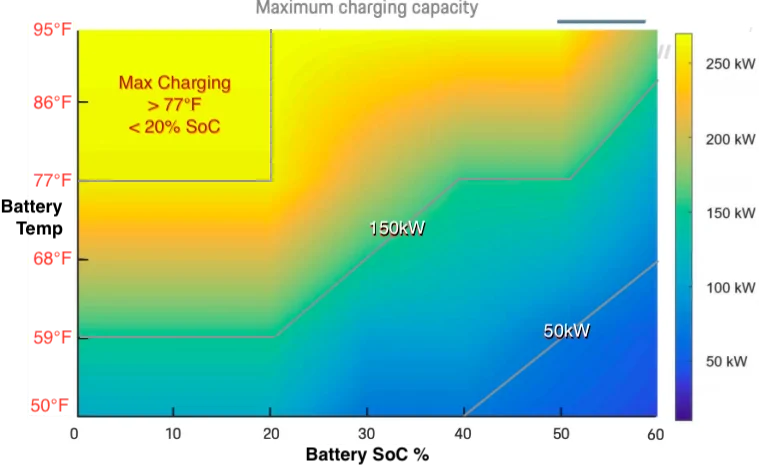
the chart provided in that posting _IS FROM PORSCHE_ - and basically 50 kW or less has virtually no impact on battery longevity - if it did then Porsche wouldn't allow under certain circumstances because it would impact the warranty…

I see that chart and I see "basically anything less than 50 kw" charge rate is not a factor to be concerned about - we only need to manage things once we're above 50 kW and then we need to coordinate with battery Thermals - and by "safe" I mean we're not going to allow anything to happen that will 'trigger the warranty".

this is why you can't get a 250 kW charging session in Feb. in Tahoe at night when the outside temperature is 10F and the battery temperature is 58F…it would damaged the battery to allow high charging speed under those conditions - and Porsche's software will throttle the maximum charging rate while it siphons power from he charging session to slowly raise the battery's overall temperature and as the battery temperature "rises" you'll see your charge rate creep up…

the chart below even shows up to 150 kW isn't that bad and they will allow that charge rate for even what most human's would consider "cold" conditions…

reading the chart below you can see that Porsche will "allow" a 100 kW charge rate at 10% SOC even when the battery is 50F - wow - there is literally nothing I can do as an owner to control any of that…and 100 kW is still pretty fast…

yeah the difference between 3 kW and 11 kW charge rate is "bug on a window" level of impact from the batteries perspective - essential the chart from Porsche shown below is that anything less than 50 kW isn't worth managing…in terms of meeting/exceeding warranty longevity.

we also all "know" that normally at a functional EA fast charging station none of us see charge rates below 50 kW until we are at 96% SOC or more - now again Porsche is communicating with us their SWAG's about what impacts battery life - and my 2020 Taycan will happily tootle along at >50 kW charge rate right up until about 97% SOC - and only then does it drop below 50 kW but remains above 20 kW - I only see charge rates less than 20 kW at 98/99% SOC…now it's a well understood "fact" that "fast charging" a LiON cell right up to the 100% mark is bad for the cell - so why is Porsche allowing a fast charging session to pump 20 kW into my 99% full Taycan battery?

because 20 kW isn't "fast" from the batteries perspective, it's quite slow actually - 20-35 kW _IS_ a slow charge rate - otherwise porsche wouldn't allow it (or more) above 90% - I only seen it dip below 20 kW from the 99%-100% before the charging session cuts off, and even then I never see it lower than 12 kW…

Porsche Taycan Is it better to wait for %20 and charge ? Is it good have less charging cycles? Taycan Charging Thermal Ma
 
Last edited:

Tooney

Well-Known Member
Joined
Aug 14, 2021
Threads
741
Messages
4,450
Reaction score
3,637
Location
Ohio
Vehicles
2022 Taycan 4S
Country flag
8 year/100,000 mile warranty don't worry about it
Footnote to the Taycan HV battery warranty:
Several forum members have reported it took 3 - 4 months for Porsche to repair/replace HV batteries in their Taycans inoperable due to Electrical Fault errors.
 

2P168S

Well-Known Member
Joined
May 18, 2023
Threads
9
Messages
154
Reaction score
164
Location
Atlanta, GA
Vehicles
2022 Taycan RWD
Country flag
Degradation in automotive lithium ion batteries is primarily a result of four factors:
1) Energy throughput- More energy throughput, more degradation. No way around this.
2) Time at high state of charge. High state of charge means high battery voltage, and high battery voltage increases the rate of parasitic side reactions in the battery. You can help manage this by only charging to 75%, 80%, 85% for normal use (no magic number).
3) Temperature- Time at higher temperatures also increases the rate of parasitic side reactions in the battery (Arrhenius relationship, for those that had some chemistry). No real way to manage this either. Good news is the highly temperature sensitive chemistries used in the early Leaf is no longer used.
4) High power- Charging at high power creates mechanical stresses in the anode because of the rate of intercalation of lithium into the material. You can manage this by fast charging only when on long trips and, if you don't mind the small inconvenience, turning on "battery friendly charging" which limits the power rate when fast charging.

All other factors are minor in comparison.
It is slightly harder on the battery to run it close to 0%, because impedance increases at low voltage, but in the big picture this is swamped by the other factors.
 

daveo4EV

Well-Known Member
First Name
David
Joined
Jan 28, 2019
Threads
192
Messages
7,003
Reaction score
10,473
Location
Santa Cruz
Vehicles
Cayenne Hybrid, 911(s) GT3/Convertable
Country flag
Degradation in automotive lithium ion batteries is primarily a result of four factors:
1) Energy throughput- More energy throughput, more degradation. No way around this.
2) Time at high state of charge. High state of charge means high battery voltage, and high battery voltage increases the rate of parasitic side reactions in the battery. You can help manage this by only charging to 75%, 80%, 85% for normal use (no magic number).
3) Temperature- Time at higher temperatures also increases the rate of parasitic side reactions in the battery (Arrhenius relationship, for those that had some chemistry). No real way to manage this either. Good news is the highly temperature sensitive chemistries used in the early Leaf is no longer used.
4) High power- Charging at high power creates mechanical stresses in the anode because of the rate of intercalation of lithium into the material. You can manage this by fast charging only when on long trips and, if you don't mind the small inconvenience, turning on "battery friendly charging" which limits the power rate when fast charging.

All other factors are minor in comparison.
It is slightly harder on the battery to run it close to 0%, because impedance increases at low voltage, but in the big picture this is swamped by the other factors.
Alanta, GA - hmmm…

https://www.porschedriving.com/atlanta/on-the-track

thank you for the posting! this is awesome information.
 

JohnnyP

New Member
First Name
John
Joined
May 31, 2023
Threads
1
Messages
3
Reaction score
0
Location
Corona del Mar, CA
Vehicles
2021 Taycan, 2017 Macan
Country flag
8 year/100,000 mile warranty don't worry about it

the car manages the battery - there is nothing _YOU_ can do to harm it or make it better

if you think you are charging the battery you are not paying attention to the 10's of thousands of lines of software code between you and the battery that are designed to manage the battery so that it meets the warranty claims

home L2 AC charging is not hard on the battery

as noted by @Scandinavian LiON battery life is estimated in terms of full charging cycles - any charging cycle that is not 0% to 100% is considered a fractional charging cycle (the exact fraction for any given charging cycle is mostly a SWAG affair (Scientific Wild Ass Guess) …in terms of overall battery life.)

industry standard "life time" estimates for LiON battery cells range from 800-3000 "full charging" cycles for the expected "life" of a LiON cell. This is based on environment, cell chemistry, manufacturing methods, charging process, charge rate, discharge rate, battery age, temperature, and number of pigons on the Statue's around Stuttgart at any given moment…Porsche has not disclosed _ANY_ of these facts about their particular combination of LiON cell chemistry or it's expected life time full charge cycles - with out this information there is no way for anyone outside of Porsche to know/estimate the actual impact of any given charging cycle from A% to B%…these sorts of facts are closely guarded industry secrets and one of the few remaining "differences" between EV vendors and company confidential.

the 100,000 miles warranty is the closest we get to some sort of "insight" into Porsche's confidence in battery longevity. Taycan is anywere from a 2.5 mile/kWh to 3.2 mile/kWh vehicle - so given 100,00 miles we can calculate the amount of kWh's "run through" the battery for 100,000 miles…

100,000 miles / 2.5 miles = 40,000 kWh's
100,000 miles / 3.2 miles = 31,250 kWh's

this tells me that Porsche has confidence that their battery chemistry will not fail/fall-below warranty standards for at least 45,000 kWh's of power "run through" the battery.

Daily driving is typically 60 miles or less - and most cars are driven 5 days a week 42 weeks year - that's a fractional charge cycle 210 times a year (assuming the car is not in fact driven _EVERY_ day).

60 miles of driving = 24 to 18 kWh for the daily charge cycle…let's call it 22 kwh on average for the daily charge…

45,000 kWh / 22 kWh = 2045 "dailiy charge cycles"
2045 daily charge cycles / 210 charge cycles a year = 9.7 years expected life of the battery

I think we'll all be good/fine

the only fact's I've found/seen regarding battery life management and longevity in 12+ years of EV driving are:
  • letting the battery get close to zero is "hard" on the battery - the closer to zero% you are the harder it is on the charge cycle count - the exact impact of getting to 1% vs. 4% (as an example) is a giant SWAG…and hard to quantify
  • charging the battery to 100% and letting it "sit there" is hard on the LiON cells - but charging to 100% and then promptly discharging the battery (by driving it) it quite a bit "less hard" on the battery - the exact amount of "hard" is another SWAG that is hard to find anyone to quantify
  • fast charging (50-70 kW or more charge rate) is "harder" on the battery than slower charging - the exact impact SWAG's are more definative in this space, and Porsche itself even indirectly communicates this with an option to limit fast charging to 200 kW max rate…
    • this is as close as Porsche has come to "documenting" their battery life expectations and impact of charging on battery life - and they are still "vauge" as to the expected improvement in limiting fast charging.
    • less fast charging is good for the battery, more fast charging is "worse" for the battery - again the exact differences and expected "impact" would be a SWAG - and even that SWAG is confidential
Porsche can not deny a warranty claim even if you fast charged every day for 8 years/100,000 miles - they place no such limits on the warranty…

so reading between the lines - if you charge 45,000 kWh's @ 270 kW charge rate for the entire 45,000 kWh's and the battery "fails" or falls below warranty specifications Porsche is on the hook to fix/repair/replace your Taycan battery. After 45,000 kWh's (which is well over 100,000 miles driven) you're on your own for the battery.

so me thinks…charging 20'ish kWh's over night @ 9.6 kW charge rate 210 times years and occasionally more (60-70 kWh's) is probably statistical noise in the grand scheme of things - and if your battery "fails" there was nothing _YOU_ did to cause that - it just happens that your battery was one of the statistically expected failures foreseen by the internal, secret, confidential SWAGs Porsche used to design the vehicle, it charging systems, it's charging software and part of the agreements it has with it's LiON cell providers.

use the car
charge the car
keep it ready to be used
enjoy driving it
the battery is outside of your control
porsche is 100% in control of the battery - you are not

in my opinion one of the small joy's of owning an EV - is getting home - plugging it in - and knowing that the car will be "fully" charged (85% most of the time) and ready next time I get into the vehicle - having the "ready" at all times and at it's ideal/common max range is what makes EV's better than gasoline vehicles, because I rarely have to worry about charging the car when I'm driving it - cause it's always "full" when it get into it - that means I don't worry about when to plug it in - I always plug it in and I always charge it so that it's ready for me next time my butt is in the seat.

and let the warranty given you the confidence to not sweat the battery - because at the end of the day there 100% nothing you can do - you were never in control of it anyways - and it's going to do what it's going to do irregardless of your actions (short of charging from 1% to 100% @ 270 kW every day) - anything less than that and you're not the reason for any issue.

enjoy the car, don't worry about it - it's why you went with a world class company that stands behind their products (or at least typically do so).
Great info. I typically charge once or twice a week at an electrify America station by my house. I go from 20% to 85%. The chargers are usually kicking out at 90KW to 125KW.
Sponsored


Top