allroadusa
Well-Known Member
- First Name
- Jerome
- Joined
- Sep 2, 2023
- Threads
- 12
- Messages
- 375
- Reaction score
- 544
- Location
- France
- Vehicles
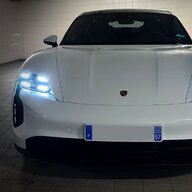
- Taycan 4S+ Pure White

I guess not.
Sponsored


Yes, it can “brake” much harder than normal regen mode (which is at a fixed rate) assuming you’re coming into the cars in front of you at a high enough rate.Does it brake any harder in Auto-regen versus normal regen with cars in front? Purely regen though - no blending
So it has to detect an upcoming vehicle to allow a deeper degree of recup/regen which presumably then reaches a deceleration level that triggers the brake lights?Yes, it can “brake” much harder than normal regen mode (which is at a fixed rate) assuming you’re coming into the cars in front of you at a high enough rate.
Yes, that is what makes it “auto”. And yes, I’m confident there is no mechanical braking involved in auto-recup mode.So it has to detect an upcoming vehicle to allow a deeper degree of recup/regen which presumably then reaches a deceleration level that triggers the brake lights?
…and you’re 100% confident that in this process there is absolutely no mechanical brake blending / assistance whatsoever?
Yes! ?Thanks @Hirschaj
So to summarise:
1. Ordinary recup mode, no brake lights as deceleration is not sufficient to cross the brake lights on threshold
2. Auto-recup mode, if car detects upcoming vehicle will regen more intensively, thus triggering the deceleration threshold, which will activate the brake lights
Correct?


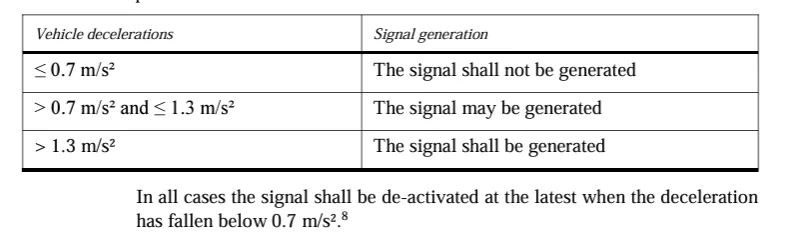
That's a significant change from this version of the regs we discussed in a thread around 12 months ago-Don’t forget that even if you press the brake pedal it won’t engage the mechanical brakes until needed, but it obviously turns on the brake lights either way.
Nevertheless, I'm not entirely sure why it actually matters what physical method of braking the car uses. If the car brakes, it brakes. Whether it's through regen or disks is essentially a technicality.
That said, the actual answer is that all cars sold in the EU are legally required to activate the brake lights at deceleration from regen (or other systems) of over 1.3 m/s².
https://eur-lex.europa.eu/legal-content/EN/TXT/PDF/?uri=CELEX:42023X0401
Technically, Porsche can of course use a different implementation in other markets, though.
So to summarise, the brake lights will turn on when:
They will not turn on if:
- Driver presses the brake pedal.
- Any system (auto regen, TACC, e.t.c) decelerates the car over 1.3m/s² through any means (regen, disks or any combination of the two) for the purpose of slowing down the car.
- The car decelerates less than 1.3m/s² (e.g. regular regen).
- Deceleration is not directly caused by a system (e.g. rolling resistance, driving up a slope, e.t.c).
- The main purpose of the system is not to slow down the car (e.g. slight braking to clean the disks).
Partially true; the brake lights will turn on if the brake pedal is engaged - irrespective of speed, deceleration, mode, distance traveled, or anything else. In the context of “no driver intervention”, the above is true.Brake light activation is based on deceleration rate only, try ShiftyWolf's tape test and see for yourself.
When I had my 911S I'd often downshift when approaching traffic to slow the car. I was told this may not be good for the engine but it became a reflexive motion for me after a decade of driving the same car. The auto-regen has a similar feeling when it kicks in. I'm addicted to it.I don’t understand the love for auto regen, personally. It’s a weird in-between where the car is intervening, but not enough, so you still have to do something too. I’ve really never liked it at all.
Auto regen is kind of like LKA where it kind of tugs the wheel, but not enough to really steer the car for you. I keep that off too. It’s more annoying than helpful.
All that said, if it works for you and you like it, fine. But it’s not for me.