Sponsored

How-to Recalibrate your SoH.

Scandinavian

Well-Known Member
First Name
Peter
Joined
Nov 3, 2019
Threads
52
Messages
3,904
Reaction score
3,549
Location
France
Vehicles
Taycan T, Aston Martin DB9, Porsche 996 C4 Cab, i4
Country flag
I spoke to a technical friend of mine and he knows a thing or two about Porsche.

If your SoH may look lower than expected you can recalibrate the battery.

Porsche uses the following method [edited]
-Drive the battery below 2% SoC.
-Don't drive or charge the car for at least 6,5 hours.
-Recharge to at least 95% SoC.
-Don't drive or charge the car for at least 6,5 hours.

I'm about to recalibrate my battery so I'll post the results.
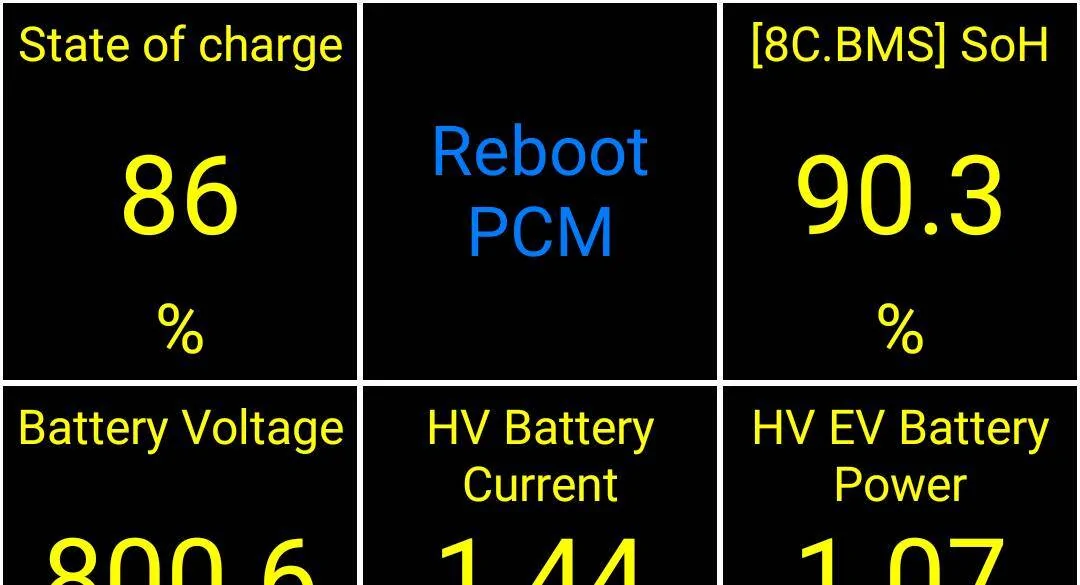
According to Carscanner my battery is at 89,9%@40.000 km (never did the 0 km test when it was new though).
I've started measuring SoH in 2022 at 15.000 km or so, which was already down to 90,3% SoH.

To be continued.

Screenshot_20220806-190832~2.webp
I follow this procedure now as well Dee!
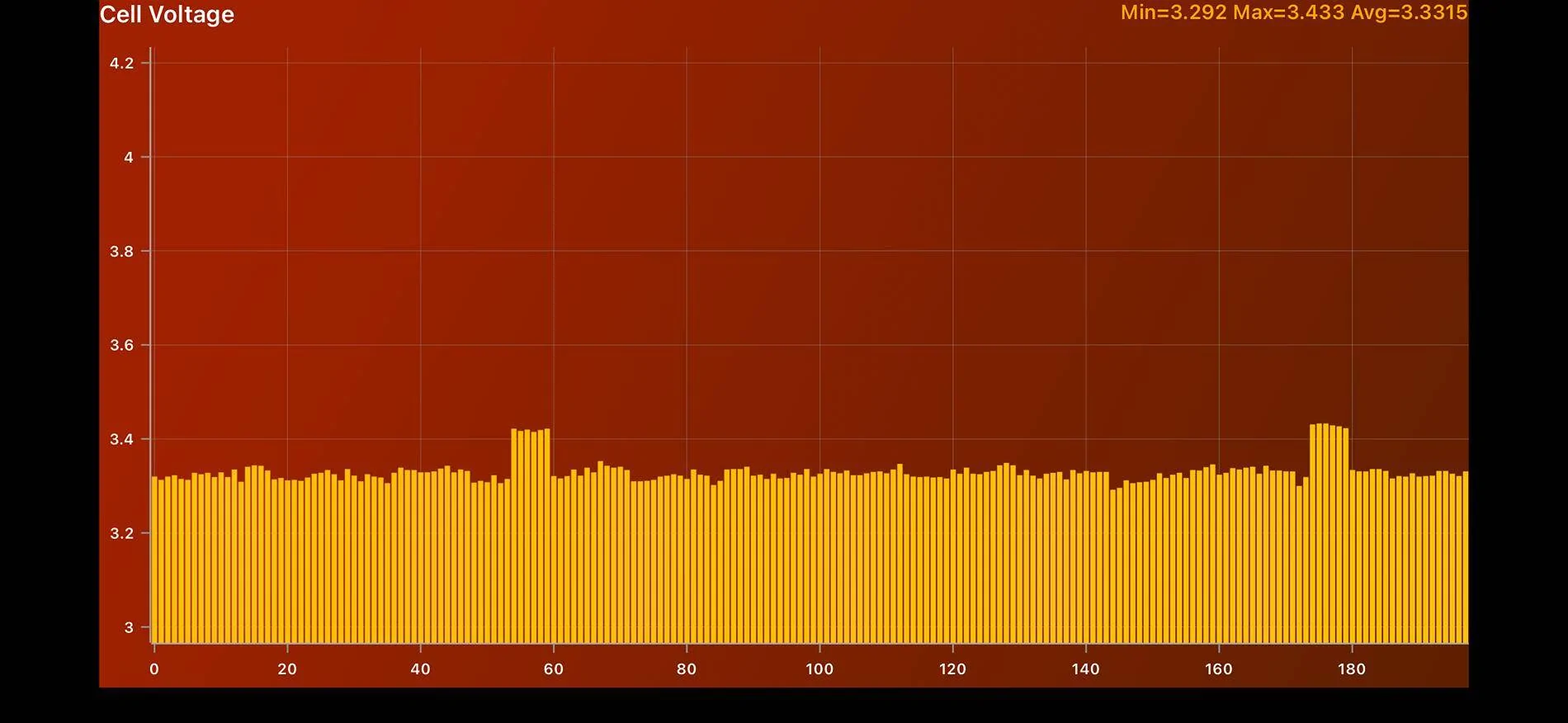
will be interesting to compare notes about development and results. I have already had two modules replaced in my battery so my initial graph has a cell voltage deviation of about 170 mV!
Porsche Taycan How-to Recalibrate your SoH. IMG_1967
Porsche Taycan How-to Recalibrate your SoH. IMG_1970


I am comparing Car Scanner to presentation from eFlow as well. They both read the same data from the car and I just want to see the difference in presentation.

I have 64100 km on the clock 2020 Turbo.

I have plugged in my PMCC and it’s delivering 11 kW just now (3phase).
Sponsored


r553

Well-Known Member
First Name
Rob
Joined
Apr 26, 2019
Threads
12
Messages
583
Reaction score
302
Location
Rockledge FL
Vehicles
2015 Cayenne Diesel, 2020 Taycan 4s
Country flag
Off topic but can Car Scanner reset the service indicator in the Taycan?
 

Tooney

Well-Known Member
Joined
Aug 14, 2021
Threads
746
Messages
4,466
Reaction score
3,647
Location
Ohio
Vehicles
2022 Taycan 4S
Country flag
@Dee. Look at your cell min/max difference at a low charge state. Probably much larger than at a full charge. My min/max was 59mv at 6% charge. Prior to rebalancing it was around 8mv at a charge of 80% or better (looked pretty good when checking at a higher SoC). After rebalancing the diff was only 10mv+/- below 15%, and 3% above 80% SoC. Biggest change was to the balance at a low SoC and this only happened after charging to 100% and letting the car sit unplugged. If you don't see any improvement after sitting at a low SoC don't despair. Finish the procedure and you will probably pick up 1.5 to 2 percentage points on your SoH. You might see if you can get the 3rd digit to display on your SoC graph. Based on the graph your cells are not exactly equal as the numeric readings would imply. Could be out of balance by as much as 9mv and min and max could be rounded to 4.17. Waiting with bated breath to see what improvement you get.
What is the impact of an increase of 1.5 - 2 % SoH? IOW, what does that do for the car? Is it noticeable, other than as a software measurement?
 
Last edited:

Tooney

Well-Known Member
Joined
Aug 14, 2021
Threads
746
Messages
4,466
Reaction score
3,647
Location
Ohio
Vehicles
2022 Taycan 4S
Country flag
I follow this procedure now as well Dee!
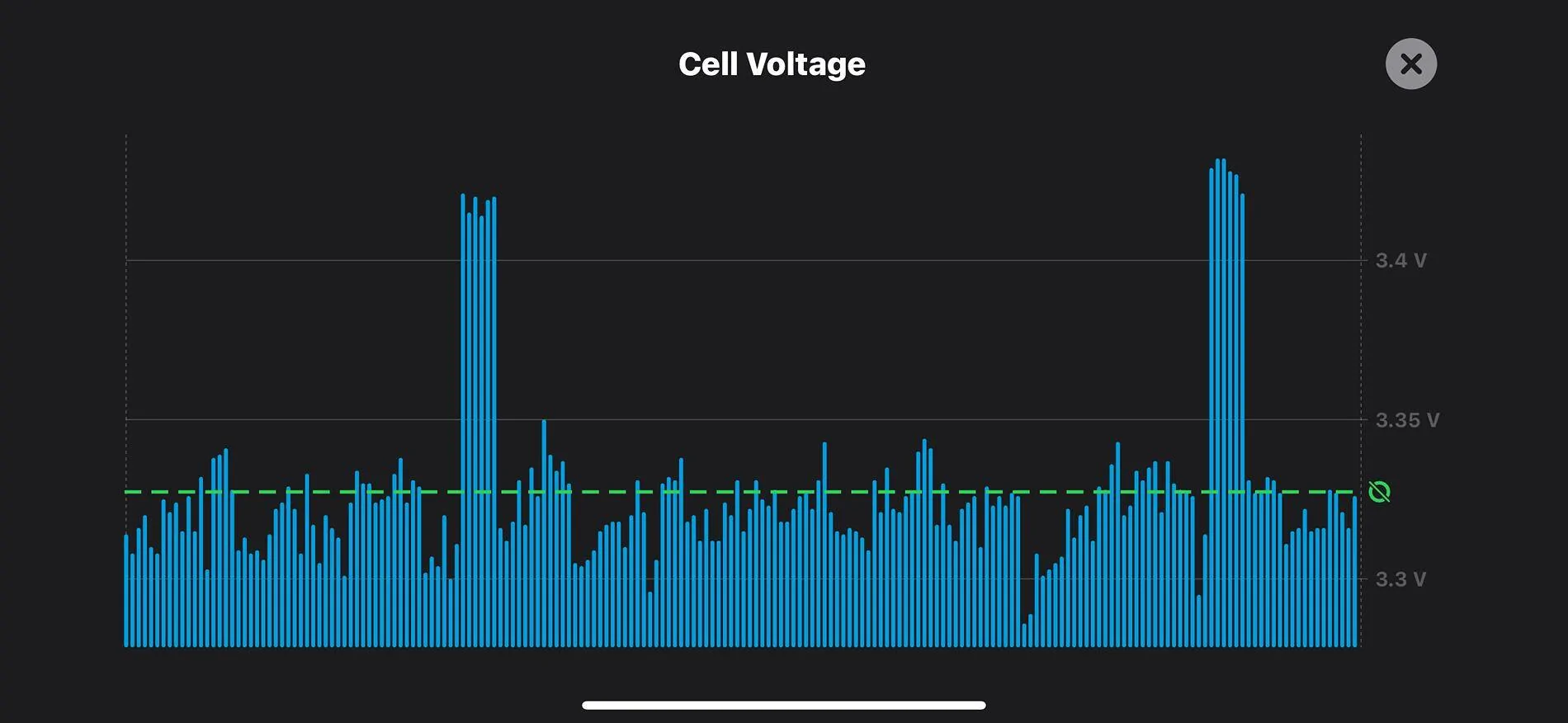
will be interesting to compare notes about development and results. I have already had two modules replaced in my battery so my initial graph has a cell voltage deviation of about 170 mV!
IMG_1967.webp
IMG_1970.webp


I am comparing Car Scanner to presentation from eFlow as well. They both read the same data from the car and I just want to see the difference in presentation.

I have 64100 km on the clock 2020 Turbo.

I have plugged in my PMCC and it’s delivering 11 kW just now (3phase).
I assume that the 2 groups of higher voltage cells are the battery modules that were replaced in @Scandinavian 's Taycan.
How does the battery management system handle charging when some cell/module voltages are higher than that of cells in other modules?
During the charging process, do their relatively higher voltages result in the other modules being charged to a lower voltage than would be the case if all the modules were roughly balanced in voltage?
I remember some posts in other threads indicating that as a HV battery gets older, replacing some of the modules would not be a good thing because the replacement modules would have higher voltages than those in the rest of the battery.
Maybe @Dr Bob or other battery experts would comment.


gtm

Well-Known Member
First Name
George
Joined
Nov 5, 2022
Threads
6
Messages
682
Reaction score
882
Location
Jacksonville, FL
Vehicles
'26 S e-tron GT, '73 Lotus, ('23 GTS sold 10/25)
Country flag
What is the impact of an increase of 1.5 - 2 % SoH? IOW, what does that do for the car? Is it noticeable, other than a software measurement?
Very good question. According to CarScanner I went from a calculated 100% battery capacity of 78.55 kWh before to 81.10 kWh at a real SoC of 99.50%. So the rebalancing may have given me back 2.55kWh of capacity. I'm guessing mostly on the low SoC end as that was pretty far out of balance prior to doing the procedure. Range went from an extrapolated 253 miles to 268 miles at a 99.5% SoC. Since there was no driving to influence the GOM the software must have been looking at some measurement of increased battery capacity. I average 3.1 miles/kWh when road tripping so 2.55 kWh couldn't give me an additional 15 miles of range. Extrapolating anything from a low SoC (5.76%) to 100% is probably not very accurate so I don't know how close to accurate the 253 miles was. After a recent road trip (500 miles of typical highway driving) my range does seem better. Actual miles tracked very closely with the GOM and it felt like 268 miles was legit.

After less than 1,000 miles since rebalancing my SoH has dropped from 92.33% to 91.06%. My GOM range has stayed at, or above, 268 miles extrapolated from an 85% SoC (with 500 miles of highway driving and 2 DC charging sessions) . My cell imbalance at 85% remains 3 or 4 mv. My range and imbalance have not deteriorated at all while my SoH dropped 1.4%. I'm no longer quite as fixated on SoH but more on the cell imbalance, especially low SoC. Other than driving down to 5% on a single trip and recording actual miles traveled and then doing the same after a rebalance I'm not sure how to measure if there is an actual improvement. And conditions would almost certainly be different. Anecdotal, but I would say there are benefits to rebalancing. The bump in GOM range feels real.
 
Last edited:

Scandinavian

Well-Known Member
First Name
Peter
Joined
Nov 3, 2019
Threads
52
Messages
3,904
Reaction score
3,549
Location
France
Vehicles
Taycan T, Aston Martin DB9, Porsche 996 C4 Cab, i4
Country flag
I assume that the 2 groups of higher voltage cells are the battery modules that were replaced in @Scandinavian 's Taycan.
How does the battery management system handle charging when some cell/module voltages are higher than that of cells in other modules?
During the charging process, do their relatively higher voltages result in the other modules being charged to a lower voltage than would be the case if all the modules were roughly balanced in voltage?
I remember some posts in other threads indicating that as a HV battery gets older, replacing some of the modules would not be a good thing because the replacement modules would have higher voltages than those in the rest of the battery.
Maybe @Dr Bob or other battery experts would comment.
Yes the two modules with higher values are the ones that have been replaced.
I guess the idea by balancing the cells is to make sure one has equal charge levels in all the modules and that they contribute equally? It will be interesting to see if I can get the charge up to 100%. I have had a lot of charging issues today with the PMCC saying charging ended. Red light on charging port but no message in car or equipment. And it is not too hot outside either with 25 C.
 

Dr Bob

Well-Known Member
First Name
Andy
Joined
Sep 16, 2023
Threads
6
Messages
123
Reaction score
174
Location
Falkirk
Vehicles
Taycan Turbo
Country flag
How does the battery management system handle charging when some cell/module voltages are higher than that of cells in other modules?
During the charging process, do their relatively higher voltages result in the other modules being charged to a lower voltage than would be the case if all the modules were roughly balanced in voltage?
Tooney,

Firstly, I have no clue of the details how Porsche operate their Battery Management System (BMS). However, battery balancing is quite straight forward to understand but maybe not as simple to implement. Li-ion batteries can either be top balanced or bottom balanced. You cannot do both. Most systems use top balancing. So charge is applied to each cell (or module) and that increases the state of charge as Li ions move to the Cathode and that increases the voltage of the cell. To make the battery most efficient you want all cells reaching the 100% limit during charging at the same time – ie their voltage reaches the max at the same time. That will be a fully top balanced bank. Unfortunately every cell is different and will have a slightly different capacity (ie different internal resistance etc) so the voltages at the top will not be all the same– and this gets worse with each cycle – so the BMS has to alter various cells to bring their voltages all together as they reach 100%. Thus as you charge out of the voltage plateau (over say 80% SoC), the battery will see differences in cell voltage and start draining some cells and charging others (note the BMS cant see the voltage differences until SoC gets over 80% ish). The balancing can be a long process as the wires to each cell are small diameter and current cannot flow too fast. Charging to 100% and not discharging for a while can allow the current to flow in and out of the higher and lower voltage cells – but I have no clue if this balancing continues to happen in the Taycan after you turn it off.

Now, what happens if you dont balance it. Well we will end up with a range of voltages in the cells as the top one reaches 100% charge. It could be the cells with the lowest voltage could be a few percent of charge short of the 100%. That % short in a number of cells has therefore reduced the total amount of charge from what you would have in a fully balanced battery. Your SoH will thus be lower. If you then discharge to low SoC, you will find some cells reach the low voltage value first while other cells could be significantly higher. It could be that some cells in the battery have a much lower capacity than others so will be a high voltage cell at the top end and yet be a lower voltage cell at the bottom. Some cells, however, will have similar capacities but one will be higher in voltage than the other both at the top and the bottom. However, as we are top balancing – and assuming all cells are balanced and reach 100% SoC at the same time, the variation in voltage will then be apparent at the bottom end – which is why the voltage spread is always worse at the bottom. The bottom end cannot be balance if we are balancing the top end.

You can operate a Li-ion battery without balancing but you loose capacity when you charge and some cells will reach the bottom earlier, again reducing range.

What I am not sure about with the Taycan, is what happens at the bottom end. One thing for certain is that it will not start balancing at the bottom end. You cannot top and bottom balance in the same battery. Balancing is a long process and going to 100% and discharging is not enough time to balance. The instructions to hold at <10% (or whatever SoC is chosen) earlier in this thread to reset the battery must be to let the BMS record what the voltages are so that that data can be used to calculate SoH or range once you get back to full SoC.

The information on Peter's car is interesting. The two high voltage cells/modules (measured at the bottom end) show they are significantly higher voltage – which is almost certain to be higher capacity cells, so on charging they will get the same charge as the other cells – until they get to over 80%. The BMS will then compare voltages but as the capacity of the new cells is higher, their voltage will not be as high as they only got the same charge as the others. It is possible then once in the top voltage knee, their voltage is the same as the rest. The BMS will then be actively balancing the cells and the new ones will eventually end up with the same voltage as the rest. The new cells will show up at the bottom end of the SoC with this higher voltage difference.

In building a battery bank, you have to use matched cells ie reasonably close capacities. These new cells are different but will not show up if the top end balancing is done right until you go to the bottom end of the SoC range where there will be a significant difference in voltage. The range will therefore be determined by the bulk of the old cells and not reflect the higher capacity of the new cells.

My driving style is to seldom go below 20% SoC and never to go below 10%. That's when a bad in-balance can happen.

I did say earlier in this post that you would loose capacity if you did not balance but that is not true. On my boat, I have had Li batteries for 7 years. I manually balanced once when installed. I have not balanced since and my BMS has no balancing function. The capacity is the same today as it was 7 years ago. Why? I only operate in the range 40% to 80% SoC and only go up to 90%+ to check the capacity and balance (few times a year). Keep under 80% and you never get an issue. Easy on a boat. Not practical with a Taycan.


Tooney

Well-Known Member
Joined
Aug 14, 2021
Threads
746
Messages
4,466
Reaction score
3,647
Location
Ohio
Vehicles
2022 Taycan 4S
Country flag
@Dr Bob Thank you for the information about balancing and the interactions between modules of different capacities and voltages. It helped my understanding a lot.

My driving style is to seldom go below 20% SoC and never to go below 10%. That's when a bad in-balance can happen.​

Do you foresee any problems/battery harm resulting from owners "recalibrating" their Taycan batteries by discharging to 10% or lower SoC, pausing for 7 hours, charging to 100%, and pausing for 7 hours as has been suggested in various threads on this forum?
 
OP
OP
Dee

Dee

Well-Known Member
First Name
Dee
Joined
Dec 14, 2018
Threads
78
Messages
3,508
Reaction score
4,049
Location
The Netherlands
Vehicles
A lot
Country flag
Last edited:

Scandinavian

Well-Known Member
First Name
Peter
Joined
Nov 3, 2019
Threads
52
Messages
3,904
Reaction score
3,549
Location
France
Vehicles
Taycan T, Aston Martin DB9, Porsche 996 C4 Cab, i4
Country flag
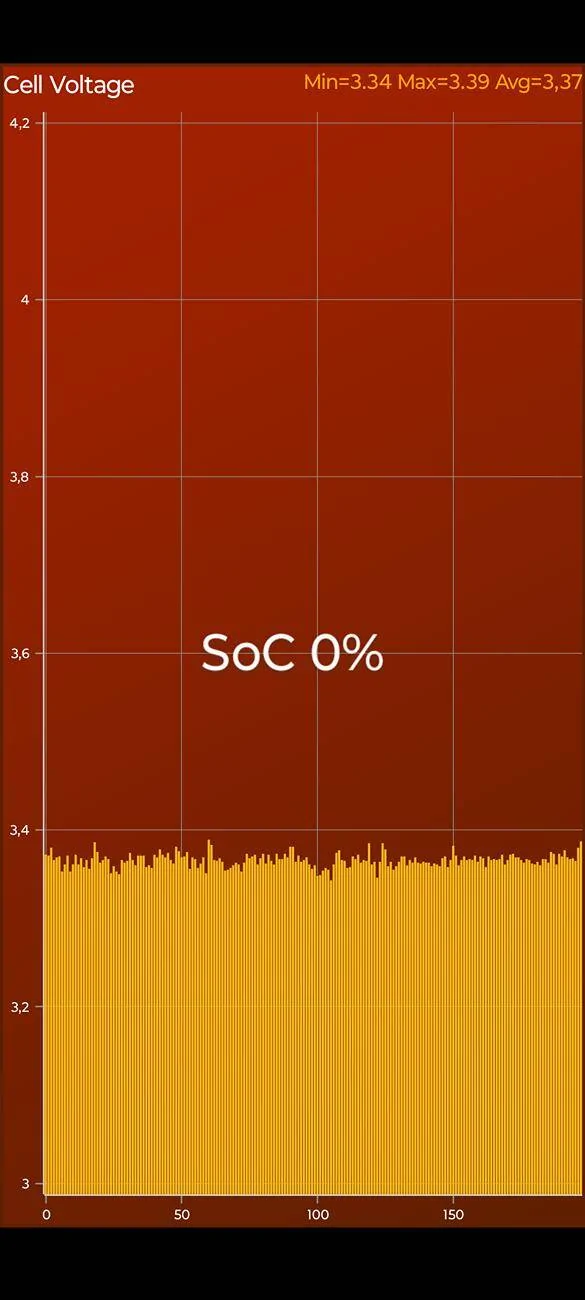
As you can see by my pictures, the difference in voltage is only visible when de SoC is low.
The lower the SoC, the better visible.
My cells are different by 1,47% at worse (0% SoC).
The higher the SoC gets, the lesser the difference if your battery is healthy.
Did you finish your charging and get some results as yet or are you still waiting?
 

Dr Bob

Well-Known Member
First Name
Andy
Joined
Sep 16, 2023
Threads
6
Messages
123
Reaction score
174
Location
Falkirk
Vehicles
Taycan Turbo
Country flag
@Dr Bob
From this article, my understanding is that Taycan uses bottom balancing?
https://newsroom.porsche.com/en/202...h-voltage-battery-reparation-sales-26854.html
IMG_1100.jpeg
All that script says is that they are using voltage to show a difference between modules. Lets go back to what I said in my previous post. You can either top or bottom balance. You cant do both as full balancing will take many hours (ie 10+ if well out of balance) so you cant balance at the top then balance at the bottom. All the cells/modules will be different, so there would be too much current to transfer in the short time you go from 80-100% SoC (while top balancing) then re-balance at the bottom end as you get down to 20% SoC as you discharge to zero. Car makers therefore top balance so that all cells reach the max cell voltage at the same time (4.? volts) but then on discharge as all cells have slightly different capacities, there will be a voltage spread around the 3.3v that is shown in Peter's voltage graph earlier in this thread.

You can bottom balance but then that requires you to discharge to <20% and keep it there for hours so that all voltages are identical at 0% - but then there will be a big difference in cell voltages when charging to full and charging will stop as soon as the first cell reaches the max voltage leaving a lot of cells short of 100% charge. Car users prefer to be at 100% rather than 0%, so top balancing is universal in EV systems. (note – I am using the words cells and modules interchangeably – Porsche seem to focus on module voltage?)

As you can see by my pictures, the difference in voltage is only visible when de SoC is low.
The lower the SoC, the better visible.
My cells are different by 1,47% at worse (0% SoC).
The higher the SoC gets, the lesser the difference if your battery is healthy
So Dee is saying you can see the voltage difference at low SoC hence the voltages will be similar at high SoC - hence it is Top Balanced.
 
OP
OP
Dee

Dee

Well-Known Member
First Name
Dee
Joined
Dec 14, 2018
Threads
78
Messages
3,508
Reaction score
4,049
Location
The Netherlands
Vehicles
A lot
Country flag
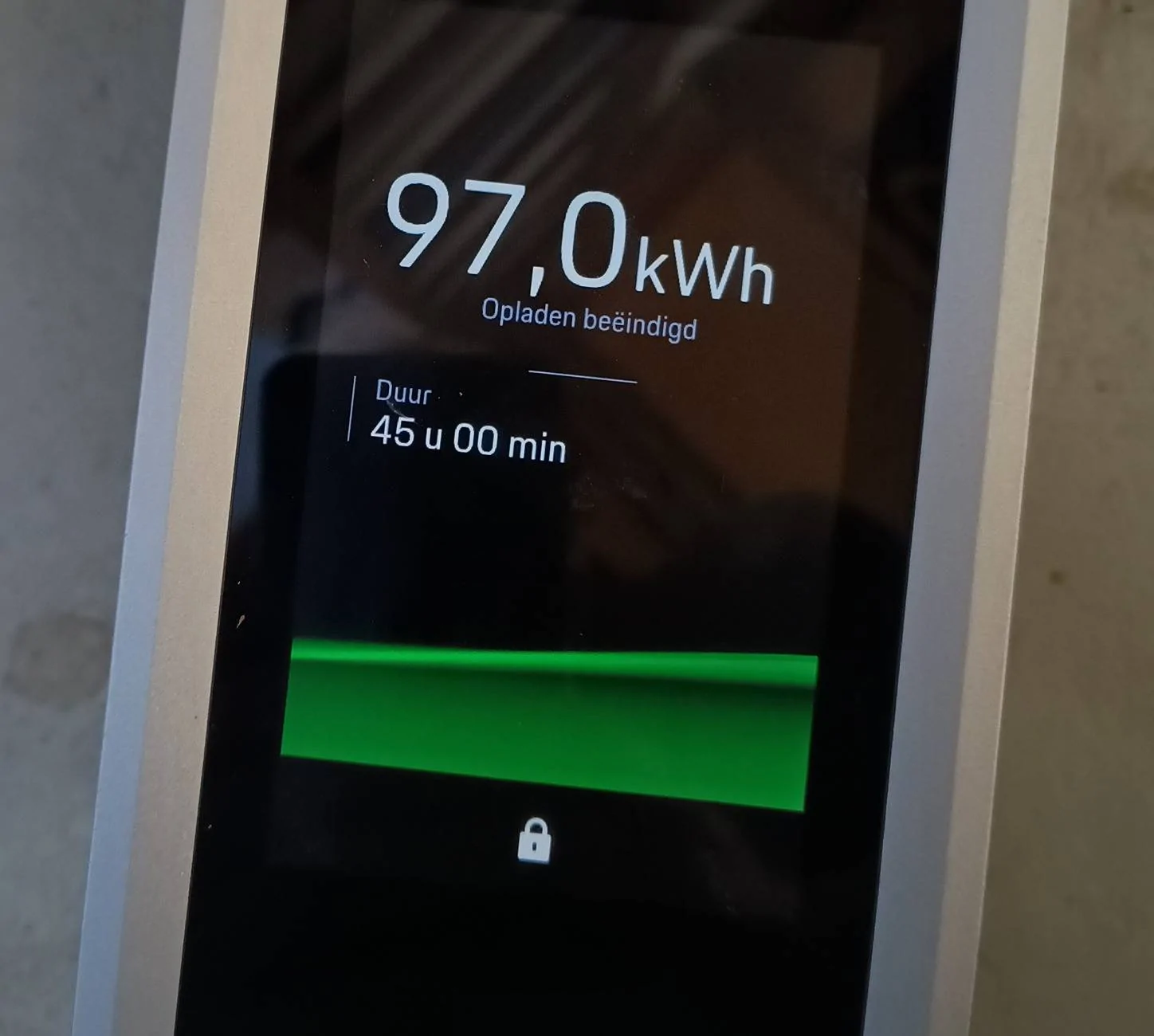
Ok, I'm done charging at a slow rate of 2kW.
Consumption is 97 kWh and it took 45 hours. ?
Porsche Taycan How-to Recalibrate your SoH. IMG_20240913_075352104_HDR

Assuming the useable battery capacity is 83kWh ("0"-100%) means I lost 14kWh.

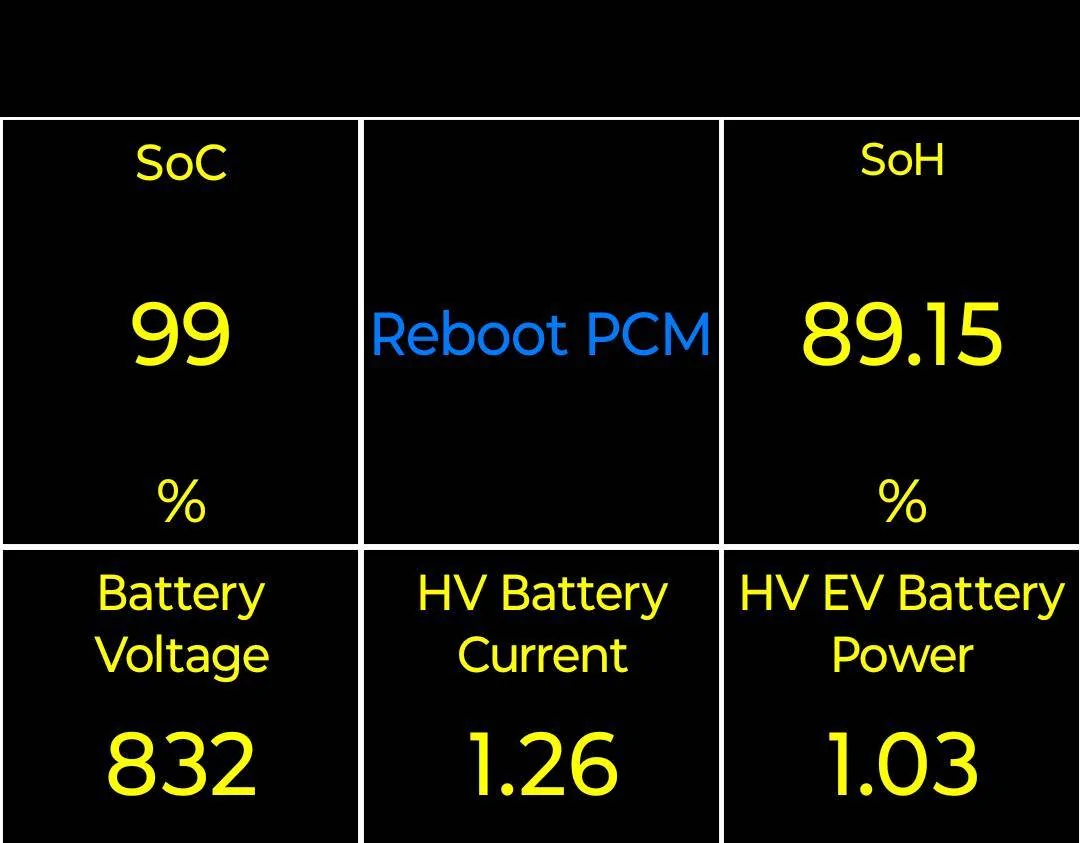
Ok, back to my SoH.
Did it improve?
Nope.
Porsche Taycan How-to Recalibrate your SoH. Screenshot_20240913-095418

Actually it got worse, from 89,5 to 89,2.
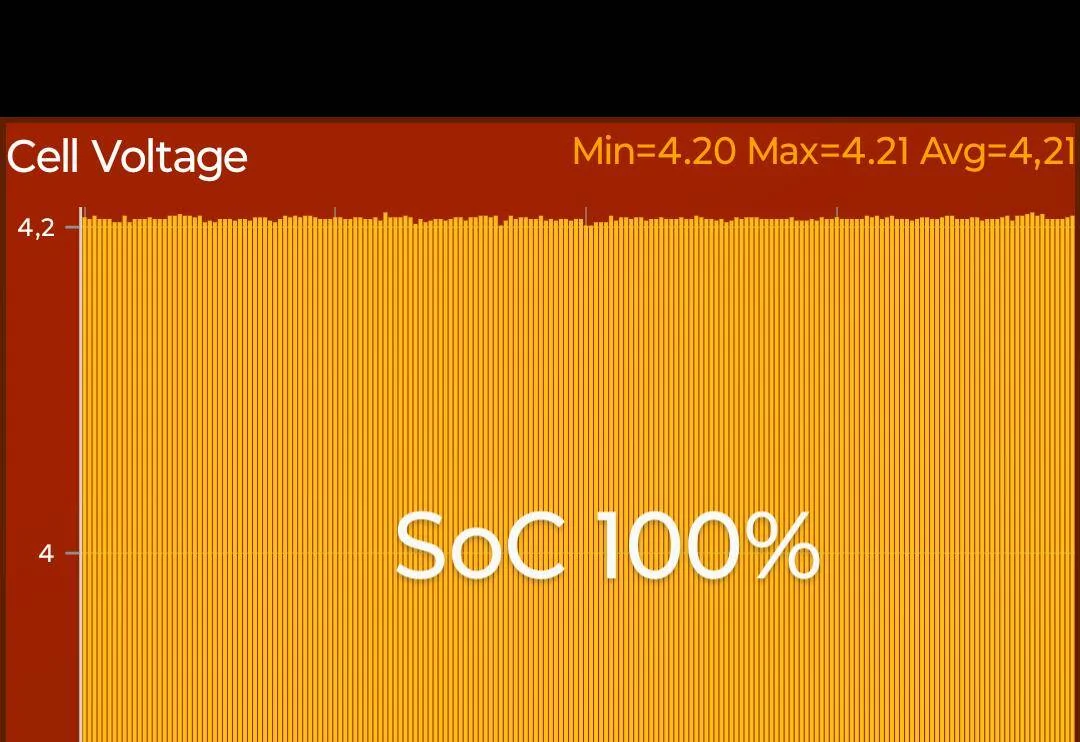
Battery voltage at 100% is still good though.
Porsche Taycan How-to Recalibrate your SoH. Screenshot_20240913-095455~2

Porsche Taycan How-to Recalibrate your SoH. Screenshot_20240911-074734~2

Conclusion: no improvement.
So now I'm curious if I see any difference after my battery recall (and brake hoses and A/C) end of October.
Of course I'll keep you updated.

To be continued.
 
Last edited:

Dr Bob

Well-Known Member
First Name
Andy
Joined
Sep 16, 2023
Threads
6
Messages
123
Reaction score
174
Location
Falkirk
Vehicles
Taycan Turbo
Country flag
@Dr Bob Thank you for the information about balancing and the interactions between modules of different capacities and voltages. It helped my understanding a lot.

Do you foresee any problems/battery harm resulting from owners "recalibrating" their Taycan batteries by discharging to 10% or lower SoC, pausing for 7 hours, charging to 100%, and pausing for 7 hours as has been suggested in various threads on this forum?
Tooney,
Glad to hear I was making sense!!
No, I dont think there is a problem at all in recalibrating that way.
At the risk of boring everyone again, I would point peeps to a post I made a few months back which tries to give a simple analogy of what is happing on charging.
https://www.taycanforum.com/forum/t...ptimize-battery-life.20297/page-2#post-311217
I know you read it Tooney, as you gave it a 'like'! Charging into the top voltage knee does stress the battery but as long as you dont do it all the time then the cells will be fine. That analagy doesnt say what happens at the bottom end of the SoC but operating in the bottom 20% of SoC will also stress the cells (I'm sure I can expand the analogy) - so again fine if you are doing it now and again, but not every cycle.
My mantra will be that the more you go into the top and bottom voltage knees, you put stress on the cells. For a well put together battery, they can accept a lot of stress over many years - ie loads of Tesla's (including the one I owned) with great capacity after 4 years. However if the battery is poorly made (or the individual cells are not of the right QC standard) then that stress can cause premature failures - is that what we are seeing in some Taycans? Those failures could happen over the whole life of a battery - not just in the first few years - based on the levels of stress (and frequency) and the integrity of the battery. I've had my Taycan a year now and charged to 100% likely 10-15 times - but normal charging is to 85% - and I try to never go under 20%. Battery seems fine (is that a good thing to say on Friday 13th?).....but then I am a muppet.
Sponsored


Top