
Sponsored
PhillyTCT4S
Well-Known Member
- Joined
- May 6, 2025
- Threads
- 7
- Messages
- 117
- Reaction score
- 112
- Location
- PA USA
- Vehicles
- 2023 Taycan Cross Turismo 4S

Doesn’t mean that you have to punch it every time, every day. You can just deive normal as before but its good to know that my car is much more capable with acceleration when I need it.

gregeast
Well-Known Member
- First Name
- Greg
- Joined
- Aug 22, 2025
- Threads
- 2
- Messages
- 47
- Reaction score
- 43
- Location
- Colorado, USA
- Vehicles
- 2022 Taycan GTS
And that throttle response, oh my!
Er, sorry, "that accelerator pedal response, oh my!"
Doesn't quite have the same ring to it, does it?
Er, sorry, "that accelerator pedal response, oh my!"
Doesn't quite have the same ring to it, does it?
Last edited:
OP
OP

prj
Well-Known Member
- Joined
- Jan 14, 2025
- Threads
- 7
- Messages
- 1,757
- Reaction score
- 2,329
- Location
- Estonia
- Website
- www.mapev.net
- Vehicles
- Taycan CT 4 - 2026

- Thread starter
- #484
It's the regenerative braking that causes the heat overload on the track, not the fast discharge.The only way harder acceleration hurts the battery or any other components is through excess heat, which one would assume all components have heat sensors and will throttle down - so no reason to worry.
Thermal limit being reach is unlikely to happen with sporadic full throttle acceleration. Maybe under constant load, say on a race track, it might cause reason to worry.
Nickj
Well-Known Member
- First Name
- Nick
- Joined
- Jun 29, 2020
- Threads
- 45
- Messages
- 772
- Reaction score
- 306
- Location
- UK
- Vehicles
- Crayon 4s

So, been reading the v long interesting threads and giving this some thought.
I’ve got an early 2020 4s pb (smaller battery) with higher mileage ( 83k).
Looking at the figures compared to the other models they are a little bit underwhelming for the outlay.
Comparing the mapped figures to turbo a standard figures I take it, it wouldn’t be as fast as a turbo s?
Below 80% battery it has even less power which would be most of the time..
Anyone have real life experience on the smaller battery 4s?
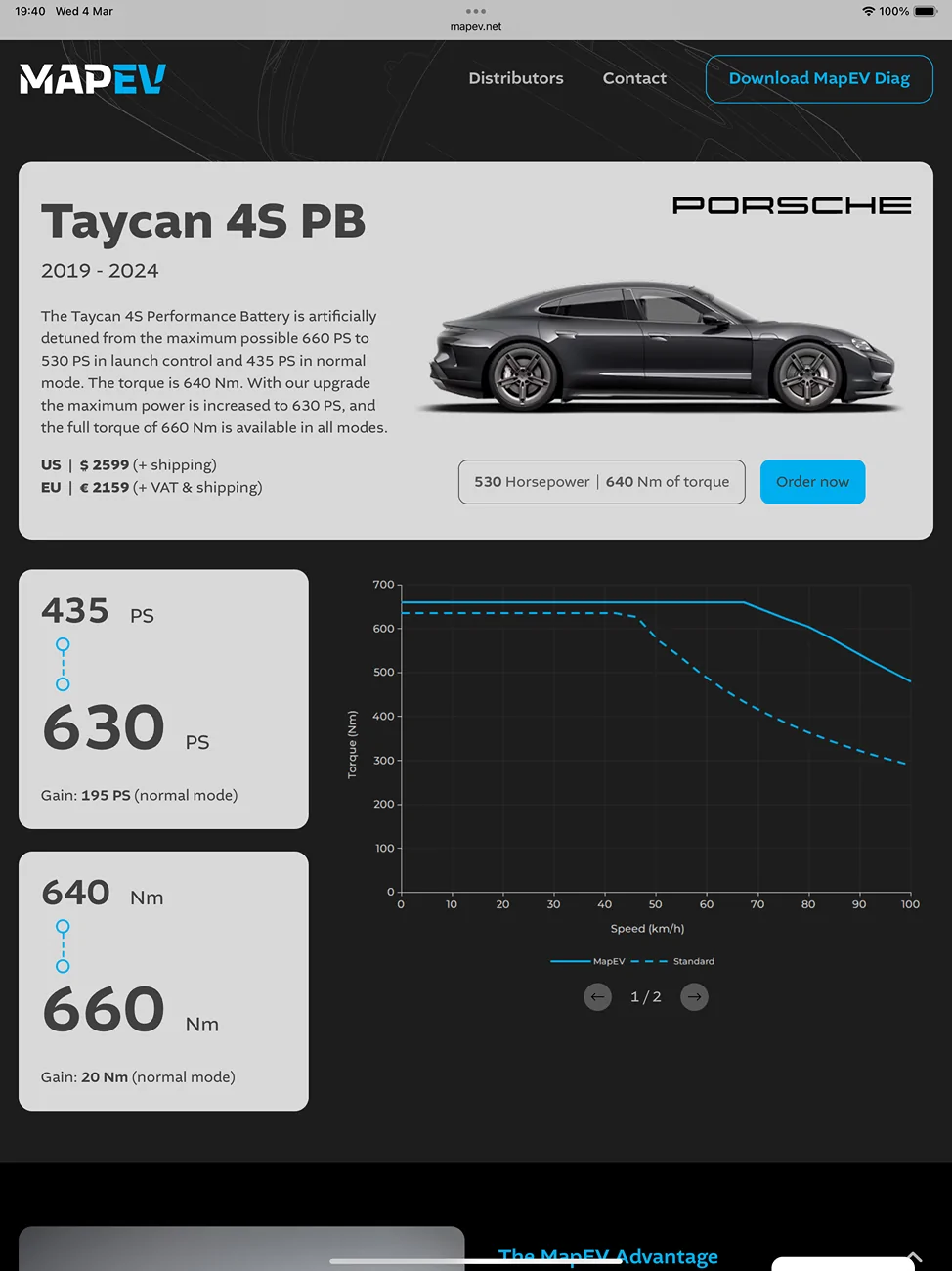
Torque/ power looks only marginally more at low end, but performance gains at top end, which isn’t where I’d really need it.
Does having a higher mileage car pose more risks?

I’ve got an early 2020 4s pb (smaller battery) with higher mileage ( 83k).
Looking at the figures compared to the other models they are a little bit underwhelming for the outlay.
Comparing the mapped figures to turbo a standard figures I take it, it wouldn’t be as fast as a turbo s?
Below 80% battery it has even less power which would be most of the time..
Anyone have real life experience on the smaller battery 4s?
Torque/ power looks only marginally more at low end, but performance gains at top end, which isn’t where I’d really need it.
Does having a higher mileage car pose more risks?
OP
OP
prj
Well-Known Member
- Joined
- Jan 14, 2025
- Threads
- 7
- Messages
- 1,757
- Reaction score
- 2,329
- Location
- Estonia
- Website
- www.mapev.net
- Vehicles
- Taycan CT 4 - 2026
- Thread starter
- #486
It's still significantly faster, but of course the Achilles heel of the J1.1 is the battery and the smaller battery just has less output.
I did tune one with a smaller battery myself locally when I was developing the tune, and I do have the numbers somewhere as well. From my memory it was like 3 seconds faster 100-200km/h. Stock was over 10 seconds and tuned was mid 7 seconds.
The overtaking and merging performance is much increased.
I would have to dig for the data though...
I did tune one with a smaller battery myself locally when I was developing the tune, and I do have the numbers somewhere as well. From my memory it was like 3 seconds faster 100-200km/h. Stock was over 10 seconds and tuned was mid 7 seconds.
The overtaking and merging performance is much increased.
I would have to dig for the data though...
69Mach390
Well-Known Member
- Joined
- Nov 14, 2025
- Threads
- 9
- Messages
- 842
- Reaction score
- 576
- Location
- Florida
- Vehicles
- 24 Taycan 4S
When you say the “low end,” look at the graph. The large gains start a 50 km/h.So, been reading the v long interesting threads and giving this some thought.
I’ve got an early 2020 4s pb (smaller battery) with higher mileage ( 83k).
Looking at the figures compared to the other models they are a little bit underwhelming for the outlay.
Comparing the mapped figures to turbo a standard figures I take it, it wouldn’t be as fast as a turbo s?
Below 80% battery it has even less power which would be most of the time..
Anyone have real life experience on the smaller battery 4s?
Torque/ power looks only marginally more at low end, but performance gains at top end, which isn’t where I’d really need it.
Does having a higher mileage car pose more risks?
That’s a pretty low speed. Basically it’s as fast as launch control all the time from a dig, but above 50 km/h it’s significantly faster.

OP
OP
prj
Well-Known Member
- Joined
- Jan 14, 2025
- Threads
- 7
- Messages
- 1,757
- Reaction score
- 2,329
- Location
- Estonia
- Website
- www.mapev.net
- Vehicles
- Taycan CT 4 - 2026
- Thread starter
- #490
Turbo S is faster because it has a lot more torque on the front, so off the line the performance is better.Should be the same as a stock turbo s.
It's a little faster than a stock Turbo, in perfect conditions you should hit 2.9s. The Turbo S can run 2.6s, which is not happening on a Turbo or GTS.
The factory number for a GTS is 3.7s btw.
Leccy61
Well-Known Member
- Joined
- Nov 18, 2024
- Threads
- 4
- Messages
- 308
- Reaction score
- 227
- Location
- United Kingdom
- Vehicles
- Taycan Cross Turismo, 986 Boxster S, VW ID.3 Pro S
EV tuning but how? Especially from a MapEV distributor! 
69Mach390
Well-Known Member
- Joined
- Nov 14, 2025
- Threads
- 9
- Messages
- 842
- Reaction score
- 576
- Location
- Florida
- Vehicles
- 24 Taycan 4S
So I’m confused, is this your tune or did they copy and compete now?I knew this was coming for a while
https://mrctuning.com/site/audi-rs-e-tron-porsche-taycan-ev-tuning-2019-2024/
OP
OP
prj
Well-Known Member
- Joined
- Jan 14, 2025
- Threads
- 7
- Messages
- 1,757
- Reaction score
- 2,329
- Location
- Estonia
- Website
- www.mapev.net
- Vehicles
- Taycan CT 4 - 2026
- Thread starter
- #494
Mine.So I’m confused, is this your tune or did they copy and compete now?
https://mrctuning.com/site/audi-rs-e-tron-porsche-taycan-ev-tuning-2019-2024/
PhillyTCT4S
Well-Known Member
- Joined
- May 6, 2025
- Threads
- 7
- Messages
- 117
- Reaction score
- 112
- Location
- PA USA
- Vehicles
- 2023 Taycan Cross Turismo 4S
Still using your tune on my 4S
Enjoying my car so much more, especially from the green light
It transformed it, especially with calibrated regen to my taste
No issues.
Enjoying my car so much more, especially from the green light
It transformed it, especially with calibrated regen to my taste
No issues.
Sponsored


