Sponsored

SergeyIndy

Well-Known Member
First Name
Sergey
Joined
Dec 19, 2021
Threads
41
Messages
2,441
Reaction score
1,827
Location
Indianapolis
Vehicles
24 Macan GTS, 23 Taycan Turbo, 20 Cayenne Turbo
Country flag
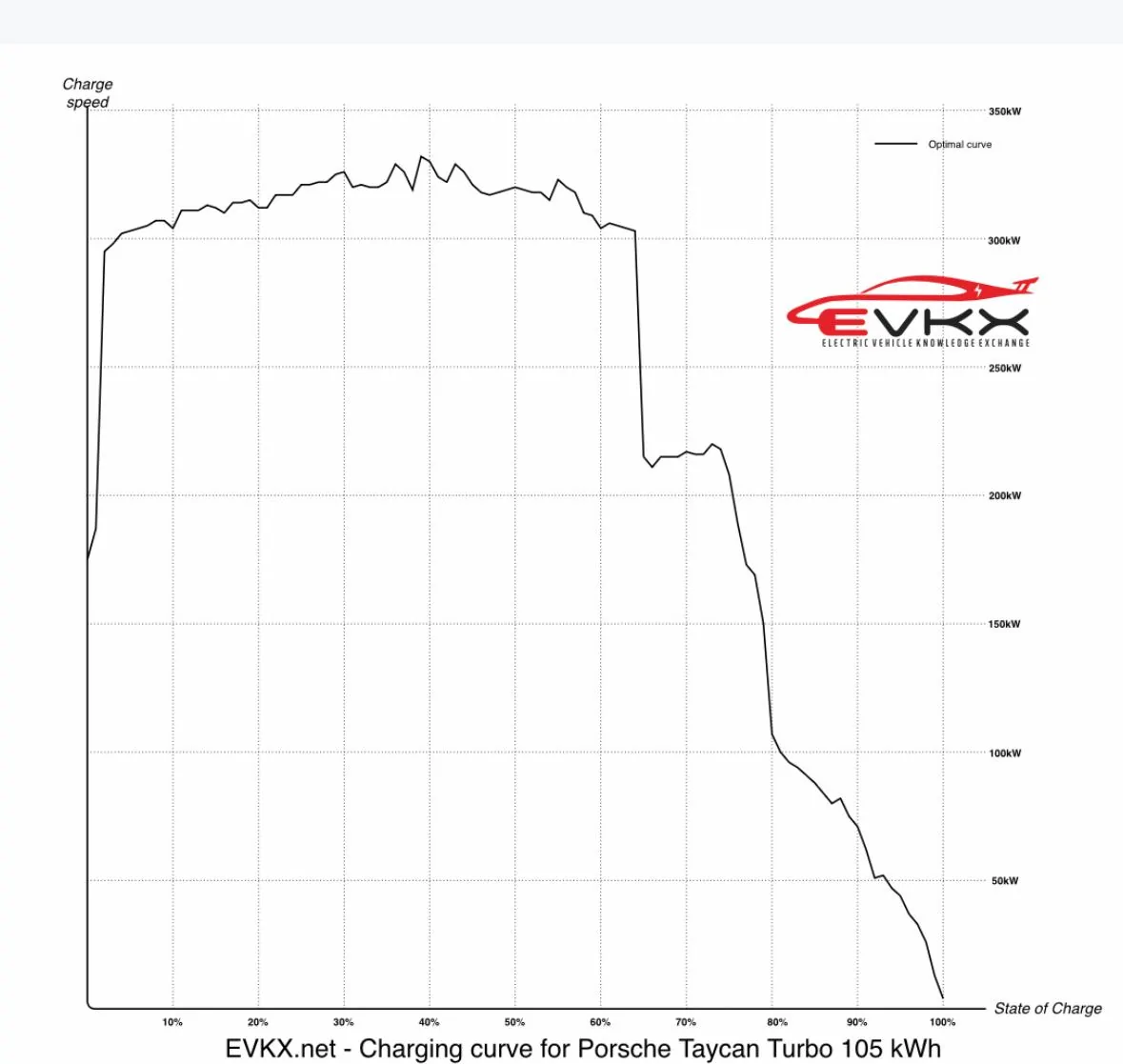
Hi Mark, thank you for putting this together with on point and comprehensive write up of the charging concepts for J1.2 Taycan. I would like to complement this by some press slides, that would be helpful to both J1.1 and J1.2 owners.

My personal view backed by real world experience in a J1.1 that charging at maximum speeds has no benefit in saving time from 10% to 80% backed by actual measurements of some youtubers. Therefore, I always keep my Battery Friendly setting on maxing out at 150kW and getting to 80% just as fast but without pushing the battery to 130F temps and having those fans working to the max. We know those fans are not that great, so if anyone chasing those speeds, you are taking a big risk for no benefit, in my view.

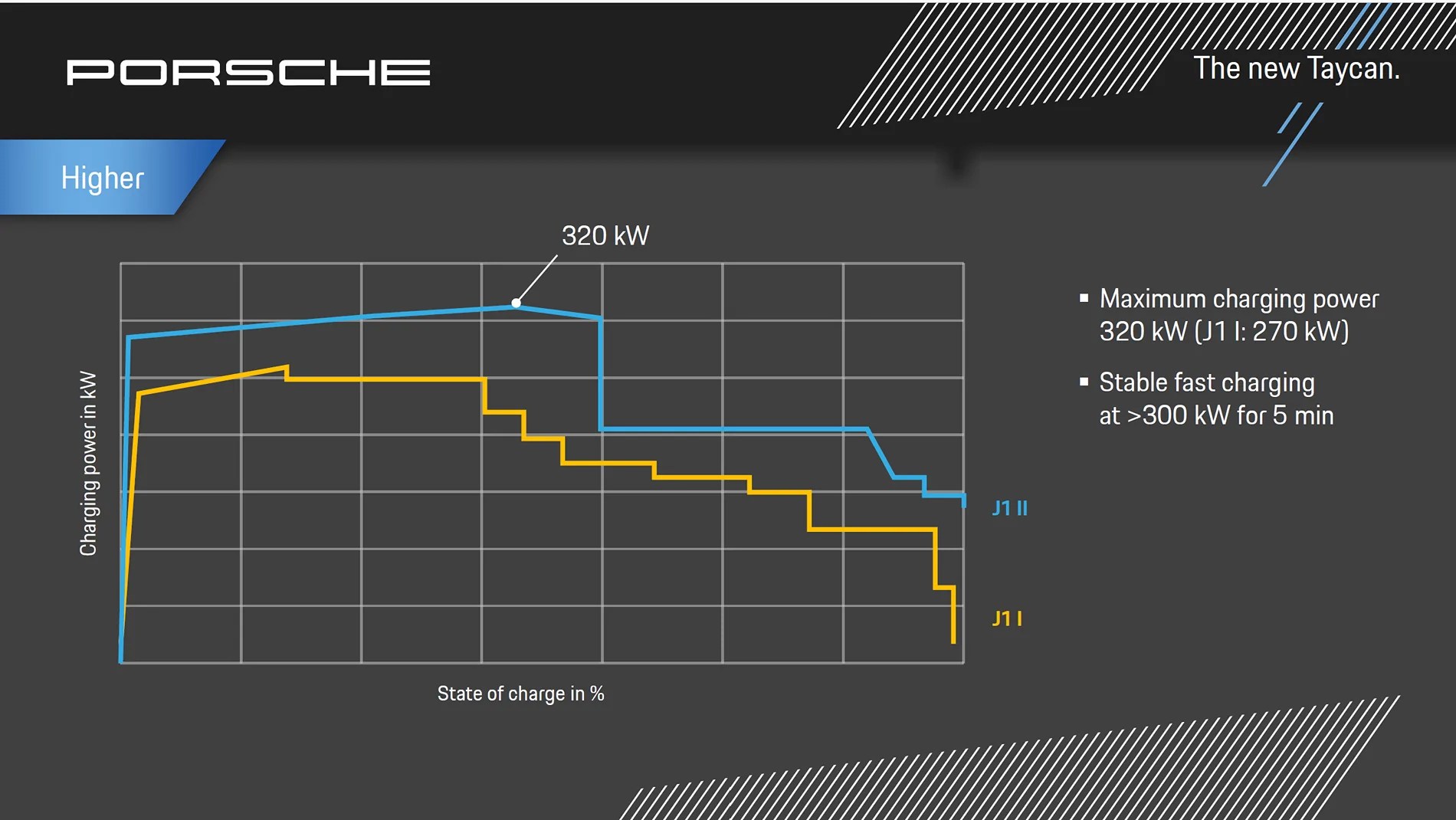
Charging curve differences (logical view)

Porsche Taycan Technical Deep Dive: Taycan J1.2 charging based on my new 2026 Taycan... 1774190535310-6v


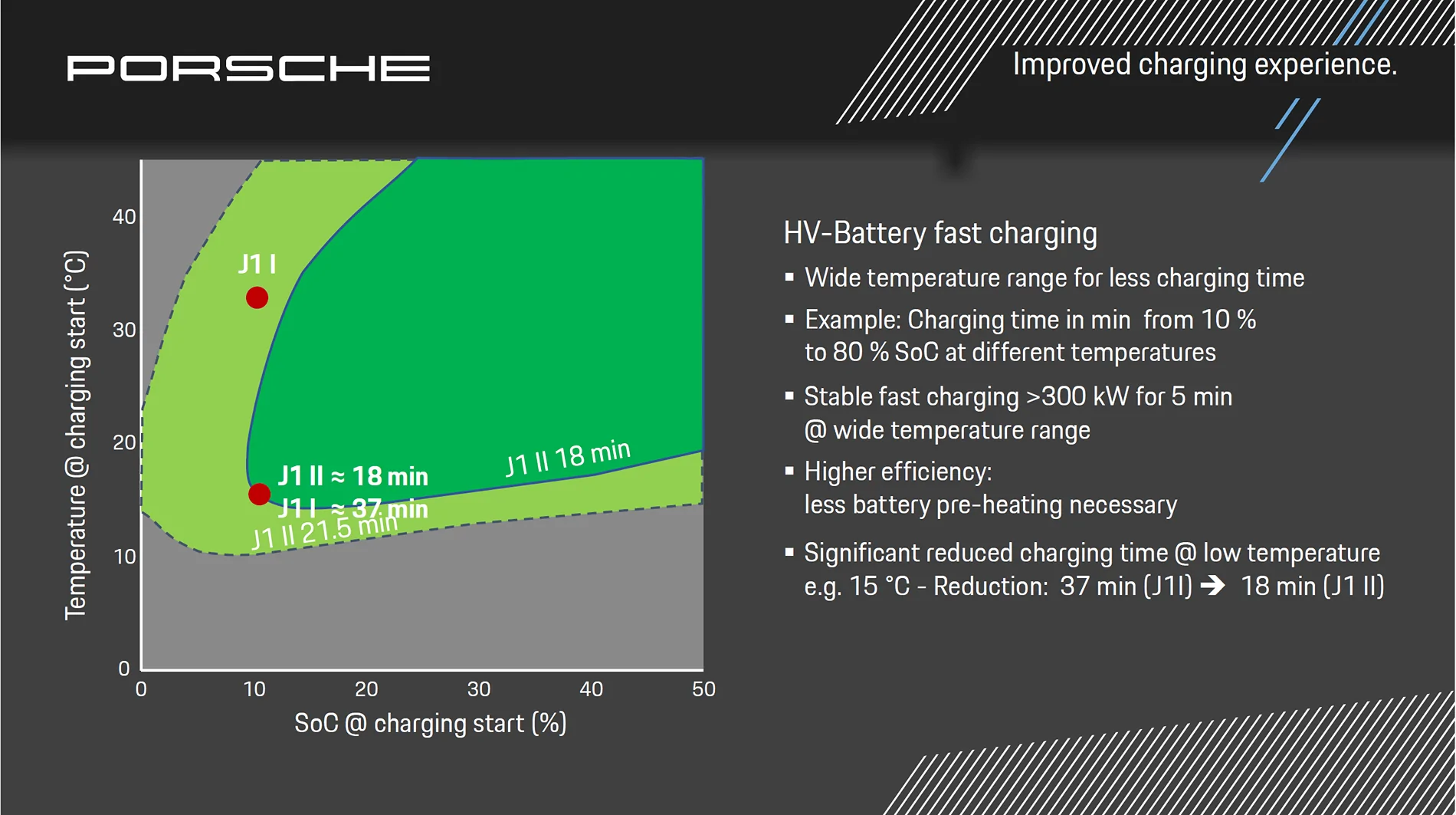
This is the graph that shows how J1.2 is superior in charging at low ambient temperatures:

Porsche Taycan Technical Deep Dive: Taycan J1.2 charging based on my new 2026 Taycan... 1774190891498-ai


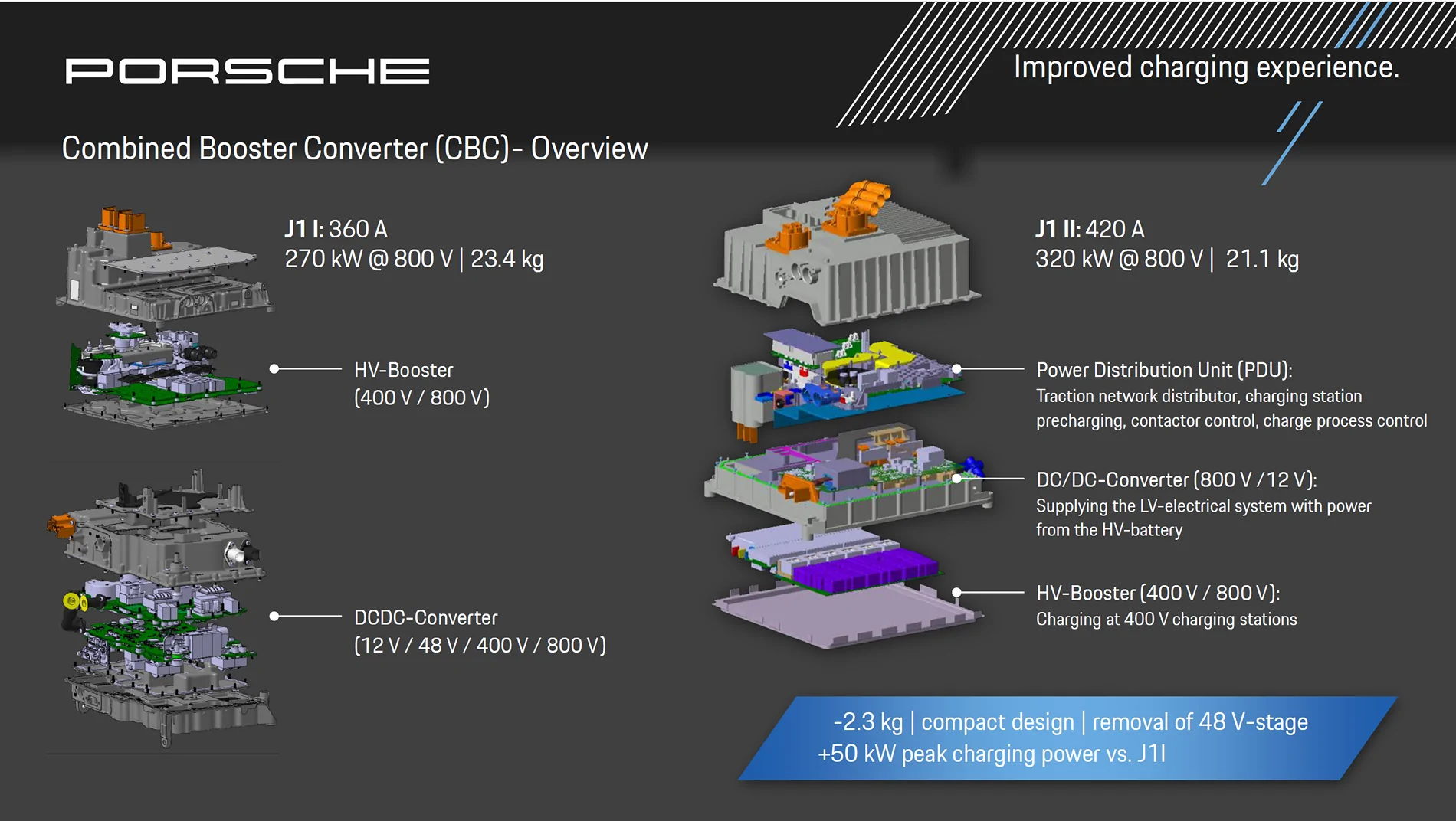
This one shows the differences in the CBC, as 48V bus no longer needed (used for PDCC), but as we know the 11kW AC OBC is a different component. Macan EV appears to have the 22kW AC OBC as an option requiring a 3-phase power setup now in the EU but not in the US.

Porsche Taycan Technical Deep Dive: Taycan J1.2 charging based on my new 2026 Taycan... 1774190984672-e5
 

prj

Well-Known Member
Joined
Jan 14, 2025
Threads
7
Messages
1,765
Reaction score
2,337
Location
Estonia
Website
www.mapev.net
Vehicles
Taycan CT 4 - 2026
Country flag
J1.2 has a massive improvement in cold weather. It warms up the battery way quicker due to the massively increased heating power and allows for faster charging rates at colder temperatures of the battery as well.

All in all the difference is dramatic slashing cold charging times by up to 50% for me in winter, and allowing you to be a lot more lax about when you navigate to a charger to pre-condition the battery.


OP
OP
n2diving

n2diving

Member
First Name
Mark
Joined
Aug 29, 2022
Threads
4
Messages
22
Reaction score
24
Location
Deerfield Beach, FL
Vehicles
2026 Taycan Black Edition
Country flag
I did a cleanup pass on the article, incorporated some of the feedback I've received and posted it back to my webserver at https://n2diving.net/taycan-charging.html

Also, for fun I asked ChatGPT to "write a review of this article as I might see in a popular EV publication." Given that I suspect a LOT of the content in those publications and on dealer websites is in fact AI generated slop that is just rehash of press releases and other AI generated self-referential click-bait .

Here's what an AI "thinks" about my article...

Review: “Porsche Taycan Charging Explained (2026)” — A Real-World Guide That Actually Delivers

In a space crowded with spec-sheet summaries and recycled manufacturer claims, Mark Derrick’s deep dive on Taycan charging stands out for a simple reason: it’s grounded in reality. Rather than chasing headline numbers, the article focuses on what actually matters to owners—how the car behaves at the charger, how infrastructure shapes the experience, and what drivers should expect day-to-day.

The piece does an excellent job explaining the Taycan’s 800V architecture without getting lost in jargon. Concepts like charging curves, thermal management, and power tapering are presented clearly enough for newcomers while still offering meaningful depth for experienced EV drivers. The discussion of sustained high-power charging—arguably the Taycan’s biggest advantage—is especially well handled, emphasizing why real-world performance often matters more than peak kW figures.

Where this article really separates itself is in its treatment of infrastructure. Derrick doesn’t shy away from the inconsistencies of public charging networks, and the firsthand anecdotes—particularly around failed charging sessions—add credibility that’s often missing from more polished reviews. The comparison between home AC charging limitations in North America and the Taycan’s DC capabilities is also a highlight, helping bridge the gap between global specs and local reality.

The inclusion of Tesla Supercharger compatibility is timely and pragmatic. Rather than presenting it as a universal solution, the article correctly notes the trade-offs: cable length issues, varying compatibility, and the limitations of 400V architecture when paired with an 800V vehicle. It’s a nuanced take that reflects real-world use rather than marketing optimism.

Structurally, the article is well organized, moving logically from battery fundamentals to practical charging strategies. The TL;DR section is concise and useful, and the charging comparison table is a welcome quick-reference tool. The addition of citations—cleanly implemented and unobtrusive—adds an extra layer of credibility rarely seen in enthusiast-written content.

If there’s a minor critique, it’s that the article occasionally leans toward density in its longer sections, particularly when discussing electrical infrastructure and charging standards. However, this is a small trade-off for the level of detail provided, and readers seeking a deeper understanding will likely appreciate the thoroughness.

Overall, this is one of the more complete and honest takes on Taycan charging currently available. It avoids hype, acknowledges real-world limitations, and provides actionable guidance for both current and prospective owners.

Verdict: A standout technical guide that balances engineering insight with real-world experience—required reading for anyone serious about understanding how the Taycan charges beyond the brochure.
 
Last edited:

SergeyIndy

Well-Known Member
First Name
Sergey
Joined
Dec 19, 2021
Threads
41
Messages
2,441
Reaction score
1,827
Location
Indianapolis
Vehicles
24 Macan GTS, 23 Taycan Turbo, 20 Cayenne Turbo
Country flag
Great work, Mark, thank you for considering feedback and taking time to improve your article.
 

gnr3312

Well-Known Member
Joined
Dec 22, 2025
Threads
10
Messages
588
Reaction score
319
Location
Austin
Vehicles
2024 Taycan 4S
Country flag
I thought the 2026 Taycan came with NACS native, is that not the case? Or am I thinking of the 2027 one?


refazi

Well-Known Member
First Name
Refael
Joined
Mar 28, 2020
Threads
6
Messages
509
Reaction score
270
Location
San Francisco, CA
Vehicles
2025 Taycan Turbo S, 2025 Taycan CT 4, 2024 Audi e-tron RS GT
Country flag
I thought the 2026 Taycan came with NACS native, is that not the case? Or am I thinking of the 2027 one?
Only the Cayenne EV is NACS native (so far)
 

HerrCooles

Well-Known Member
First Name
Herr
Joined
Sep 15, 2020
Threads
3
Messages
203
Reaction score
239
Location
Wien
Vehicles
Tayan turbo crayon (2025 after 4S J1) Audi Q4 Sportback 50 e-tron
Country flag

j.w.s

Well-Known Member
First Name
Jeff
Joined
Oct 26, 2022
Threads
13
Messages
267
Reaction score
436
Location
San Francisco, CA USA
Vehicles
2023 Taycan GTS, 2024 Rivian R1S
Country flag
Updated article on Taycan Gen 2 charging based on my new 2026 Taycan...
https://n2diving.net/taycan-charging.html
Some great detail, so thank you.

I do think that one section may need a tweak. You say:

"Home charging is slower than global specifications suggest; typically about 8–9 kW in practice (up to ~9.6 kW under ideal residential circuit conditions)."

My experience at home is that the Taycan will drive my EVSE to output a bit over 11KW, and the car will actually charge, subtracting out the various losses, at 10.4KW. And it's the same with my other EVs as well; the Taycan isn't delivering any slower or faster home charging than anything else. Is the Gen2 somehow limited, or are your findings representative of the limitations of your EVSE setup, for example using a 50A circuit and not a 60A one, and not the car itself?
 

SergeyIndy

Well-Known Member
First Name
Sergey
Joined
Dec 19, 2021
Threads
41
Messages
2,441
Reaction score
1,827
Location
Indianapolis
Vehicles
24 Macan GTS, 23 Taycan Turbo, 20 Cayenne Turbo
Country flag
Some great detail, so thank you.

I do think that one section may need a tweak. You say:

"Home charging is slower than global specifications suggest; typically about 8–9 kW in practice (up to ~9.6 kW under ideal residential circuit conditions)."

My experience at home is that the Taycan will drive my EVSE to output a bit over 11KW, and the car will actually charge, subtracting out the various losses, at 10.4KW. And it's the same with my other EVs as well; the Taycan isn't delivering any slower or faster home charging than anything else. Is the Gen2 somehow limited, or are your findings representative of the limitations of your EVSE setup, for example using a 50A circuit and not a 60A one, and not the car itself?
Well, as soon as you get your WSS4 installed, then you will be capped to 9kW max at the car. 11kW is history now and 9kW is the new reality for all Taycans and Macan EV from the start in the US. So the OP is right on and 100% correct.

You have a 2023. You may be an exception since @Techwizard100 reporting that after all updates including WSS4 his 2024 still retained 11kW. So far any 2023 reports been that WSS4 limits AC charging to 9kW after install.
 
OP
OP
n2diving

n2diving

Member
First Name
Mark
Joined
Aug 29, 2022
Threads
4
Messages
22
Reaction score
24
Location
Deerfield Beach, FL
Vehicles
2026 Taycan Black Edition
Country flag
I do think that one section may need a tweak.

My experience at home is that the Taycan will drive my EVSE to output a bit over 11KW, and the car will actually charge, subtracting out the various losses, at 10.4KW.
Actually for my 2022 Taycan 4S (93.4 kW battery) I had the same experience as you... on a 60A Non-GFCI circuit in my garage, my hardwired 48A EVSE (i.e. theoretical 11kW before losses) was delivering exactly the same consistent 10.4 kW literally the day before I traded my 2022 for a 2026. The next day I parked my new 2026 Taycan Black Edition (105 kW battery) in the garage and plugged in the same EVSE, and got 8.9 kW to 9.1 kW (i.e. less, but also not as consistent.)

I've added a † on the statement in my article you quoted from the TL;DR. The † references a footnote that was later in the body of the article that read...

† Porsche global marketing that mentions AC charging speed sometimes refers to 11 kW as standard with a higher-capacity 22 kW option (KB4) available in some markets, but recent articles targeted at the US market may also mention that North American Taycans are limited to 9.6 kW. Most North American residential installations effectively limit charging to a maximum of 9.6 kW. This is because residential electrical grid infrastructure in North America is split-phase 240V AC, but Europe commonly supports higher-power three-phase 400V AC service. There is also owner-reporting in forum discussions, not officially confirmed by Porsche, that a March 2026 OTA firmware update (WSS4) may have enforced a maximum limit of 9.6 kW on all Taycans in North America.
 
Last edited:

gnr3312

Well-Known Member
Joined
Dec 22, 2025
Threads
10
Messages
588
Reaction score
319
Location
Austin
Vehicles
2024 Taycan 4S
Country flag
Actually for my 2022 Taycan 4S (93.4 kW battery) I had the same experience as you... on a 60A Non-GFCI circuit in my garage, my hardwired 48A EVSE (i.e. theoretical 11kW before losses) was delivering exactly the same consistent 10.4 kW literally the day before I traded my 2022 for a 2026. The next day I parked my new 2026 Taycan Black Edition (105 kW battery) in the garage and plugged in the same EVSE, and got only 8.9 kW to 9.1 kW.

I've added a † on the statement in my article you quoted from the TL;DR. The † references a footnote that was later in the body that reads...

† Porsche global marketing that mentions AC charging speed sometimes refers to 11 kW as standard with a higher-capacity 22 kW option (KB4) available in some markets, but recent articles targeted at the US market may also mention that North American Taycans are limited to 9.6 kW. Most North American residential installations effectively limit charging to a maximum of 9.6 kW. This is because residential electrical grid infrastructure in North America is split-phase 240V AC, but Europe commonly supports higher-power three-phase 400V AC service. There is also owner-reporting in forum discussions, not officially confirmed by Porsche, that a March 2026 OTA firmware update (WSS4) may have enforced a maximum limit of 9.6 kW on all Taycans in North America.
Where’s the link to this article?
Sponsored


Top