Sponsored

High speed charging spotted on facelift Taycan

daveo4EV

Well-Known Member
First Name
David
Joined
Jan 28, 2019
Threads
193
Messages
7,028
Reaction score
10,511
Location
Santa Cruz
Vehicles
Cayenne Hybrid, 911(s) GT3/Convertable
Country flag
Does it have to be though? Imagine a quick swap plug at the end of the cable (heck, imagine a NACS connector with permanent MagiDock, only the MagicDock is swapped out when broken) - even with a truck roll that's gotta be way less than $3K a pop.
that could be the case - but so far isn't - at the moment when I talked to EA tech's - when the connector breaks -it's an entire cable swap…I'm not saying it couldn't be better - I'm saying currently it's not

and if it's a quick switch type of thing - just sub-in an NACS connector and no more CCS1 latch problems!!
Sponsored
 

Tooney

Well-Known Member
Joined
Aug 14, 2021
Threads
762
Messages
4,554
Reaction score
3,705
Location
Ohio
Vehicles
2022 Taycan 4S
Country flag
What is the "locking mechanism" in the CCS plug?
When I insert the CCS1 plug into the charging port on the car, there is a click. Pressing tab on the top of the plug allows removal of the plug. Is that the locking mechanism?
Seems mechanical.
Is there some additional electrical function within the plug itself (controlled by the charging dispenser/hardware) that controls that locking mechanism or some other locking mechanism?
 

whitex

Well-Known Member
Joined
Jul 30, 2021
Threads
88
Messages
8,338
Reaction score
7,345
Location
WA, USA
Vehicles
2023 Taycan TCT, 2024 Q8 eTron P+
Country flag
The 2 failed chargers in Auburn, WA had a similar behavior: upon plugging in, the negotiation would go past the authorization/“payment accepted” phase but would not proceed with charging. In my understanding of the protocol, the next step would be that the car initiates the session by asking for “this many Volts, please”. It didn’t happen - the charger would simply wait and then say “reconnecting to vehicle”. The car showed a “charging error” but no details.

After several attempts, I noticed the whirring noise associated with locking the plug was missing from the sequence. Basically the charger didn’t know it was broken. (It failed for me and 2 other drivers, one of which promptly sniped me to the last remaining functional one, just as I was pulling out from the stall. But I digress..)
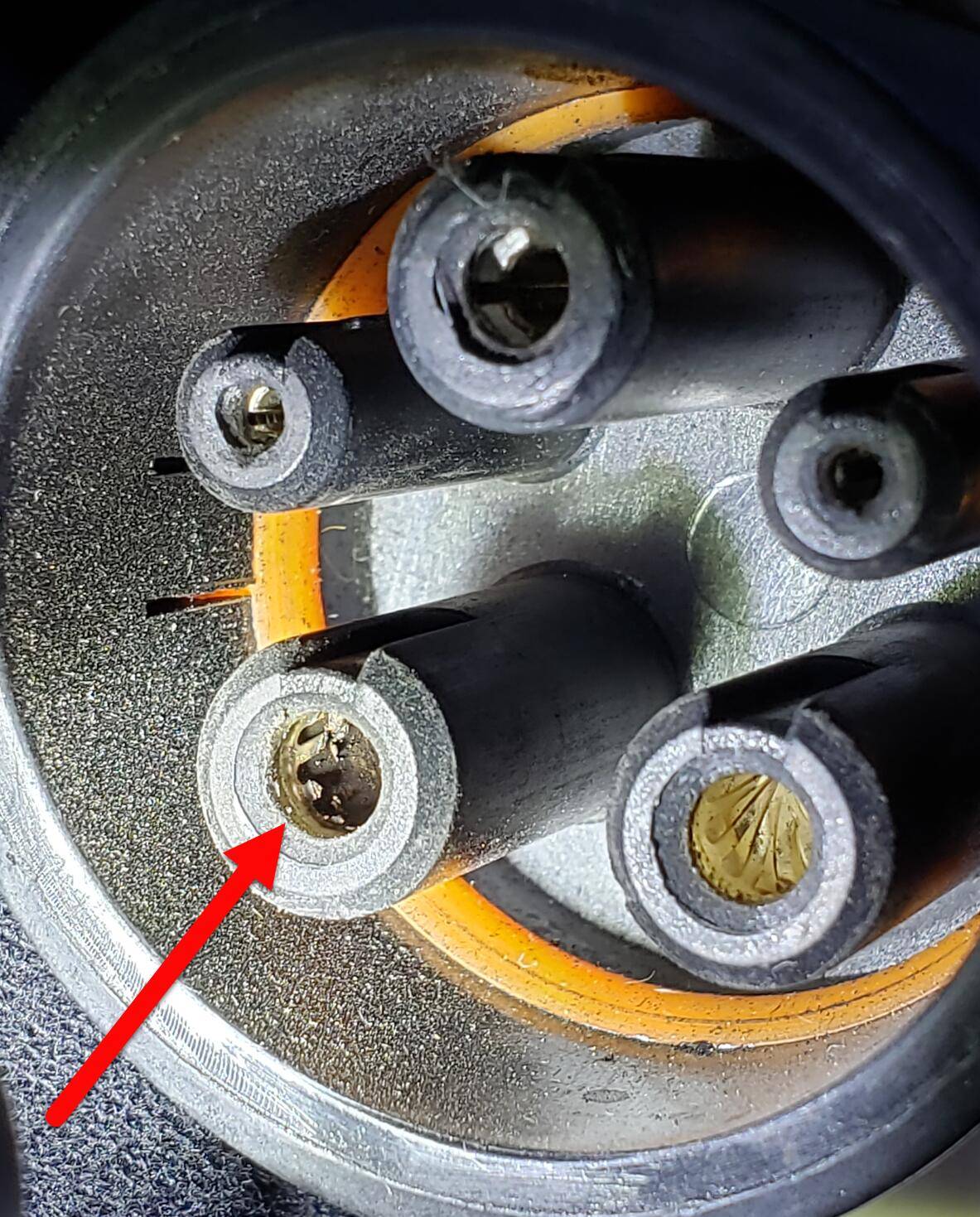
I wish you would have taken some pictures of bad vs. good plug to see whether there was in fact mechanical damage. Personally I suspect it's not the mechanical locking mechanism that gets damaged, but rather that the mechanism can be forced (which is probably easier or harder depending on the car), and when that happens, the pins get damaged. As you know I am a hands on car enthusiast, and I learn from both experimenting on my cars as well as buying used parts off the internet and reverse engineering them. At one point I ended up buying a few used 80A capable J1772 cables (I converted my Tesla HPWC's to J1772, as well as was prototyping my own EVSE). Interestingly out of 5 cables I got, 2 of them had severely burned out pins.
Porsche Taycan High speed charging spotted on facelift Taycan 1696794015215


I strongly suspect this happens when someone is live unplugging the connector. Given that can happen to AC pins which only charge up 80A, imagine what can happen to DC charging pins going at 500A+ when you force unplug them without stopping the charging session.

So my speculation here is that it's not that the plug fails mechanically, as I can imagine it should be possible to make a plug that is practically mechanically indestructible against human strength manipulation, even malicious (might be expensive, but possible and worth while if it saves $3K per week or even month expense). My theory would be forcing the plug out without hitting the button to stop the charging session (which note that for CCS it's a separate button on the car, yet another fail of CCS1) or not waiting after hitting the stop button (it takes a few seconds to stop), damages the current carrying pins. That, IMHO, is what is unfixable about CCS1 - if you can force the plug out in the middle of a session, there is no good way to stop 500A+ in a few milliseconds.

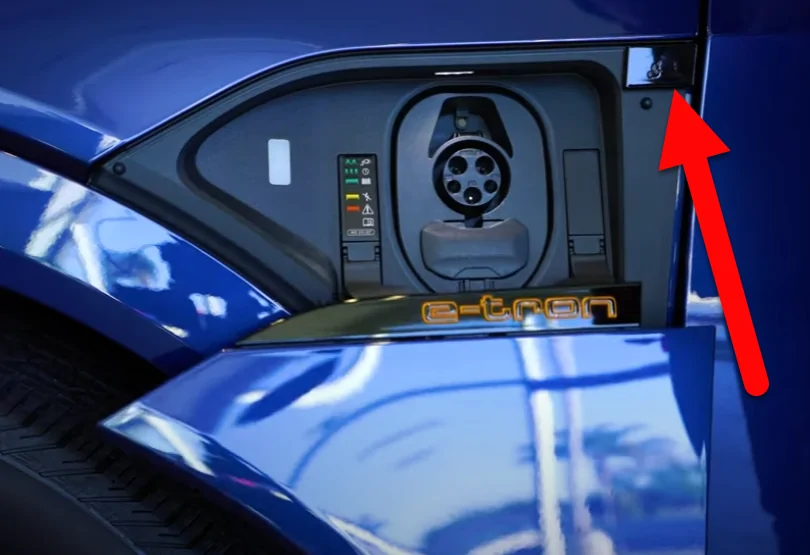
PS> When my wife switched from Tesla to J1772 car, I watched her try to force the J1772 from the car, as it seems intuitive to just press the button on top of the handle and pull (whether you're switching from a Tesla or ICE car). On her car the button is more inconspicuous than on the Taycan - it doesn't light up, and it's nicely camouflaged with the body of the car, same button is used to open/close the port (example below, photo from the internet, faster than running down to the garage to snap actual photo, close enough).

Porsche Taycan High speed charging spotted on facelift Taycan 1696795204325
 
Last edited:

Mr. 2021 Taycan

Well-Known Member
Joined
Feb 1, 2021
Threads
11
Messages
159
Reaction score
194
Location
Florida
Vehicles
2021 Taycan 4S
Country flag
A larger battery suggests that Porsche is still coming up the learning curve. The real breakthrough will be when a new/updated model has a smaller battery. This would mean that they have broken through another weight/performance/efficiency barrier.

I am always generally encouraged by Porsche innovation. Sending them positive vibes on their endeavors…
I agree. I'm keeping my Taycan until they halve the battery weight with the same energy density. That breakthrough will create flexibility in design objectives and lower cost, materially lower vehicle weight, improve performance, and afford more range (as a function of design tradeoffs).

Can't wait!


Jonathan S.

Well-Known Member
First Name
Jonathan
Joined
Jan 19, 2023
Threads
43
Messages
2,130
Reaction score
1,935
Location
Amherst MA & Twin Mtn NH
Website
tinyurl.com
Vehicles
'22 4CT, '22 Audi A6 Allroad, '23 BMW i4 M50
Country flag
Although the CCS1 plug design's inherent vulnerability could explain many EA failures, what about all the stations that have had half their chargers broken right from the very start at the not-so-grand opening? I know of two just from September alone.

And what about all the EA chargers that are derated, whether deliberately or otherwise?

At the opposite extreme, I know of some ancient EVgo 50kW chargers that somehow keep soldiering on, delivering their rated speed (faster than some EA "150" and "350" chargers!) with apparently zero down time from PlugShare reviews.

I definitely don't give EVgo credit for that, since I also know of at least two ancient EVgo 50kW single-charger sites that have been broken for many (many) months, with only seemingly automated responses from EVgo to PlugShare complaints.

Plus EVgo is anything but forthright with press releases like this:
For those in need of a translation:
  1. At the beginning of 2023, EVgo was aware of at least 120 chargers that didn't work at all, some portion of which have since been simply shut down, with some equally unknown portion either actually fixed or replaced.
  2. The majority of new EVgo stations under construction are still undersized at only four (or fewer) chargers.
  3. Some small portion of EVgo chargers have not received any maintenance or even inspection since 2021.
  4. EVgo tracks the average station repair time yet does not reveal the result (instead vaguely claimed to have been halved over the past 12 months).
  5. EVgo tracks the percentage of successful first-try session initiations yet does not reveal the result (although definitely less than EVgo's 95% goal and definitely improved by six percentage points in the first half of 2023 but that could have been from, say, 1% to 7%).
  6. EVgo has created a new "Customer Empathy Program" that ... okay, now I really can't take any more of this!
As for EA, in case anyone is curious about the progress toward the settlement-required $2b in officially termed creditable costs, I created a tally at the link below from EA's annual reports.

Unfortunately, it's not very interesting or insightful!

But not my fault (really!):
  • The creditable costs are reported (at least publicly) on an annual basis, so although three quarters are already finished for 2023, the available documentation covers only through 2022. However, seems like EA will be more than halfway through its required $2b by the end of 2023.
  • The categories are so broad that no meaningful conclusions can be drawn about the ratio of DCFC maintenance to DCFS installation. Moreover, what EV drivers might think of as maintenance could fall under "investments" and not "expenses" for maintenance that takes the form of equipment replacement. And the subcategory of site identification and acquisition is classified as an expense not as an investment.
With those caveats aside, HERE it is anyway!

(And if you're curious about the revenue side, me too! But that does not appear to be public.)
 

whitex

Well-Known Member
Joined
Jul 30, 2021
Threads
88
Messages
8,338
Reaction score
7,345
Location
WA, USA
Vehicles
2023 Taycan TCT, 2024 Q8 eTron P+
Country flag
And what about all the EA chargers that are derated, whether deliberately or otherwise?
Derated units would be consistent with my pin damage theory. Partially damaged/burned pins can still work, just not to full capacity. This derating might happen if DC charger is reporting too high resistance in the connection to the cars.

Next time you come across one, take some pictures of the plug and its pins. It would be interesting to see what damage, if any, such derated or offline chargers have.
 

Jonathan S.

Well-Known Member
First Name
Jonathan
Joined
Jan 19, 2023
Threads
43
Messages
2,130
Reaction score
1,935
Location
Amherst MA & Twin Mtn NH
Website
tinyurl.com
Vehicles
'22 4CT, '22 Audi A6 Allroad, '23 BMW i4 M50
Country flag
^ Ah, interesting, I had thought (mistakenly) that plug functionality was of a binary nature, didn't realize that it could be damaged yet still work, thanks for the clarification. That would also seem to imply that the two cables/plugs on an EA charger could delivery at different speeds if one is damaged (yet still functional to some extent) but the other is undamaged (or at least, less damaged).


Jonathan S.

Well-Known Member
First Name
Jonathan
Joined
Jan 19, 2023
Threads
43
Messages
2,130
Reaction score
1,935
Location
Amherst MA & Twin Mtn NH
Website
tinyurl.com
Vehicles
'22 4CT, '22 Audi A6 Allroad, '23 BMW i4 M50
Country flag
Parking meters are the same and it’s a PITA. Different app for all kinds of different vendors. I hate it.
True, but better than the prior era of trying to find a sufficient quantity & mixture of magical metal trinkets, i.e., coins.
(I went through this the other week when realizing that Manhattan parking did not use any of the various apps I already had installed. Fortunately downloading the app and setting up an account probably took less than a minute. And any anxieties about parking a Taycan on a Manhattan street were eased by the close proximity of a Macan and RS7, so figured other pricey targets might take the brunt of a crime spree.)
 

daveo4EV

Well-Known Member
First Name
David
Joined
Jan 28, 2019
Threads
193
Messages
7,028
Reaction score
10,511
Location
Santa Cruz
Vehicles
Cayenne Hybrid, 911(s) GT3/Convertable
Country flag
I wish you would have taken some pictures of bad vs. good plug to see whether there was in fact mechanical damage. Personally I suspect it's not the mechanical locking mechanism that gets damaged, but rather that the mechanism can be forced (which is probably easier or harder depending on the car), and when that happens, the pins get damaged. As you know I am a hands on car enthusiast, and I learn from both experimenting on my cars as well as buying used parts off the internet and reverse engineering them. At one point I ended up buying a few used 80A capable J1772 cables (I converted my Tesla HPWC's to J1772, as well as was prototyping my own EVSE). Interestingly out of 5 cables I got, 2 of them had severely burned out pins.
1696794015215.png


I strongly suspect this happens when someone is live unplugging the connector. Given that can happen to AC pins which only charge up 80A, imagine what can happen to DC charging pins going at 500A+ when you force unplug them without stopping the charging session.

So my speculation here is that it's not that the plug fails mechanically, as I can imagine it should be possible to make a plug that is practically mechanically indestructible against human strength manipulation, even malicious (might be expensive, but possible and worth while if it saves $3K per week or even month expense). My theory would be forcing the plug out without hitting the button to stop the charging session (which note that for CCS it's a separate button on the car, yet another fail of CCS1) or not waiting after hitting the stop button (it takes a few seconds to stop), damages the current carrying pins. That, IMHO, is what is unfixable about CCS1 - if you can force the plug out in the middle of a session, there is no good way to stop 500A+ in a few milliseconds.

PS> When my wife switched from Tesla to J1772 car, I watched her try to force the J1772 from the car, as it seems intuitive to just press the button on top of the handle and pull (whether you're switching from a Tesla or ICE car). On her car the button is more inconspicuous than on the Taycan - it doesn't light up, and it's nicely camouflaged with the body of the car, same button is used to open/close the port (example below, photo from the internet, faster than running down to the garage to snap actual photo, close enough).

1696795204325.png
I find this write up very plausible along with the physical latch being damaged - there is a whole host of CCS1 design fails…
 

Tooney

Well-Known Member
Joined
Aug 14, 2021
Threads
762
Messages
4,554
Reaction score
3,705
Location
Ohio
Vehicles
2022 Taycan 4S
Country flag
Although the NACS plug is "better design", whether the CCS1 plug is the primary cause of non-Tesla DC charging networks reputed/actual poorer reliability is an open question.

Ford/GM/Hyundai/etc would much rather say we are switching to NACS because:
'it is a better plug design'
than to admit
'unlike the charging network players we originally bet on, our EV competitor Tesla's charging network is the only reliable DC charging game in North America and we will do/say almost anything to get access to that network'.
 

Jonathan S.

Well-Known Member
First Name
Jonathan
Joined
Jan 19, 2023
Threads
43
Messages
2,130
Reaction score
1,935
Location
Amherst MA & Twin Mtn NH
Website
tinyurl.com
Vehicles
'22 4CT, '22 Audi A6 Allroad, '23 BMW i4 M50
Country flag
[...] Is it like Biden's big announcement about making adaptive headlights (not blinding other motorists) finally legal in the USA? It was part of the same spending bill, yet not a single auto manufacturer is offering this technology in USA despite having shipped it worldwide for over a decade, and even having thousands of cars on US roads equipped with the hardware to do it, but which will never be enabled due to government red tape. Government is probably stalled on that too, arguing how to make it perfect. Perfections is the biggest enemy of good enough. Tesla is a good enough example of that.
I was curious what happened with the executive branch implementation of that legislative branch action.
This appears to be the long detailed answer:
https://www.newsweek.com/nhtsa-roadblocking-headlight-technology-that-could-save-lives-1811354
Although your post works well as an executive summary!
 

whitex

Well-Known Member
Joined
Jul 30, 2021
Threads
88
Messages
8,338
Reaction score
7,345
Location
WA, USA
Vehicles
2023 Taycan TCT, 2024 Q8 eTron P+
Country flag
I find this write up very plausible along with the physical latch being damaged - there is a whole host of CCS1 design fails…
My engineering brain is thinking that there should be a way to design a CCS1 compatible plug which would make it practically impossible to force the plug out, unless you rip out the entire charge port from your car - some mechanism to maximize friction which grips all around the plug upon insert, as well as expands inside the pin holes, and disables the mechanical latch from disengaging from the charger side (rather than just from the car side). I would also consider signaling directly from the handle to the charger, rather that just the car, so that if the car doesn't stop charging (e.g. user didn't press their car button), the charge session can still be properly terminated by just detecting the handle button press, even if the car would show it as an error.

Yea, I know it's just adding a bunch of bandaids on top of existing design, but considering the existing install base of CCS1, perhaps a CCS1X plug, compatible with CCS sockets but with mitigations to the known issues, would be a good interim solution - probably cheaper than replacing all plugs with NACS and giving every CCS1 car on the road a free adapter.
 

daveo4EV

Well-Known Member
First Name
David
Joined
Jan 28, 2019
Threads
193
Messages
7,028
Reaction score
10,511
Location
Santa Cruz
Vehicles
Cayenne Hybrid, 911(s) GT3/Convertable
Country flag
probably cheaper than replacing all plugs with NACS and giving every CCS1 car on the road a free adapter.
I'm humbly disagree and respectfully - but your suggestion in the rest of your post are excellent - but I think it's chasing a bad position into a terrible long term situation - honestly I don't see what's wrong with NACS -other than "it's change" - I would suggest any amount of change is about equal cost given that we're going down that road.
 

WasserGKuehlt

Well-Known Member
Joined
Sep 7, 2022
Threads
5
Messages
2,066
Reaction score
2,456
Location
WA
Vehicles
4CT, 996C2, MacanS
Country flag
Although the NACS plug is "better design", whether the CCS1 plug is the primary cause of non-Tesla DC charging networks reputed/actual poorer reliability is an open question.

Ford/GM/Hyundai/etc would much rather say we are switching to NACS because:
'it is a better plug design'
than to admit
'unlike the charging network players we originally bet on, our EV competitor Tesla's charging network is the only reliable DC charging game in North America and we will do/say almost anything to get access to that network'.
Ultimately it doesn't really matter what the reason is; to me, this en masse defection points out to a systemic (==design) flaw, as opposed to some implementation defect. Whether that is the plug or something else, enough manufacturers (who wouldn't make such a change to their designs without considerable due diligence) have decided "this" network is unfixable. Again, I doubt it's software, or the hardware running inside the stations - both would be eminently addressable, and achieve (and retain) increasingly higher reliability levels.
Sponsored


Top