Sponsored

PSCB Brakes

daveo4EV

Well-Known Member
First Name
David
Joined
Jan 28, 2019
Threads
192
Messages
7,003
Reaction score
10,473
Location
Santa Cruz
Vehicles
Cayenne Hybrid, 911(s) GT3/Convertable
Country flag
read this and get back to us

https://www.[Banned Site].com/threads/porsche-taycan-regenerative-braking-explained.845/

Recuperation: recovering high levels of energy
In internal combustion engine vehicles, the kinetic energy present at the brakes is converted into heat during deceleration. With electric vehicles, it is possible to recover a large portion of this kinetic energy, use the electric motors as generators during deceleration, and feed the battery with the power generated.

In the Taycan, Porsche takes its own approach in a number of ways within these parameters:

• The maximum potential recuperation capacity of up to 265 kW is significantly greater than that of most competitors, decelerations of up to 3.8 m/s2 are recuperated.
• When the accelerator pedal is released, the Taycan is designed to always roll or coast as far as possible; the available kinetic energy is reserved for dealing with the driving route.
• Recuperation takes place only when the brake pedal is pressed, but then, as mentioned above, with a very high level of energy recovery.

With the strategy of controlling recuperation mainly via the brake pedal, the customer experiences reproducible and predictable deceleration behaviour which is independent of battery charge and temperature. Testing has shown that, Thanks to the Taycan’s high recuperation output of up to 265 kW, approximately 90 percent of braking operations in everyday use are performed by the electric motors alone, without activating the wheel brakes. For this reason and for the first time ever, Porsche is prescribing a time-dependent replacement interval for the brake pads: they must be replaced every six years.
 
Last edited:

daveo4EV

Well-Known Member
First Name
David
Joined
Jan 28, 2019
Threads
192
Messages
7,003
Reaction score
10,473
Location
Santa Cruz
Vehicles
Cayenne Hybrid, 911(s) GT3/Convertable
Country flag
I guess you misunderstood my meaning........ fly off the offramp at 105 to 45 and very hard on the brakes......... yes, most of the braking force is mechanical. Not regenerative.
I don't know about you guys but I don't generally get off the highway at 105 gently or in 8 seconds........ ?
not even necessary most - 266 kW of recuperation is a LOT of deceleration - 3.8 meters/sec^2 - so if we declare MOST brakeing to be 51% of the total - that means you have to achieve 7.6 meters/sec^2 deceleration - at which point 3.8 meter/sec^2 would be via regeneration and the other 3.8 meter/sec^2 would be via friction brakes - if you're only doing 4.1 meter/sec^2 of deceleration then 3.8 is coming from regeneration, and the remainder of 0.3 meters/sec^2 is coming from friction brakes…

so we have to be careful about most - the friction brakes are blended in only when regeneration will not do the job - so it's rarely "most"
 

daveo4EV

Well-Known Member
First Name
David
Joined
Jan 28, 2019
Threads
192
Messages
7,003
Reaction score
10,473
Location
Santa Cruz
Vehicles
Cayenne Hybrid, 911(s) GT3/Convertable
Country flag
on the Taycan in particular the two systems are "additive" with regen being used "first" and friction being "added" in after you exhaust the abilities of regeneration…

now if the battery is full/cold - there isn't anywhere to put power generated so regeneration is not at it's full 265 kW level of power - in that case MOST braking is handled by the friction brakes because regeneration is not powerful enough to properly slow the car…

but if the battery is 90% or less you have the full 265 kW braking capacity of the Taycan underneath the brake pedal - and all 265 kW will be used _BEFORE_ the friction brakes are invoked…

the Tesla has about 65 kW of regen on accelerator pedal lift off - and the brake pedal is 100% friction brakes

Porsche could do something similar, but a full 265 kW of power on accelerator lift would be too much - so they could for example "hack" their software to the do the following:

40 kw on lift off accelerator
and the remaining 225 kW blended with the brake pedal
Friction brakes only "added" when 265 kW is not up to the task…

it's also interesting to note - Tesla's design is also blended - in that when you touch the brake pedal it doesn't stop the regen - it simply adds the friction brakes into the mix - to slow the vehicle faster

both vehicles have blended braking in that Regen is first and friction is added/blended to decelerate the vehicle

but the user-interface between the two vehicles is vastly different

I think porsche should add one pedal driving as an "option" for "range/normal" mode - sport and sports+ could be as today

it's just software

but it's all regen and the friction brakes are never used unless they are needed - and it turns out with 265 kW of braking power in the regen - friction brakes are rarely needed - even from high speed - it's the amoutn of deceleration requested that dictate the friction brakes - NOT the touching of the brake pedal…
 

daveo4EV

Well-Known Member
First Name
David
Joined
Jan 28, 2019
Threads
192
Messages
7,003
Reaction score
10,473
Location
Santa Cruz
Vehicles
Cayenne Hybrid, 911(s) GT3/Convertable
Country flag
says the guy who believes that brakes should be replaced because of time. OK :)
actually this is porsche recomendation with the taycan in their factory service.


wurzitup

Well-Known Member
First Name
MD
Joined
Aug 28, 2021
Threads
6
Messages
374
Reaction score
362
Location
CA
Vehicles
2022 Taycan
Country flag
not even necessary most - 266 kW of recuperation is a LOT of deceleration - 3.8 meters/sec^2 - so if we declare MOST brakeing to be 51% of the total - that means you have to achieve 7.6 meters/sec^2 deceleration - at which point 3.8 meter/sec^2 would be via regeneration and the other 3.8 meter/sec^2 would be via friction brakes - if you're only doing 4.1 meter/sec^2 of deceleration then 3.8 is coming from regeneration, and the remainder of 0.3 meters/sec^2 is coming from friction brakes…

so we have to be careful about most - the friction brakes are blended in only when regeneration will not do the job - so it's rarely "most"
not even necessary most - 266 kW of recuperation is a LOT of deceleration - 3.8 meters/sec^2 - so if we declare MOST brakeing to be 51% of the total - that means you have to achieve 7.6 meters/sec^2 deceleration - at which point 3.8 meter/sec^2 would be via regeneration and the other 3.8 meter/sec^2 would be via friction brakes - if you're only doing 4.1 meter/sec^2 of deceleration then 3.8 is coming from regeneration, and the remainder of 0.3 meters/sec^2 is coming from friction brakes…

so we have to be careful about most - the friction brakes are blended in only when regeneration will not do the job - so it's rarely "most"
You're not reading what I'm saying......... lol.
At 105, MOST of the braking force is coming from mechanical brakes. A 5100lb Taycan needs over 800hp in braking force to come to a stop within the limits of the tires adhesion capabilites........ rough numbers. If the motors can take care of 265kW of that....... MOST of the remainder is coming from the mechanical brakes. Otherwise you're rear ending the car at the bottom of the off ramp.
 

daveo4EV

Well-Known Member
First Name
David
Joined
Jan 28, 2019
Threads
192
Messages
7,003
Reaction score
10,473
Location
Santa Cruz
Vehicles
Cayenne Hybrid, 911(s) GT3/Convertable
Country flag
OK so what you are saying is that while you are using the traditional 2 pedal function the motors are simulating brake bias and the brakes aren't actually being applied except to compensate in such a minor way? If that is the case, @Jhenson29 I owe you a huge apology for my saltiness and humbly agree that I was talking out of my a**.

Its genius and so traditional like that it never occured to me and I was too busy talking and not enough listening. It just doesn't feel like that at all...Is there a white paper or more detailed explanation on this? I equate this giant calipers and rotors to having a purpose - it never occured to me that they would only be there for 10% of the overall braking function. Now it seems like a great deal of overkill.

mind = blown.
it is a great deal of overkill - which is why Tesla's friction brakes suck - it turns out with effective regen brakes simply are there as "backup" and infrequently used - Tesla's are in the wild with over 300,000 miles and no brake job due to regeneration and light friction brake usage.

sure their brakes suck - but honestly how often are they used? and they work well enough in the cases where they are needed, that maybe one could save some money and not invest in a high demand braking system that will never see high demand…perhaps invest instead in a super efficient drive train to optimize battery range…yeah that's the ticket - we'll be a better EV with crappy brakes that are never used, rather than engineer $30,000 high demand endurance ceramic brake systems for an EV with 265 kW 3.8 m/sec^2 regeneration deceleration that can't run on track for more than 20 min before running out of battery power…

mind blown is a good way to think about it

Taycan handles all deceleration with Regeneration "first" and friction-brakes "second" when needed - it's entirely possible to drive the Taycan around town and NEVER actually use the friction brakes. I do it often…

because of this FACT - Porsche's factory brake service recommendations for Taycan are now time based vs. wear based - no appreciable wear is expected on Taycan brakes systems due to heavy regen.

this is also why I believe PCCB's on a 265 kW 3.8 m/sec^2 regeneration vehicle might be a tad bit of overkill and un-necessary - the brakes on an EV really aren't used that much - mostly there for infrequent high-demand single incident applications - we can't get rid of them, but they are no longer used all that much.
 
Last edited:

daveo4EV

Well-Known Member
First Name
David
Joined
Jan 28, 2019
Threads
192
Messages
7,003
Reaction score
10,473
Location
Santa Cruz
Vehicles
Cayenne Hybrid, 911(s) GT3/Convertable
Country flag
You're not reading what I'm saying......... lol.
At 105, MOST of the braking force is coming from mechanical brakes. A 5100lb Taycan needs over 800hp in braking force to come to a stop within the limits of the tires adhesion capabilites........ rough numbers. If the motors can take care of 265kW of that....... MOST of the remainder is coming from the mechanical brakes. Otherwise you're rear ending the car at the bottom of the off ramp.
still not true - I've stopped from higher speeds and done some "heavy" braking in my taycan that did NOT max out the regen bar - that means NO friction brakes - 265 kW 3.8 m/sec^2 is pretty heavy deceleration - try it out

you'll be suprised how little the friction brakes are actually used - it is also true over the life of the car that 75 mph or less - that 90% or more of braking is entirely handled by regeneration.


wurzitup

Well-Known Member
First Name
MD
Joined
Aug 28, 2021
Threads
6
Messages
374
Reaction score
362
Location
CA
Vehicles
2022 Taycan
Country flag
still not true - I've stopped from higher speeds and done some "heavy" braking in my taycan that did NOT max out the regen bar - that means NO friction brakes - 265 kW 3.8 m/sec^2 is pretty heavy deceleration - try it out

you'll be suprised how little the friction brakes are actually used - it is also true over the life of the car that 75 mph or less - that 90% or more of braking is entirely handled by regeneration.
Sorry dude........ you're wrong.

You might wanna do some reading........ there's a German company by the name of "Bosch" who says so otherwise on their customer facing website advertising the product.

SYSTEM BENEFITS FOR DRIVERS
Deceleration from the regenerative braking system suffices in most cases to slow the vehicle as wanted
Friction brake is seldom fully used, e.g. for very rapid deceleration, at low speeds and when stationary
Noticeable increase in range (electric vehicles)
Reduced fuel consumption and CO2 emissions — particularly in urban traffic situations involving frequent braking and acceleration (hybrid vehicles)

SELDOM FULLY USED. But fully used under RAPID DECELERATION. Like my original point?

And so said the engineers I spoke to at Le Mans when I discussed. The 919 was being largely utilized in braking blending for the development of the Taycan. They said, not me.
And I'm well aware of the regeneration meter on the dash....... I stare at it all the time too just like you do.......

still not true - I've stopped from higher speeds and done some "heavy" braking in my taycan that did NOT max out the regen bar - that means NO friction brakes - 265 kW 3.8 m/sec^2 is pretty heavy deceleration - try it out

you'll be suprised how little the friction brakes are actually used - it is also true over the life of the car that 75 mph or less - that 90% or more of braking is entirely handled by regeneration.
Porsche Taycan PSCB Brakes Screenshot_20220602-225202_Photos-01
 

f1eng

Well-Known Member
First Name
Frank
Joined
Aug 19, 2021
Threads
48
Messages
4,765
Reaction score
8,335
Location
Oxfordshire, UK
Vehicles
Taycan CT4S, Ferrari 355, Merc 500E, Prius PHV
Country flag
now if the battery is full/cold - there isn't anywhere to put power generated so regeneration is not at it's full 265 kW level of power - in that case MOST braking is handled by the friction brakes because regeneration is not powerful enough to properly slow the car…
It may be me jumping to conclusions but I had always assumed at least one of the reasons the “usable” battery capacity was less than the total was to allow some regen braking when fully charged as well as the battery life related side.

Even on our PHEV Prius the braking is blended (ie not as crude as the Tesla system though crude admittedly is being good for simple software and hardware design) and using the dash meter it is possible to see quite a bit of deceleration without the pads touching the discs. On long journeys driving with passenger comfort in mind the discs are hardly used even on this hybrid which has a 6kWh battery.
 

daveo4EV

Well-Known Member
First Name
David
Joined
Jan 28, 2019
Threads
192
Messages
7,003
Reaction score
10,473
Location
Santa Cruz
Vehicles
Cayenne Hybrid, 911(s) GT3/Convertable
Country flag
OK so what you are saying is that while you are using the traditional 2 pedal function the motors are simulating brake bias and the brakes aren't actually being applied except to compensate in such a minor way? If that is the case, @Jhenson29 I owe you a huge apology for my saltiness and humbly agree that I was talking out of my a**.

Its genius and so traditional like that it never occured to me and I was too busy talking and not enough listening. It just doesn't feel like that at all...Is there a white paper or more detailed explanation on this? I equate this giant calipers and rotors to having a purpose - it never occured to me that they would only be there for 10% of the overall braking function. Now it seems like a great deal of overkill.

mind = blown.
smash the brake pedal to the floor in a panic stop from 140 mph adn you're using the friction brakes way more than 10% of the braking - that would be mostly friction braking + regen at the limit of the Tire grip - about 1.2 g's…

but unless you're doing _HEAVY_ braking (enough to cause the seat belt lock to engage) MOST of Taycan's deceleration is via EV motor retardation - regen - with Porsche software controlling the exact "blend" of regeneration and friction

for normal driving - and normal stopping rates - regen is all that you need with the friction brakes only coming in at the "end" for a short time because below 6 mph there just isn't enough energy left to be effective

because of the blended nature of the braking, and the extensive regen capabilities of the Taycan (265 kW or about 3.8 m/sec^2 deceleration according to Porsche) the friction brakes are honestly only there as 'back up' to the regen - which means they are used infrequently - which also means they will not produce a lot of dust since they are mostly never used - and when they are used it's incremental on top of the regen - so less wear…
 
Last edited:

daveo4EV

Well-Known Member
First Name
David
Joined
Jan 28, 2019
Threads
192
Messages
7,003
Reaction score
10,473
Location
Santa Cruz
Vehicles
Cayenne Hybrid, 911(s) GT3/Convertable
Country flag
It may be me jumping to conclusions but I had always assumed at least one of the reasons the “usable” battery capacity was less than the total was to allow some regen braking when fully charged as well as the battery life related side.

Even on our PHEV Prius the braking is blended (ie not as crude as the Tesla system though crude admittedly is being good for simple software and hardware design) and using the dash meter it is possible to see quite a bit of deceleration without the pads touching the discs. On long journeys driving with passenger comfort in mind the discs are hardly used even on this hybrid which has a 6kWh battery.
some is there, but when my Taycan battery is 100% full - regeneration is almost non-existent - and Porsche software reflects this - because the max-regen "bar" (grey scale "meter") is very very short (11:30 o'clock or less) in terms of "max value" - as you drain the battery from 100% you can watch this grey-meter-bar grow on the power meter and gradually give you more and more regen until about 80% where you have full regen - Porsche's blended braking software however keeps the brake pedal feel constant and deceleration rates predictable even when Regen is not possible due to battery capacity/thermals

cold battery yields simliar results (very little regen possible) so friction brakes carry the load...

now when my Tesla has a full battery - lift off the pedal and it behaves like a Taycan (coasting) and it's an oh sh*t moment and you have to go to teh brake pedal - cause the battery is cold and/or full - there is no regen

this is what porsche objects to about one-pedal driving - no consistency - and they are mostly right - the Tesla will roll nearly forever lifting off the accelerator if your battery is nearly full...you must use the brakes…but by the time you've drained 5% of the battery (not hard) you have full regen back and a predictable amount of deceleration back from simply lifting off the accelerator…

regen is a wonderful thing and really really lightens the load on friction brakes -making them mostly a high-demand circumstance backup system, but mostly idle for well over the majority of the time…
 

daveo4EV

Well-Known Member
First Name
David
Joined
Jan 28, 2019
Threads
192
Messages
7,003
Reaction score
10,473
Location
Santa Cruz
Vehicles
Cayenne Hybrid, 911(s) GT3/Convertable
Country flag
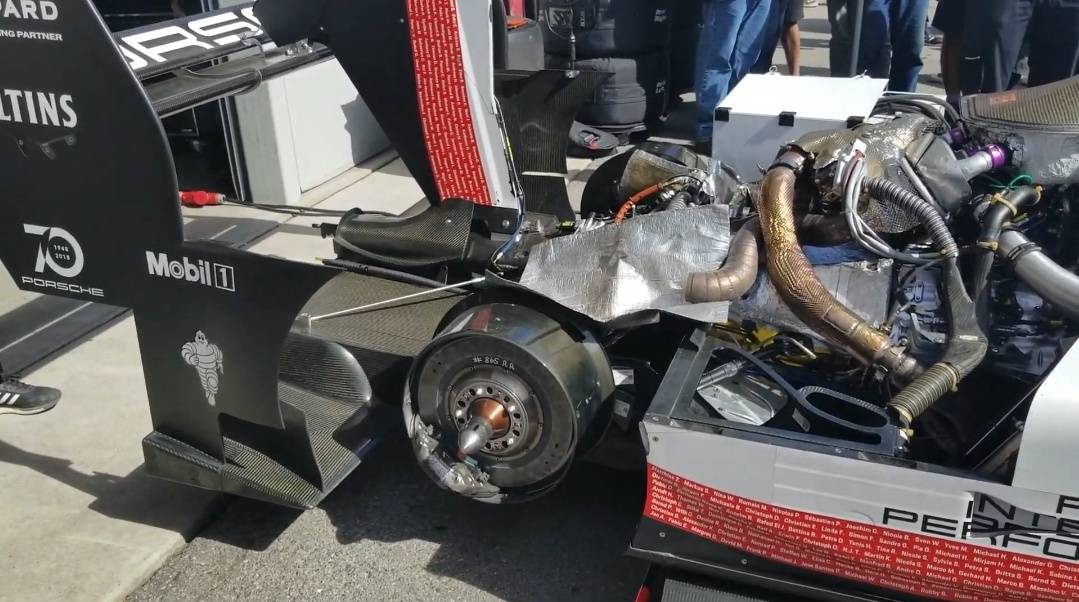
it's interesting (to me at least) to note that the Porsche Mission-R concept vehicle EV race car from Porsche has NO REAR friction brakes - turns out the EV motor on the rear of the vehicle can provide about as much stopping force as rear brakes anyways- and software can do a better job of front to back brake bias management by managing 3 systems
  1. rear bias retardation - EV motor regen only
  2. front bias retardation - regen on tap as necessary
  3. front bias retardation - friction brakes as necessary
but yeah - no rear brakes on Mission-R EV concept race car- not necessary - so no brake dust on those wheels :rock:
 
Last edited:

daveo4EV

Well-Known Member
First Name
David
Joined
Jan 28, 2019
Threads
192
Messages
7,003
Reaction score
10,473
Location
Santa Cruz
Vehicles
Cayenne Hybrid, 911(s) GT3/Convertable
Country flag
porsche's blended braking sofware is brillant and well executed - their goal of consistent brake pedal "feel" and deceleration rates are largely achieved - and honestly as a driver/owner of Taycan none of us "know" the exact mix of regen and friction for any given deceleration - we'd need logs to actually know and we do not have access to such data - the car does the "right thing" to achieve the requested level of deceleration mixing as much regen and friction as necessary and leaving me the drive in control with consistent brake pedal application…

having tracked both the Taycan and a 2018 Model 3 Performance - I 100% understand Porsche's approach and objection to one-pedal driving - with out software to "fill in the blanks" one-pedal driving deceleration rates vary with battery temp/soc/recent power demands - at laguna seca I could achieve very little consistency for when/where to lift off the pedal going into turn 2 (hair pin) making lap to lap to lap a giant guessing game as to how much and when to lift off the accelerator and when/where to apply the brakes - this lack of consistency is abhorrent to any performance oriented brand and flys in the face of Porsche's storied performance/racing experience…
  • the Tesla model 3 performance lacks any predictable consistency in high performance scenarios and there is no way to sufficiently dial back the regen to let me the driver take control to achieve predictable on track behavior
  • the Taycan was a model of predictability and had no issues for this type of application
however for normal street driving one pedal driving is "acceptable" and to a significant number of customers (once they get used to it) desirable - street driving does not have the split-second consistency requirements of performance driving and one pedal driving is more relaxed and consistent enough that it's acceptable…high demand and/or panic stops are handled equally well by both systems - so it's only when one is attempting "lapping" consistency that I feel one-pedal driving as implemented by Tesla is a liability - there is no issue for emergency use cases with the Tesla approach as long as the driver goes to the brake pedal.

Porsche should certainly not force this on us I would object louder and harder than any of you - but it would seem to me an option in range/normal mode for "some" one-pedal driving regeneration would be acceptable (capping it at say 40 or 50 kW - less than Tesla's 65 kW regeneration rates) but more than the weak-sauce we currently have - adding this as a vehicle/driver preference would seem to me to be acceptable - and still allow Porsche to offer the consistency they are going for

it's just software afterall -Porsche could easily add this as an optional setting - and their software should be more than capable of managing this given the sophistication they have already demonstrated…

what's important to me in this conversation is that we all need to realize this is all just an illusion - and a user interface design decision about how/when/why Regen is or is not invoked - the basics are all there - we can have our cake and eat it too - we can make this all configurable in software - because at the end of the day it's just software doing it anyways - it never was mechanical, and hasn't been for at least the past 8-10 years…

who would really object to 40-50 kW of lift-off regen (engine braking) as an optional setting (off by default) and restricted to range/normal driving modes (not sports or sports+) - I think Porsche could do it - and I think their EV's would be better for it - and then it would no longer be a religous conversation - it would be a personal preference conversation - which in my mind is as it should be.
 
Last edited:

bsclywilly

Well-Known Member
Joined
Aug 13, 2021
Threads
26
Messages
711
Reaction score
1,182
Location
San Jose
Vehicles
CT4
Country flag
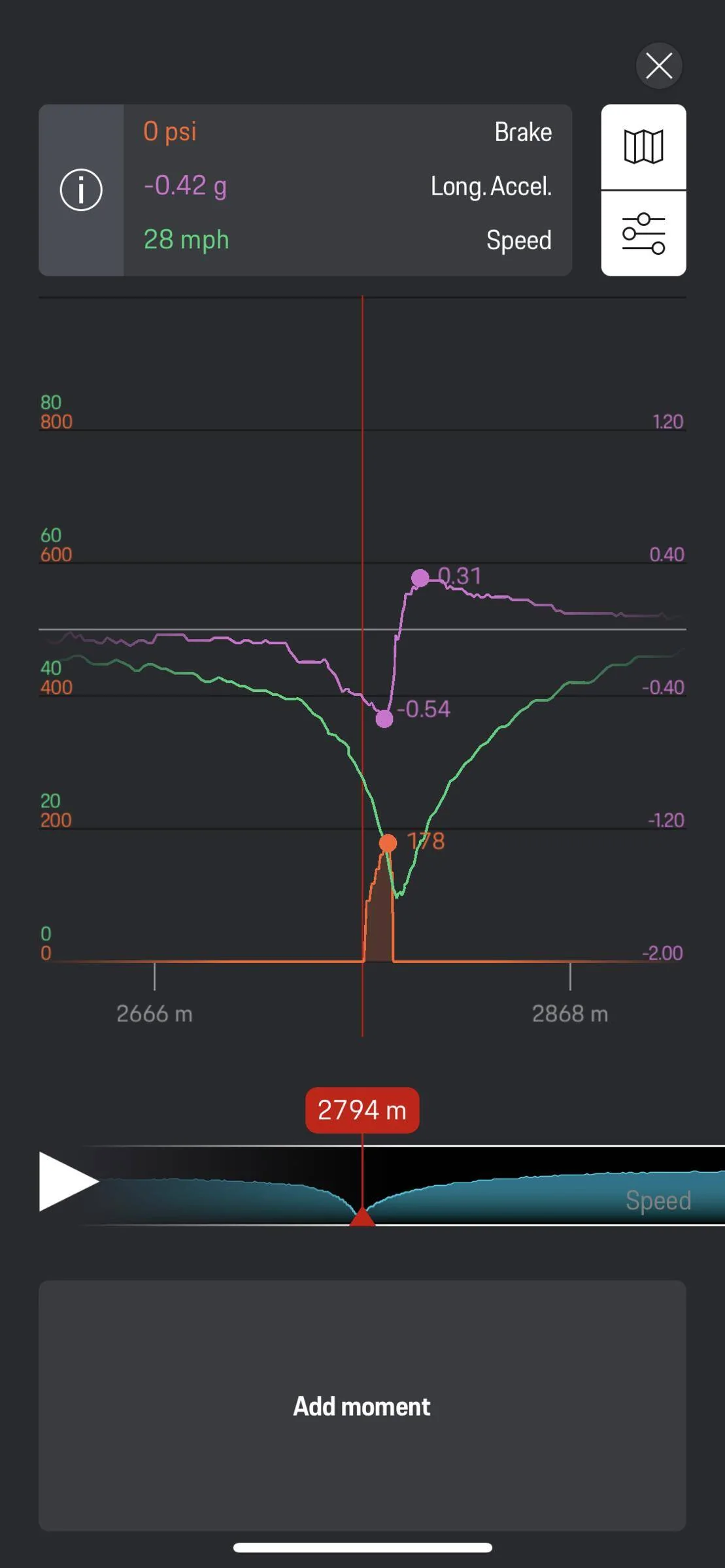
Here’s a braking event for a stop sign. Indeed the regen is responsible for 100% of deceleration up to about .42g (this is pretty close to the .38g they publish, with the difference accounted for by elevation, rolling resistance, and aero drag). Can’t even feel when the friction brakes get blended in.

Porsche Taycan PSCB Brakes BC48C197-88C8-4E74-9A35-5291BEA1559F
Sponsored

 
Last edited:


Top