
Sponsored
🔋 Baseline for HV Battery SoH Performance (Battery Degradation Data by Taycan Owners)

PrimaBB
Member
- First Name
- Martijn
- Joined
- Sep 18, 2025
- Threads
- 0
- Messages
- 15
- Reaction score
- 6
- Location
- The Netherlands
- Vehicles
- Taycan 4S Cross Turismo 2024 (J1.1)

It’s a J1.1 but still off then.If you have a J1.2 then it does not show correctly.

prj
Well-Known Member
- Joined
- Jan 14, 2025
- Threads
- 7
- Messages
- 1,766
- Reaction score
- 2,346
- Location
- Estonia
- Website
- www.mapev.net
- Vehicles
- Taycan CT 4 - 2026

Then I would start to get really worried.It’s a J1.1 but still off then.
PrimaBB
Member
- First Name
- Martijn
- Joined
- Sep 18, 2025
- Threads
- 0
- Messages
- 15
- Reaction score
- 6
- Location
- The Netherlands
- Vehicles
- Taycan 4S Cross Turismo 2024 (J1.1)
Since my daily range seems pretty ok to me I think my regular SoC levels confuses the BMS giving the weird SoH values. Is that even possible?
I don’t know the charging behavior of the previous owner, but I keep my HV battery levels between 20-60% most of the time.
Never have fast charged yet myself and only charged to max 80%.
A few weeks ago I tried to rebalance the BMS.
I uncharged to around 10%. Kept this state overnight and charged to 100% the next day. Left the car for about 8 hours again.
I was expecting a few km range extra but from what I can recall there was no effect on max range after rebalancing.
Unfortunately I did not looked up the OBD2 values by then.
Maybe the deep uncharge level not low enough for proper rebalancing. Don’t know.
I don’t know the charging behavior of the previous owner, but I keep my HV battery levels between 20-60% most of the time.
Never have fast charged yet myself and only charged to max 80%.
A few weeks ago I tried to rebalance the BMS.
I uncharged to around 10%. Kept this state overnight and charged to 100% the next day. Left the car for about 8 hours again.
I was expecting a few km range extra but from what I can recall there was no effect on max range after rebalancing.
Unfortunately I did not looked up the OBD2 values by then.
Maybe the deep uncharge level not low enough for proper rebalancing. Don’t know.
gtm
Well-Known Member
- First Name
- George
- Joined
- Nov 5, 2022
- Threads
- 6
- Messages
- 683
- Reaction score
- 882
- Location
- Jacksonville, FL
- Vehicles
- '26 S e-tron GT, '73 Lotus, ('23 GTS sold 10/25)

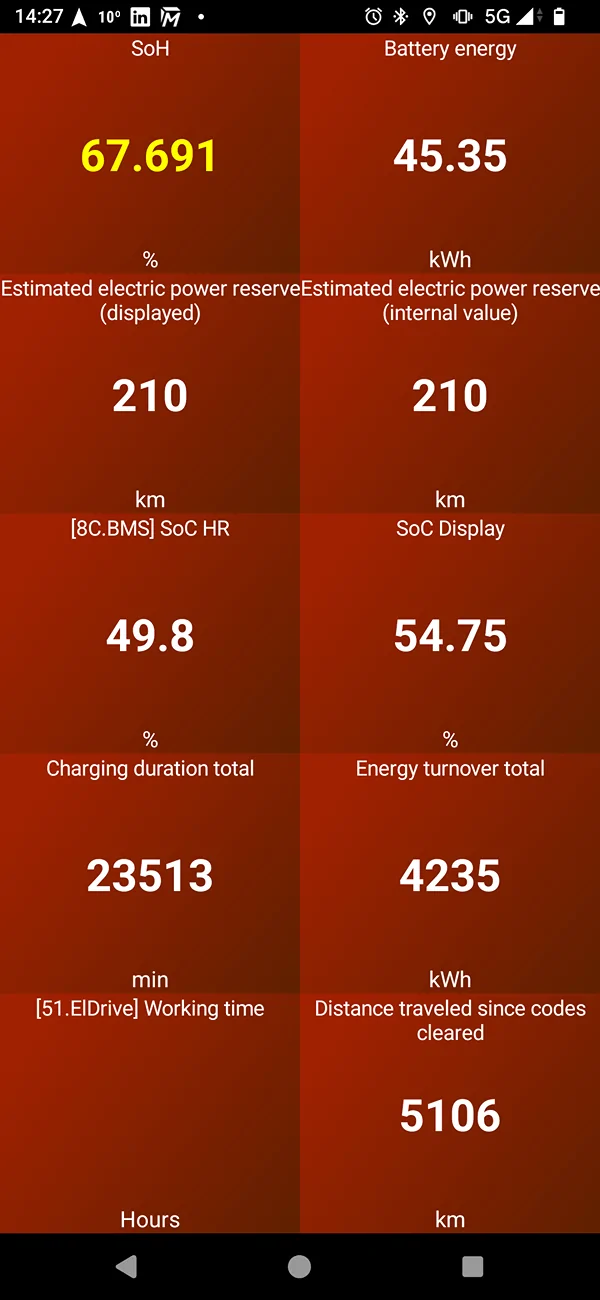
Something is wrong with your SoH reading if the other numbers are correct. 45.35 kWh battery energy at 54.75% SoC yields 82.3 kWh available at 100% SoC. Just under 5% degradation (based on 86.7 kWh available at 100% SoH). 210 km range at 54.75% SoC yields 383 km at 100% SoC. Not spectacular range but certainly in the normal range. Is it possible a new J1.2 battery was installed rather than just replacing a few modules? As @prj wrote the data is incorrect for the J1.2 cars.Got my Taycan CS 4S by end of September this year with 22K km. Now I’m at 27400 km.
I know there were cell modules replaced.
Today I connected my ODB2 dongle to get current SoH. That was quite surprising.

My GOM since I got the Taycan never worried me much but that SoH seems too low even for a non calibrated BMS.
I ride EVs since 2017 but I never seen a SoH under 93%
PrimaBB
Member
- First Name
- Martijn
- Joined
- Sep 18, 2025
- Threads
- 0
- Messages
- 15
- Reaction score
- 6
- Location
- The Netherlands
- Vehicles
- Taycan 4S Cross Turismo 2024 (J1.1)
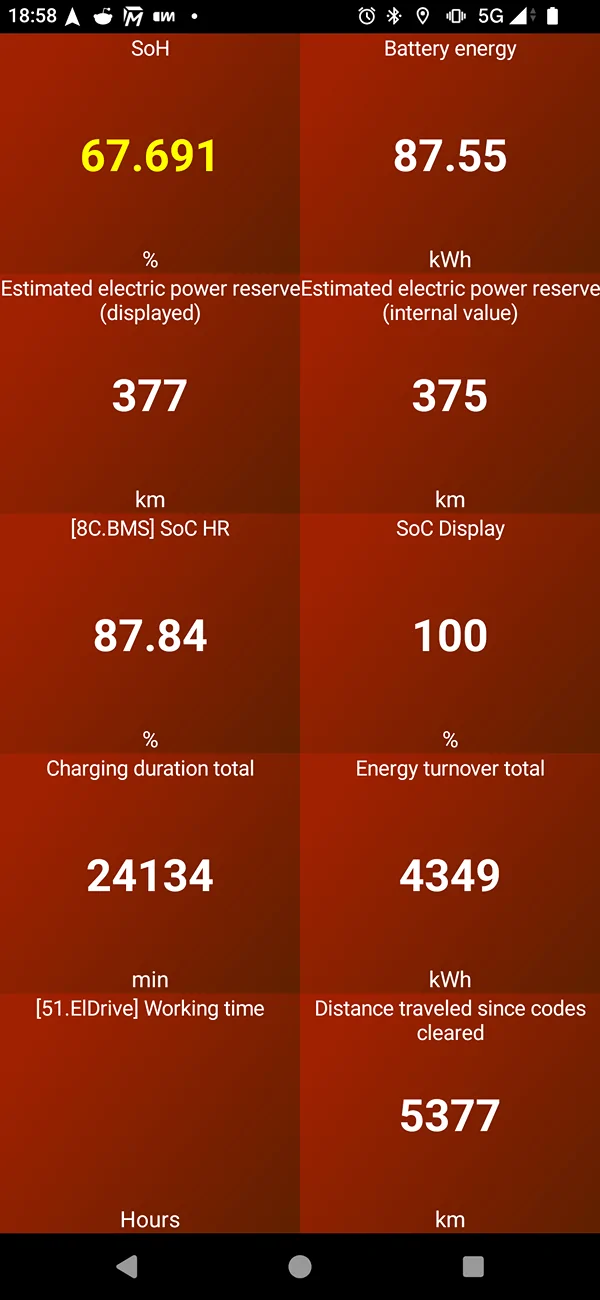
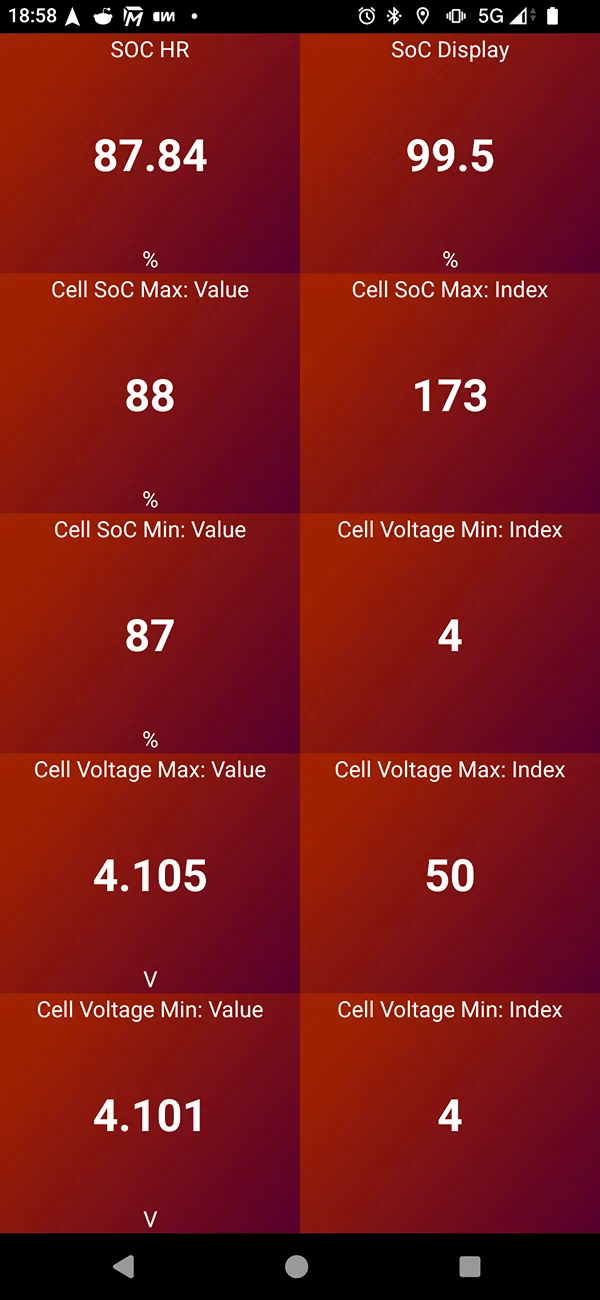
After driving the HV battery to 8% and leaving it overnight today I charged the Taycan to 100%.
Again looking at the numbers I noticed that the cell voltage delta is okish (4mV) but the cell voltages seem to hover on 4.1V. I was expecting something around 4.2V at 100% SoC.
The battery energy is 87.55kWh at 100%. Is this the usable capacity value? That seems a bit higher than the usable capacity of 83.7kWh belonging to the gross capacity of 93.4 kWh (Performance Plus battery).
The range corresponds with my driving behavior of mostly highway on winter wheels.
The SoH still is kind of broken at 67.69%.
Also the SoC HR value of 87.84 looks a bit weird.
I will leave the Taycan parked for the night and will check for new numbers tomorrow morning.
Last edited:
Dee
Well-Known Member
- First Name
- Dee
- Joined
- Dec 14, 2018
- Threads
- 78
- Messages
- 3,508
- Reaction score
- 4,050
- Location
- The Netherlands
- Vehicles
- A lot
You have to look at the diagram which displays all the cells, like this:
After driving the HV battery to 8% and leaving it overnight today I charged the Taycan to 100%.
Again looking at the numbers I noticed that the cell voltage delta is okish (4mV) but the cell voltages seem to hover on 4.1V. I was expecting something around 4.2V at 100% SoC.
The battery energy is 87.55kWh at 100%. Is this the usable capacity value? That seems a bit higher than the usable capacity of 83.7kWh belonging to the gross capacity of 93.4 kWh (Performance Plus battery).
The range corresponds with my driving behavior of mostly highway on winter wheels.
The SoH still is kind of broken at 67.69%.
Also the SoC HR value of 87.84 looks a bit weird.
I will leave the Taycan parked for the night and will check for new numbers tomorrow morning.
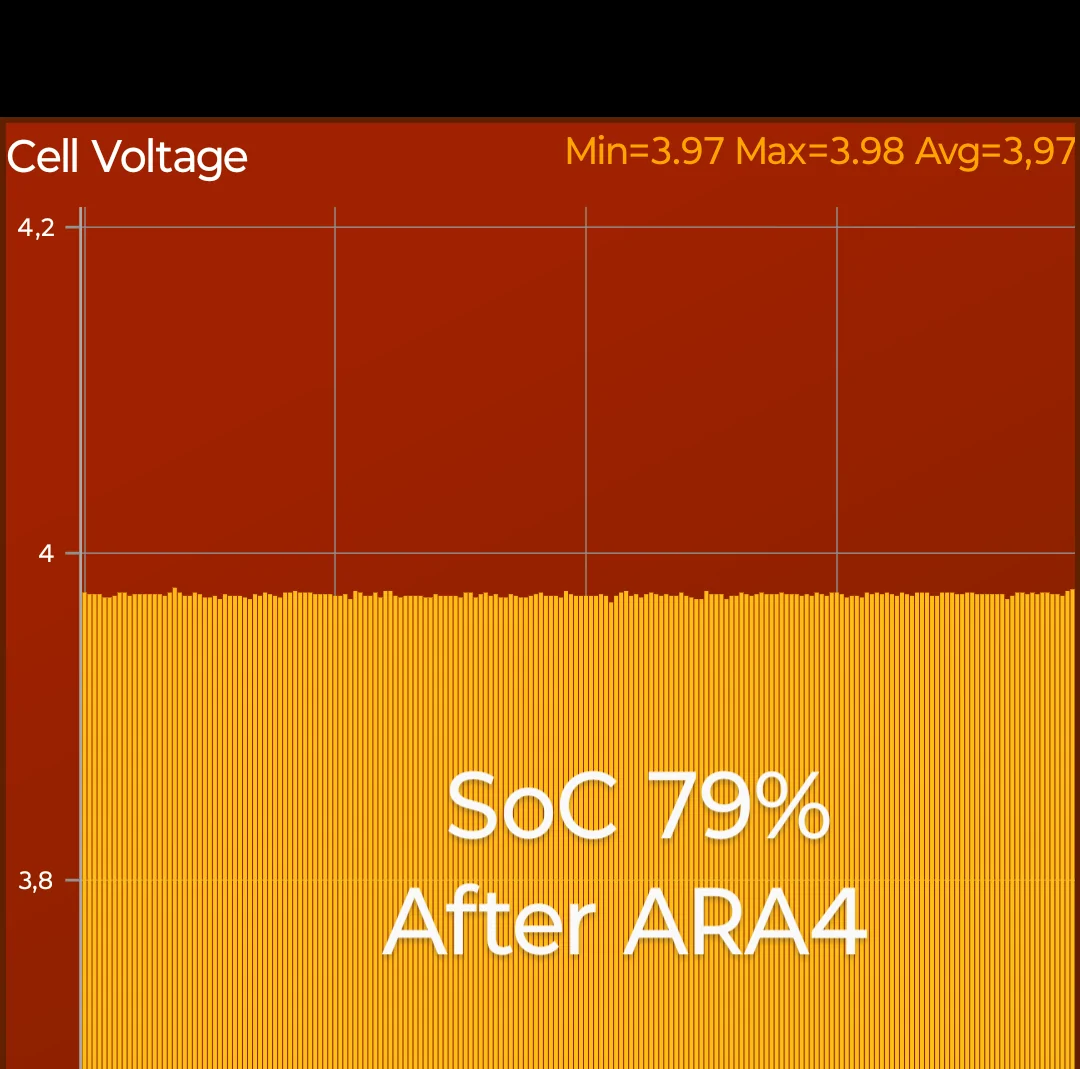
Here you can see all the cells are within a certain threshold.
I'm curious about yours cuz your SoH looks WAY off....
PrimaBB
Member
- First Name
- Martijn
- Joined
- Sep 18, 2025
- Threads
- 0
- Messages
- 15
- Reaction score
- 6
- Location
- The Netherlands
- Vehicles
- Taycan 4S Cross Turismo 2024 (J1.1)
Dee
Well-Known Member
- First Name
- Dee
- Joined
- Dec 14, 2018
- Threads
- 78
- Messages
- 3,508
- Reaction score
- 4,050
- Location
- The Netherlands
- Vehicles
- A lot
It shouldn't be that big of a difference at 100% SoC though.
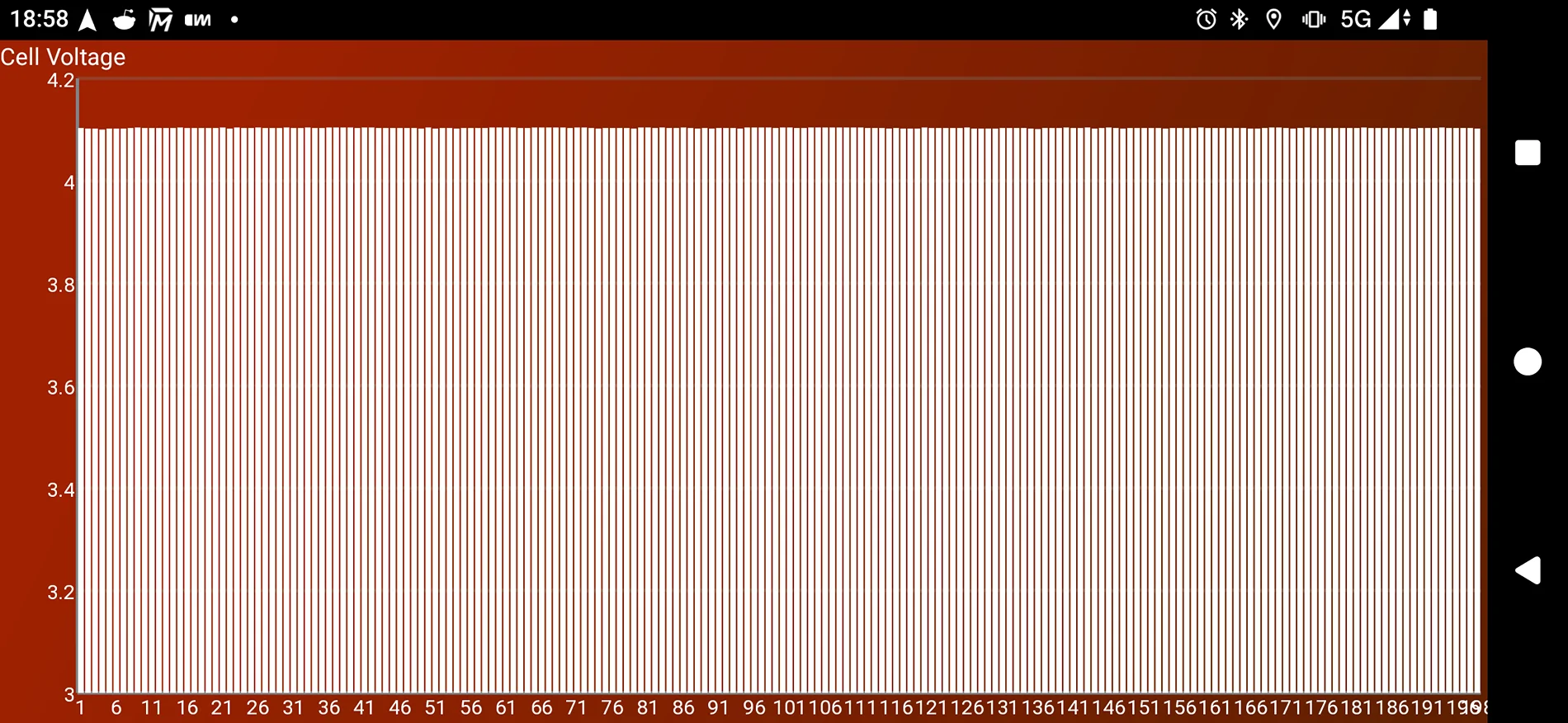
Quite balanced I think.
Cell voltage between 4.101V and 4.105V. So delta of 4mV.
Maybe balancing overnight closes the gap a bit. We shall see
@Dee Yours has a smaller (better) delta of 1mV but with lower voltage because of lower SoC.
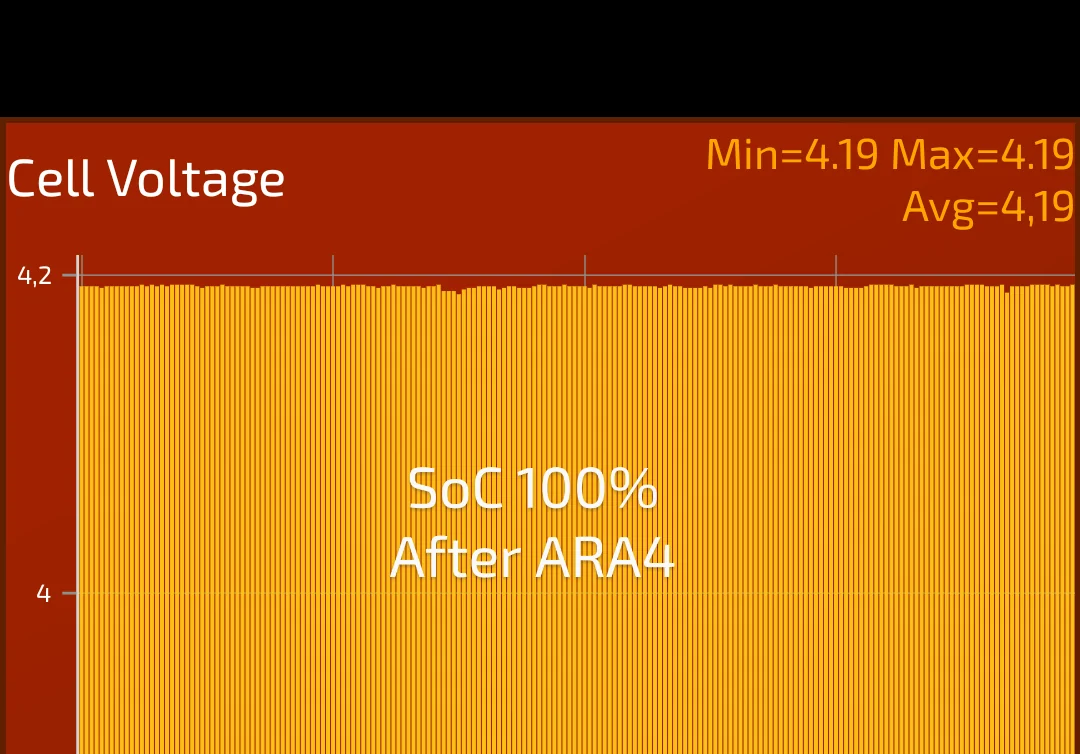
It's also weird that it is only 4,10x V instead of 4,200V (max).
Maybe that's what the problem is.
It looks like one or more bad cells are preventing to charge to 4,200 V and keep the rest of the cells at that particular 4,100V cuz the BMS is protecting against the overcharging.
This is mine at 100% SoH:
I'm curious what your diagram will look like at low SoC, like 20-30%.
If there is any imbalance it should be clearly visible at a lower SoC, not at 100% if you know what I mean.
I had only one module replaced and it's pretty clear which one:
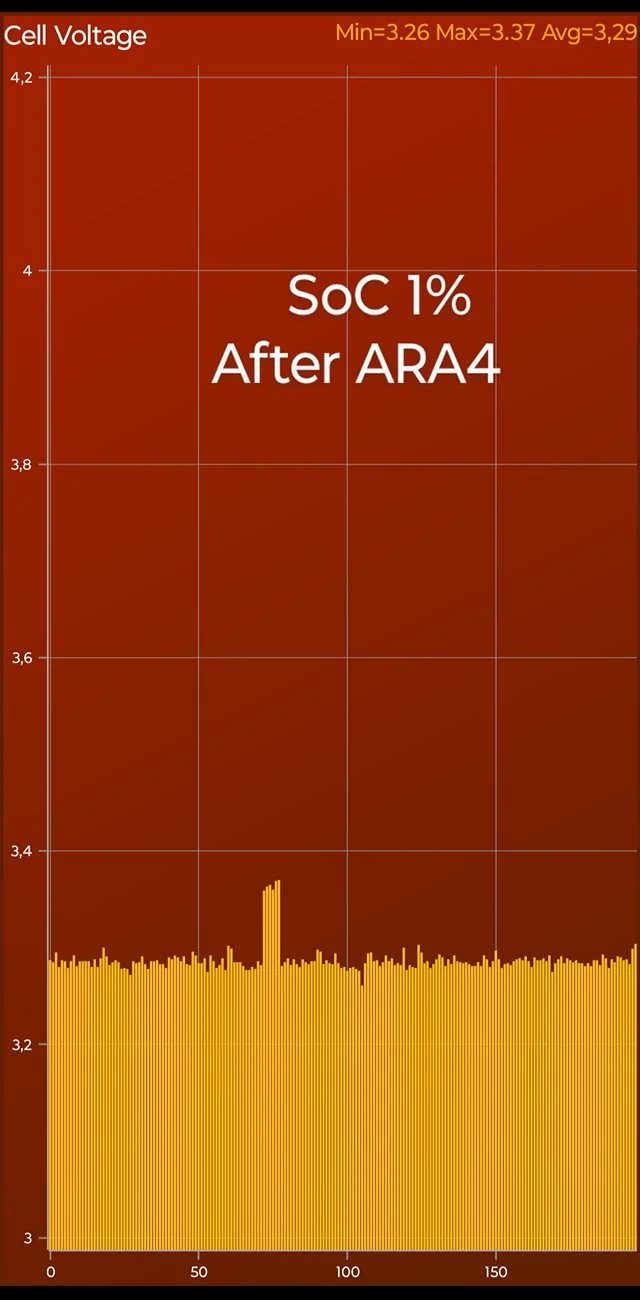
Still, the whole battery is very healthy now.
Last edited:
PrimaBB
Member
- First Name
- Martijn
- Joined
- Sep 18, 2025
- Threads
- 0
- Messages
- 15
- Reaction score
- 6
- Location
- The Netherlands
- Vehicles
- Taycan 4S Cross Turismo 2024 (J1.1)
Thanks for your detailed reply.It shouldn't be that big of a difference at 100% SoC though.
It's also weird that it is only 4,10x V instead of 4,200V (max).
Maybe that's what the problem is.
It looks like one or more bad cells are preventing to charge to 4,200 V and keep the rest of the cells at that particular 4,100V cuz the BMS is protecting against the overcharging.
This is mine at 100% SoH:
...
I'm curious what your diagram will look like at low SoC, like 20-30%.
If there is any imbalance it should be clearly visible at a lower SoC, not at 100% if you know what I mean.
I had only one module replaced and it's pretty clear which one:
...
Still, the whole battery is very healthy now.
This morning no movement in the SoH. Still showing the off value.
GOM was at 380km at around 100% now.
I think you're right with that my HV battery max 4.1V at 100%Soc is not normal at all. I had already noticed that low voltage maximum.
It sounds logical that at a high SoC the voltages are balanced at a max and that at a lower SoC the deviations are more visible.
I will look again at a lower SoC for abnormal cell voltages.
Johann55
Active Member
If you had battery modules replaced, their cell voltage will clearly stand out on the graph at lower SOC.I will look again at a lower SoC for abnormal cell voltages.
You should also use the ECU Identifiers menu in Car Scanner - it shows the hardware version and production date of the BMS module (008C Battery Management System). What values do you see there?
All facelift Taycans show SOH around 66-67% in CarScanner. Your 67.691% SOH might suggest this car probably received the entire new battery, maybe with a new BMS (or new BMS software).
https://www.taycanforum.com/forum/t...-and-diagnose-taycan.12052/page-3#post-348170
https://www.taycanforum.com/forum/threads/obd-ii-data-state-of-health.25572/
PrimaBB
Member
- First Name
- Martijn
- Joined
- Sep 18, 2025
- Threads
- 0
- Messages
- 15
- Reaction score
- 6
- Location
- The Netherlands
- Vehicles
- Taycan 4S Cross Turismo 2024 (J1.1)
The ECU ids of my BMS (008C) show that this module is replaced or updated end of april 2025.If you had battery modules replaced, their cell voltage will clearly stand out on the graph at lower SOC.
You should also use the ECU Identifiers menu in Car Scanner - it shows the hardware version and production date of the BMS module (008C Battery Management System). What values do you see there?
All facelift Taycans show SOH around 66-67% in CarScanner. Your 67.691% SOH might suggest this car probably received the entire new battery, maybe with a new BMS (or new BMS software).
...
Porsche did not tell me in detail what was replaced exactly when I bought the Taycan. I only was told that 'a few cell modules of the HV battery were replaced'.
This BMS ECU data below however tells me that also the BMS module itself was involved in the update/replacement:
VAG Part number: 9J1915185R
Software version: 0520
Hardware Part number: 9J1915231E
System supplier ECU hardware number: BCUe
System supplier ECU hardware version: 06.01
System supplier ECU software number: P2309_PAG_J1PA_BCU_BCU_APPL_
System supplier ECU software version: 50.03.03
System designation: AA0520A
ASAM/ODX: EV_BECM1982091
Hardware version: H11
ASAM/ODX version: 106106
ECU manufacturing date (HEX): 250409
This 'updated' BMS could indeed be the reason that Car Scanner cannot deal with the OBD2 output and interprets the SoH value completely wrong (still a value of 67.691%).
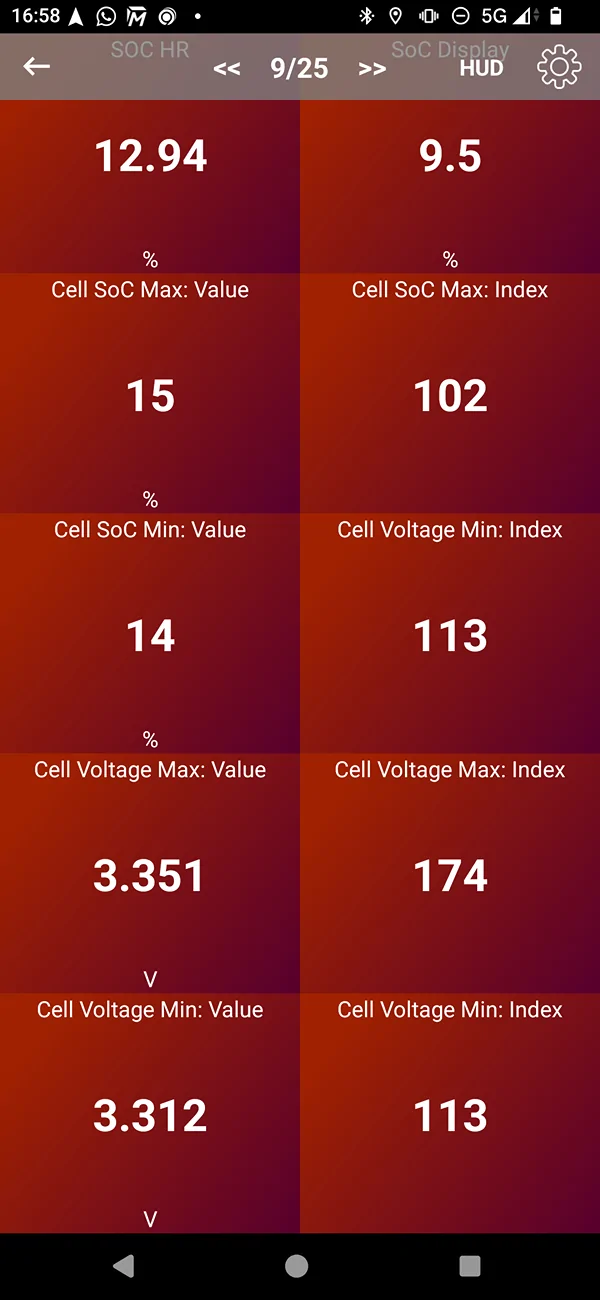
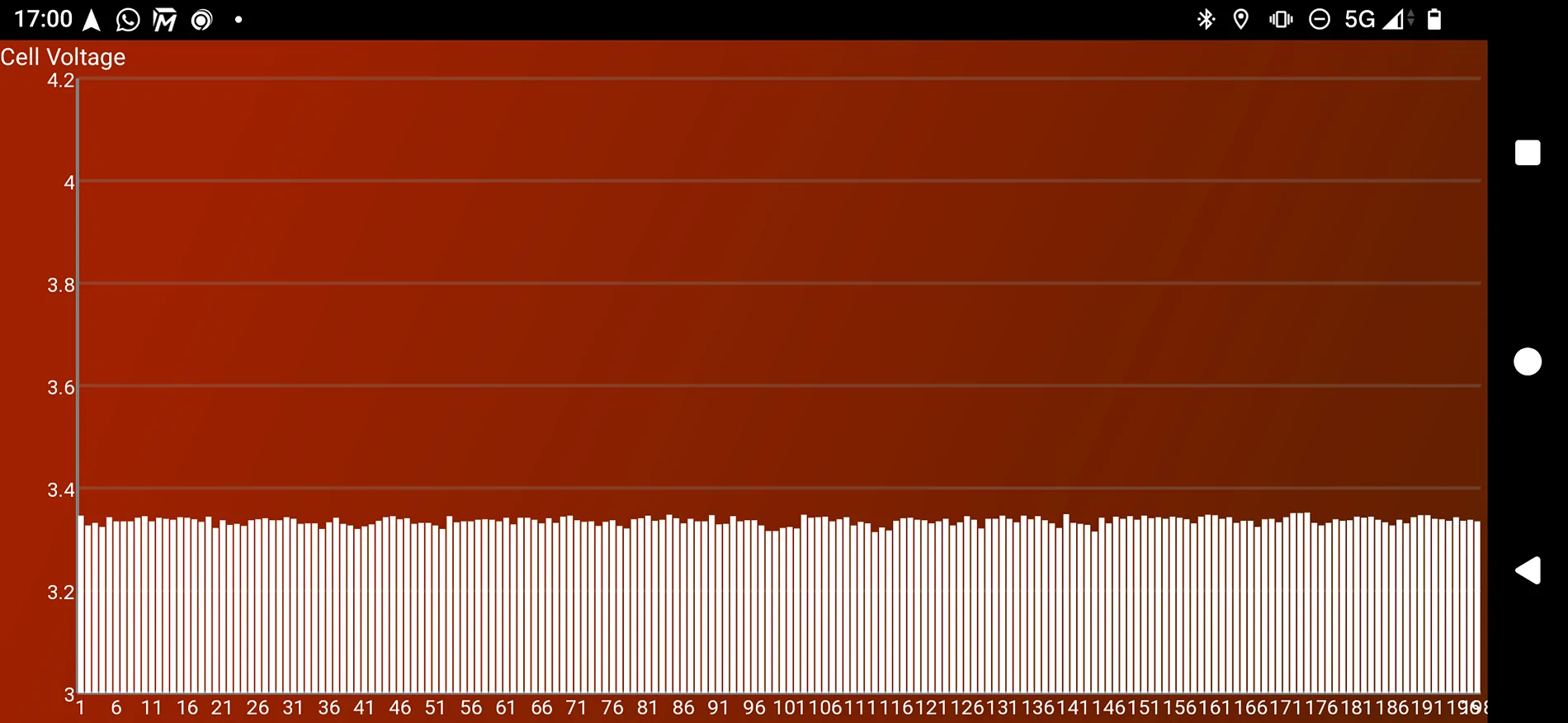
When I look at the Voltage cell differences on lower SoC levels there there are no notable outliers visible.
The numbers below are captured right after a longer drive. So a bit off balance with a cell difference of 39mV which is acceptable in my opinion.
SergeyIndy
Well-Known Member
- First Name
- Sergey
- Joined
- Dec 19, 2021
- Threads
- 41
- Messages
- 2,445
- Reaction score
- 1,831
- Location
- Indianapolis
- Vehicles
- 24 Macan GTS, 23 Taycan Turbo, 20 Cayenne Turbo
70% SoH is the minimum acceptable before battery replacement under warranty is triggered.Got my Taycan CS 4S by end of September this year with 22K km. Now I’m at 27400 km.
I know there were cell modules replaced.
Today I connected my ODB2 dongle to get current SoH. That was quite surprising.
My GOM since I got the Taycan never worried me much but that SoH seems too low even for a non calibrated BMS.
I ride EVs since 2017 but I never seen a SoH under 93%
There is actually even an earlier threashold at least in the US for 37.5k miles and minimum acceptable SoH, but 67% SoH is an indicator of some bad cells.

chun
Well-Known Member
- Joined
- Feb 4, 2024
- Threads
- 27
- Messages
- 2,358
- Reaction score
- 2,120
- Location
- Switzerland
- Vehicles
- Taycan Turbo 2020, Cayman GT4

Just to clarify, if your SOH drops to 70%/Below; they will replace the minimum amount of modules to bring it just above that, so say replace 1 module to bring it to 73% SOH, and then you're good to go - it does not mean a full battery replacement.70% SoH is the minimum acceptable before battery replacement under warranty is triggered.
There is actually even an earlier threashold at least in the US for 37.5k miles and minimum acceptable SoH, but 67% SoH is an indicator of some bad cells.
It's a very important and critical detail that Porsche intentionally omits and is hardly ever mentioned, since it's unlikely for most people to reach that SoH any time soon.
chun
Well-Known Member
- Joined
- Feb 4, 2024
- Threads
- 27
- Messages
- 2,358
- Reaction score
- 2,120
- Location
- Switzerland
- Vehicles
- Taycan Turbo 2020, Cayman GT4
This looks like the reading from a j1.2 - which has a newer BMS that no app currently reads data off correctly.
So likely you have a newer BMS part in your j1.1
Sponsored


