Sponsored

Why US drivers may be thinking about EVs all wrong.... BBC article....

whitex

Well-Known Member
Joined
Jul 30, 2021
Threads
87
Messages
8,211
Reaction score
7,248
Location
WA, USA
Vehicles
2023 Taycan TCT, 2024 Q8 eTron P+
Country flag
I know this is probably a stupid question ... why are they doing this? What's the motivation?
Click bait for ads is probably one answer, but also there are certain well funded interests out there financing disinformation about EV's. It's not just oil companies by the way (they have obvious vested interest in selling oil for cars), it's car companies too. EV's are forcing them to spend money on engineering new products. A lot of them would be much happier just selling what they already have developed - internal combustion engines. Most companies don't like to spend to improve or develop new products if customers are still wiling to keep buying what they already have. Until Tesla came along and started grabbing market share, no existing auto manufacturer had any serious interest in EV's outside regulatory cars in place like California. Now they are looking at governments pushing EV mandates, which means they have to spend a bunch of engineering money to gain nothing - best case scenario they continue to sell the same number of cars as before.

So it's not a big surprise that oil companies and traditional auto makers would prefer to turn public opinion against EV's, both to put pressure on politicians to loosen the regulations, and to dissuade the public from buying Teslas (or other EVs) which eat into ICE car sales and oil sales.
 

SteveDC

Well-Known Member
First Name
Steve
Joined
Apr 22, 2021
Threads
23
Messages
211
Reaction score
124
Location
Mid-Atlantic
Vehicles
Taycan 4S, 308QV
Country flag
So what if the percent of trips beyond the real range (i.e., at highway speeds, and often at lower than optimal temperatures, which for many models is far less than the EPA rating) is somewhere in the single digits -- does that means potential purchasers are "wrong" to be reluctant to buy an EV that they effectively can't use (without many add'l hours of delay) on several big family trips each year?
How well would an ICE model sell if despite offering various attractive attributes it would require many add'l hours of refueling for any trip beyond ~250 miles in many regions?
You’re right — concern about charging is a pain. However, when I first got the car I did an East Coast drive from the mid Atlantic to Florida with no problems charging and welcome stops after several hours driving. This was using EA chargers. Since then, EVGo seems the better choice here in terms of reliability. I don’t trust the EA system to save my bacon should they need arise.


irrelevant

Well-Known Member
Joined
Apr 16, 2022
Threads
4
Messages
393
Reaction score
468
Location
SE PA
Vehicles
Taycan Turbo, e-tron, C7 Corvette, Piper Aerostar
Country flag
I've had no issues in the mid-Atlantic region with DCFC, other than Chevy Bolts clogging up the 350Kw dispensers, and EA sites often being derated to half capacity.

There are a lot of issues there shouldn't be. In time this should improve.
 

Jonathan S.

Well-Known Member
First Name
Jonathan
Joined
Jan 19, 2023
Threads
43
Messages
2,094
Reaction score
1,914
Location
Amherst MA & Twin Mtn NH
Website
tinyurl.com
Vehicles
'22 4CT, '22 Audi A6 Allroad, '23 BMW i4 M50
Country flag
The furthest south I've charged in the Mid Atlantic has been the EA in New Castle DE.
Didn't get out of the 80s for kW.
Which really adds up after awhile on a long trip.

I had almost taken my wife's i4 in August (before I had my 4CT) to Washington DC and Richmond VA.
So glad I did not do so, as my schedule meant I had to do the return trip from Richmond VA to Western Mass in a single push. Would have added hours to that day.

In a way though, the typically derated EA units are wonderfully equalizing: everyone is pretty much a Bolt.

Although some of the EVgo stations south of NYC seem functional, I doubt we'll see any more of that until all the billions of the 2021 federal dollars are disbursed: have to be a sucker to spend your own money now when another network might be getting paid handsomely quite soon.

And why bother investing now in CCS1 stations when about fifteen thousand Tesla chargers are about to open to up to most CCS1 EV models?
For some examples of how this will affect New England ...

The I-93 corridor north of Manchester NH has a shopping plaza with two 50kW chargers.
But otherwise, nothing for CCS1.
By contrast, Tesla has 54 chargers, of which 36 will be open to most CCS1 starting in Spring 2024.

The I-91 corridor north of Greenfield MA has many CCS1 stations.
But only 16 chargers.
Of those, six are at one-charger stations, mainly 50kW, so potentially hours-long wait even from just two cars.
Six chargers are at two-charger stations:
- two stations that each have a shared-power 125kW but don't get out of double digits
- one station with two 175kW chargers that seldom work (4.4 PlugShare score)
The only station with more than two chargers is the EA at the junction with I-89.
This EA has been so unreliable that on Labor Day all four chargers were broken.
By contrast, although Tesla has only three stations, they are sensibly spaced out to be of use to interstate drivers.
And the total count is 40 chargers, of which 24 will be open to CCS1 (at least for most EVs) starting in Spring 2024.

For the I-90 corridor west of Auburn MA out to I-87 in NY state:
- a hotel has four chargers, only one or two of which work, and only in the 40s.
- EVgo has a 50kW charger that has not worked since July ... of 2022.
- EA has its very first station, installed in May 2018, with four 350kW units, of which two are usually broken, and the other two are currently hitting in the 30s and 40s.
The Tesla count is 56, of which 40 will be open to most CCS1 starting in Spring 2024.
 

bluedonkey

Well-Known Member
First Name
John
Joined
Apr 20, 2021
Threads
3
Messages
115
Reaction score
91
Location
Alameda, CA
Vehicles
Taycan 4S
Country flag
My take as an expat living here in the US is that it is not just EVs that elicit this type of reaction. Those who have grown up here don't tolerate change well, and even worse if there is any perceived inconvenience associated with the change.

Plastic bag laws in supermarkets, paper drinking straws (OK, well, maybe this one is slightly valid since the paper straws don't last long enough to drink the bucket-sized beverages that are commonplace) all met resistance.

Typically, financial penalties (or, in some cases, like HOV lane access, incentives) are the way to get more people on board here, but even that won't sway for a significant number who just resist any change at all.

With EVs, it seems many people believe they need to sit at a charger for an hour to charge their car. I've had new EV drivers at public chargers ask me if it is OK to leave the car while it charges (and one ask me if it was OK to sit in it with the AC running too). Few people I talk to when they're thinking of getting an EV realize they can charge them in their garage at home. Manufacturers offering free charging incentives have not helped here either - that just encourages people to think that sitting at a public charger is how you live with an EV.

We need more information telling people how easy living with an EV is for their day-to-day lives, and even for long trips - we've done thousand+ mile trips without even worrying about charging. There has always been somewhere we can charge (whether public networks or hotels with chargers we can use overnight).


MHC

Well-Known Member
First Name
Mitchell
Joined
Apr 5, 2023
Threads
1
Messages
126
Reaction score
100
Location
CT
Vehicles
2023 Taycan GTS ST, 2022 BMW IX,
Country flag
Tesla is by far the best network and expanding rapidly . Tesla owners other don’t experience range anxiety. By contrast the EA experience is horrible and creates anxiety for fear of the frequently broken chargers and poor performance for the ones that do work. Unfortunately this is made worse by recent sales of cheaper poor charging EV’s to people who have no home charging and spend hours each day charging at EA networks to 100 percent. Nothing is worse than waiting for a charger when a bolt is at a 350k charger at 86 percent and drawing 17kw and adamant they are charging to 100 percent. I have frequently encountered this issue in the last several months and it is often a uber driver at the wheel. When you suggest they charge to 80 percent they tell you they can do what they want. EA needs to limit these folks as it is clogging up the network. Similarly I am seeing mercedes SUV’s used as limos where the drivers are hooked on free charging at EA stations. I never felt anxiety when I had access to working chargers and lines were unusual. Now - especially on the I95 corridor - lines are common at CCS chargers and I often have to wait an hour plus for the people described above who have no charging etiquette and have nothing better to do than charge their car every day. Perhaps we need legislative change that requires a home charger installation for EV ownership to take pressure off the network.
 

bluedonkey

Well-Known Member
First Name
John
Joined
Apr 20, 2021
Threads
3
Messages
115
Reaction score
91
Location
Alameda, CA
Vehicles
Taycan 4S
Country flag
I definitely think EA should do something about those charging over 80-85% - perhaps based on how many chargers are available (and working) at the location. If there are none available, charging should end at 80% and start the 10 minute grace period and then overstay fees.

Over here in California I haven't had many problems with EA. There are often odd chargers out of action, but I have never had to wait and always managed to get a charge. When it's busy, the charge speed drops off, but that is expected when they are balancing (most of the ones I've used are balanced). The few places I've been with 350kW chargers that don't balance, I've seen close to the full 270kW power level.
 

whitex

Well-Known Member
Joined
Jul 30, 2021
Threads
87
Messages
8,211
Reaction score
7,248
Location
WA, USA
Vehicles
2023 Taycan TCT, 2024 Q8 eTron P+
Country flag
I definitely think EA should do something about those charging over 80-85% - perhaps based on how many chargers are available (and working) at the location. If there are none available, charging should end at 80% and start the 10 minute grace period and then overstay fees.

Over here in California I haven't had many problems with EA. There are often odd chargers out of action, but I have never had to wait and always managed to get a charge. When it's busy, the charge speed drops off, but that is expected when they are balancing (most of the ones I've used are balanced). The few places I've been with 350kW chargers that don't balance, I've seen close to the full 270kW power level.
You cannot limit cars to 80% or else no manufacturer can claim full range. What's the point of having 200 mile range on a Taycan if you can only charge to 160 max? I suspect you are extrapolating from your own car usage, so maybe you never need more that 80% SoC, but there are people who do. I drove my car across the country in February, there were a few situations where I needed it. In one case I charged to high 90's (98 maybe, in retrospect I should have waited to 100% and kept the car ON in SportPlus mode to heat the battery as high as possible which later would have saved on cabin heating energy), the car arrived with 3 miles range to go at the next charger, and there was no other chargers along the way - PCM tried to find me one as it predicted I might not make it, but sadly all it was able to find was a 50KW DCFC station which was 6 feet closer (same EA charger just different stall) than the 350KW one I selected as my destination.
 

bluedonkey

Well-Known Member
First Name
John
Joined
Apr 20, 2021
Threads
3
Messages
115
Reaction score
91
Location
Alameda, CA
Vehicles
Taycan 4S
Country flag
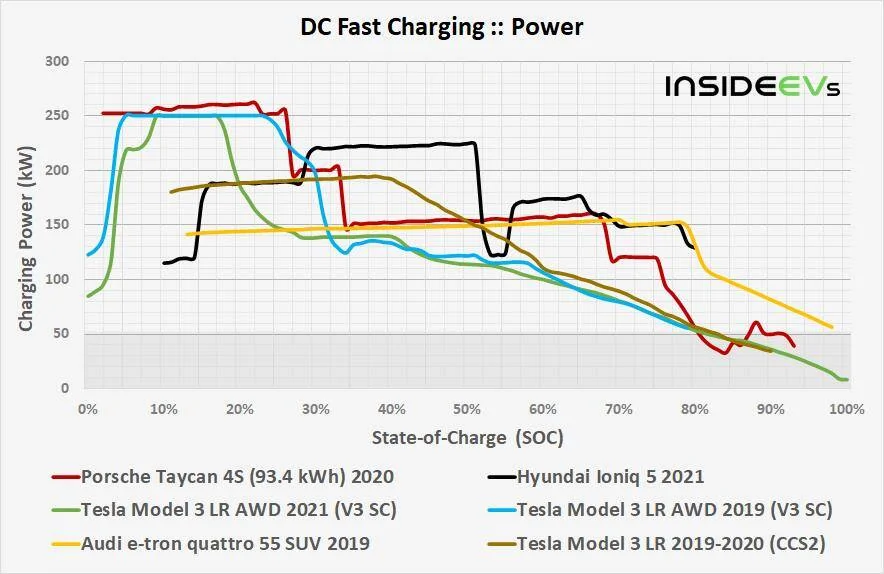
The 80% thing is not about optimizing range. It is about optimizing time spent charging. Sure, if there are no chargers in range of 80% SoC, then you will need more, but if you can get to the next charger on ~80%, then you are better to charge to 80% and stop at the next one with a low state of charge. The reason being that 10%-80% (i.e. adding 70%) takes less time than adding that final 20% (and the final 10% from 90%-100% takes longer than the 80%-90% too). Battery charging is not linear. When you start at a low state of charge (assuming a warm battery), you will be able to get up to 270 kW, but as the charge increases, the power level drops. By the time you get close to 80%, it could be down to 100 kW, and by 90% it will likely be down under 50kW.

Porsche Taycan Why US drivers may be thinking about EVs all wrong.... BBC article.... taycan-934-kwh-2021-dcfc-power-comparison-20210607


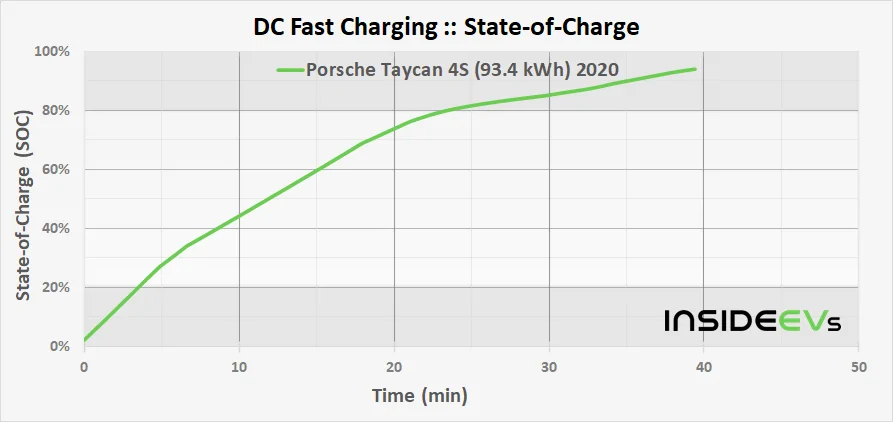
Here's the Inside EVs charging curve for a Taycan 4S which shows how much slower that 80%+ part of the process is compared to the first part. If you split your charge into two sessions from 10% to 80%, then that 40 minutes spent charging adds 140% of the battery as opposed to just 85% (if you go from 10% to 95%).

It is not immediately obvious, and is very different to the approach taken with an ICE car where you fill up at each stop to maximize range, but an ICE car refuels linearly.

Porsche Taycan Why US drivers may be thinking about EVs all wrong.... BBC article.... porsche-taycan-934-kwh-2021-dcfc-soc-time-20210607
 

Jonathan S.

Well-Known Member
First Name
Jonathan
Joined
Jan 19, 2023
Threads
43
Messages
2,094
Reaction score
1,914
Location
Amherst MA & Twin Mtn NH
Website
tinyurl.com
Vehicles
'22 4CT, '22 Audi A6 Allroad, '23 BMW i4 M50
Country flag
That Taycan theoretical maximum charging curve has almost zero relevance to DCFC in New England (with the sole exception of the Magic Dock in Enfield CT).
I've experienced only relatively modest tapering during most EA sessions all the way up to ~95%.
And as the graph shows, the Taycan is pretty much maxing out the typical ChargePoint 62kW or the many 50kW chargers all the way up to around 95%.
(Vermont is even now building out two networks -- funded back in 2019 and 2020 -- for a total of 34 chargers, at 17 stations, with each station hosting two 50kW chargers.)

Even with more functional chargers, the strategy of stopping at ~80% ignores the significant "overhead" time of driving diversions, possibly waiting for an available plug, possibly experiencing handshake problems, and possibly encountering a derated charger that even at a low SoC isn't any faster than continuing with the prior charger at a higher SoC.

In backcountry skiing, we have a phrase of, "Never leave good snow to find better snow."
Given the current state of the CCS1 infrastructure in New England, if I need more than 80% to reach my ultimate destination, then my second-most optimal strategy is to continue to charge as long as I'm above the frequent public L2 rate of ~3kW.
(The most optimal strategy though is to take my ICE, which is what I almost always do.)
 

bluedonkey

Well-Known Member
First Name
John
Joined
Apr 20, 2021
Threads
3
Messages
115
Reaction score
91
Location
Alameda, CA
Vehicles
Taycan 4S
Country flag
The EA map shows a lot of 350 kW chargers up and down the whole east coast, but there are some states (including VT) that seem to have none at all. I can only see one > 150kW charger in Vermont - at a Ford dealer. Very strange that none of the network have installed 150kW+ units.

I agree if you're using 50kw/60kW chargers, there isn't much difference over the charge, although it will still drop off in that last 10%-15%. Those are probably 400V chargers too, which means you could be capped at 50 kW unless you spec'd the 150 kW DC-DC converter option - same thing happens at the Tesla superchargers today - I think I read the V4 units will have 800V too, and hopefully magic docks as well :)

The rush to installing 350kW chargers everywhere doesn't make sense to me. On longer trips, there are times when I might need that (alongside a freeway), but there are more times when I'd rather see more 50kW units and have time to get a meal without needing to rush back and move the car. It puzzles me that Walmart and Target are so keen to have 150kW and 350kW chargers outside their stores - it just means I am limited to ~30 minutes in their store. Most of them would be better served with more 50kW, or even 11kW AC posts.
 

WasserGKuehlt

Well-Known Member
Joined
Sep 7, 2022
Threads
5
Messages
2,066
Reaction score
2,456
Location
WA
Vehicles
4CT, 996C2, MacanS
Country flag
The rush to installing 350kW chargers everywhere doesn't make sense to me. On longer trips, there are times when I might need that (alongside a freeway), but there are more times when I'd rather see more 50kW units and have time to get a meal without needing to rush back and move the car. It puzzles me that Walmart and Target are so keen to have 150kW and 350kW chargers outside their stores - it just means I am limited to ~30 minutes in their store. Most of them would be better served with more 50kW, or even 11kW AC posts.
I may be wrong, but there is no downside to having a higher-powered charger over a lesser one? I am assuming that the location has sufficient power available (as in electric main), and that the total cost of a station would not differ significantly between all-50kW and all-350kW chargers.

I only charge at DC stations on longer trips, and for me the problem is that the ratio of driving time to charging is still too low. There is the occasional stop where I'd want to take a longer break, but stopping for 30 min every 1.5 hours is already too much/fragmented. Can't imagine having to stop for just as long but more frequently, nor making longer stops.
Sponsored


Top