Sponsored

PSCB Brakes

f1eng

Well-Known Member
First Name
Frank
Joined
Aug 19, 2021
Threads
48
Messages
4,765
Reaction score
8,335
Location
Oxfordshire, UK
Vehicles
Taycan CT4S, Ferrari 355, Merc 500E, Prius PHV
Country flag
I guess what I was clarifying was like you said system hydraulic pressure, and not pedal pressure. You could have a fair amount of pedal force without mechanical intervention, but system pressure would obviously correlate with mechanical braking. Agree?
It shouldn’t need clarifying, tbh.
“Pedal pressure” would never be quoted in psi because it is actually a load and to call it a pressure is a mis-use of English. It would be Lbf or Newtons.

It is conventional in all braking data logging I have ever seen to quote the brake data as pressure in the hydraulic system in psi (in the old days) or bar (now).

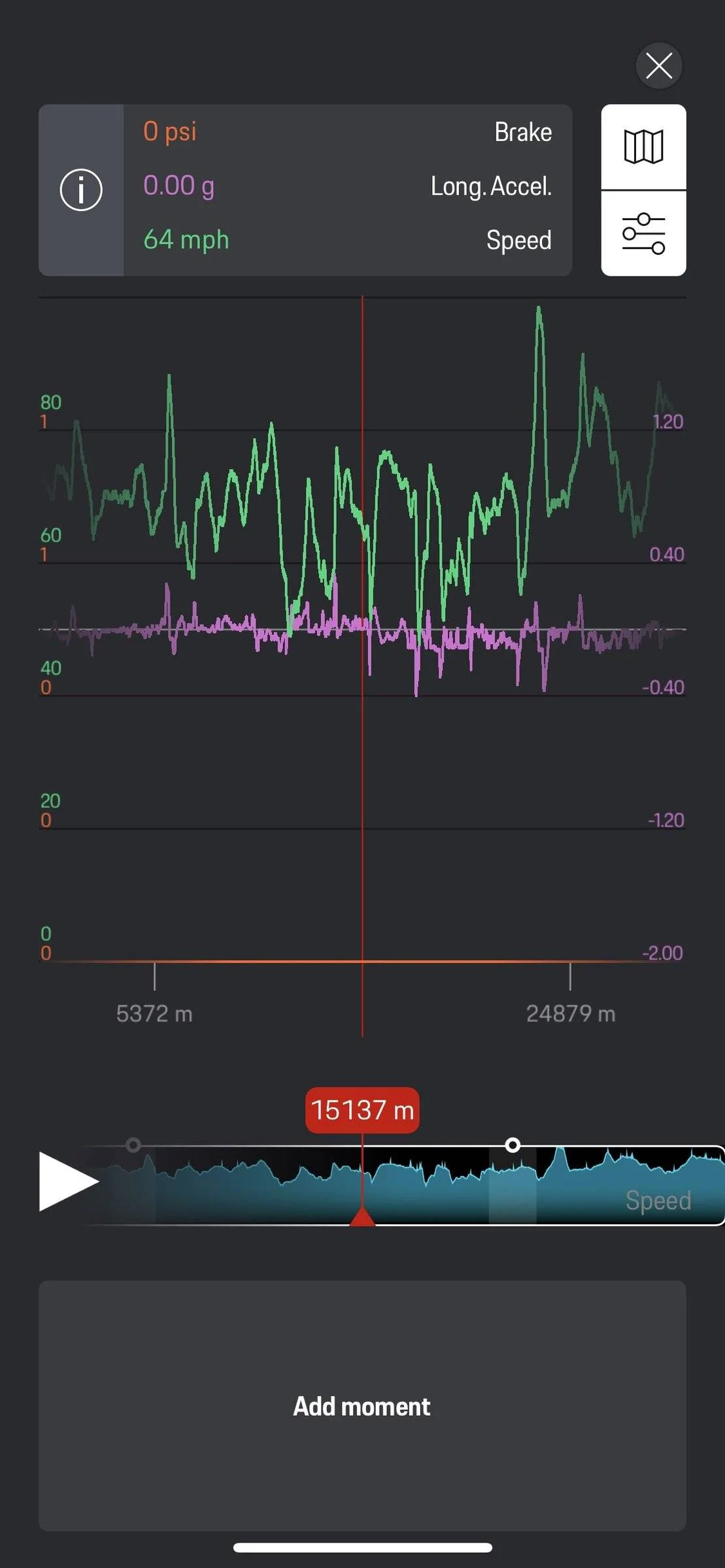
The fact that the pressure in the hydraulics remains zero means definitively that the friction brakes are not being used at all on this data recording.
Sponsored
 

gnop1950

Well-Known Member
First Name
Gary
Joined
Nov 5, 2021
Threads
6
Messages
539
Reaction score
639
Location
Sierra Vista, AZ
Vehicles
2022 Taycan 4s
Country flag
It shouldn’t need clarifying, tbh.
“Pedal pressure” would never be quoted in psi because it is actually a load and to call it a pressure is a mis-use of English. It would be Lbf or Newtons.

It is conventional in all braking data logging I have ever seen to quote the brake data as pressure in the hydraulic system in psi (in the old days) or bar (now).

The fact that the pressure in the hydraulics remains zero means definitively that the friction brakes are not being used at all on this data recording.
Hey now, are you saying the USA is stuck in the past ;)
 

f1eng

Well-Known Member
First Name
Frank
Joined
Aug 19, 2021
Threads
48
Messages
4,765
Reaction score
8,335
Location
Oxfordshire, UK
Vehicles
Taycan CT4S, Ferrari 355, Merc 500E, Prius PHV
Country flag
Hey now, are you saying the USA is stuck in the past ;)
No, just that I am English!
40 years ago we used to use some US steel parts and some sensors which were in Imperial sizes and calibrated in Imperial units at work. SI units were the only ones used in engineering in university from 1968 though.

Officially we went to SI units in 1968 iirc but there are plenty of people who didn’t do anything technical who never changed and we still buy a pint of beer road signs and speed limits are in mph my grandma still only understood temperature in Fahrenheit and most people still quote their weight in stones (never pounds) and height in feet and inches so the UK never really “went metric” in total.
 

npx

Well-Known Member
First Name
Justin
Joined
Jan 26, 2022
Threads
7
Messages
283
Reaction score
270
Location
Cupertino, CA
Vehicles
2020 Taycan Turbo
Country flag
It shouldn’t need clarifying, tbh.
“Pedal pressure” would never be quoted in psi because it is actually a load and to call it a pressure is a mis-use of English. It would be Lbf or Newtons.
this guy units


tomdfw1

Well-Known Member
First Name
Tom
Joined
Oct 26, 2021
Threads
30
Messages
262
Reaction score
178
Location
Plano
Vehicles
2019 Lamborghini Huracan Performante Spyder
Country flag
worth it? I have to lock down my build within a couple weeks. Switching back and forth between eMission wheels (which require PSCB) and RS Spyder Wheels, which obviously do not require it. Love eMission wheels, but, man that additional $3500 or $4400 bucks for PSCB just burns me. Thoughts?
I got the mission-e rims and consider it the best option I got. IMHO best looking OEM rims on any car. (Just make sure you get the wheel insets to color match the car or they come silver)
 

tomdfw1

Well-Known Member
First Name
Tom
Joined
Oct 26, 2021
Threads
30
Messages
262
Reaction score
178
Location
Plano
Vehicles
2019 Lamborghini Huracan Performante Spyder
Country flag
PSCB rotors are $6300 per set and there is no aftermarket alternative. It's likely they'll last a long time due to the reliance on regen, however after a certain number of years they have to be replaced per Porsche spec.

if you care about this, get the standard brakes. if you don't, get the PSCB. they're better than the standard brakes in every way except for some very minor squeal that occurs sometimes.

that's pretty much the answer.
PSCB brakes/rotors will last much longer than standard...
 

Archimedes

Well-Known Member
Joined
Jan 22, 2022
Threads
12
Messages
1,966
Reaction score
2,533
Location
Monterey
Vehicles
2022 Taycan 4S
Country flag
worth it? I have to lock down my build within a couple weeks. Switching back and forth between eMission wheels (which require PSCB) and RS Spyder Wheels, which obviously do not require it. Love eMission wheels, but, man that additional $3500 or $4400 bucks for PSCB just burns me. Thoughts?
Funny how the OP’s simple question above turned into seven pages of people talking past each other…:CWL:


npx

Well-Known Member
First Name
Justin
Joined
Jan 26, 2022
Threads
7
Messages
283
Reaction score
270
Location
Cupertino, CA
Vehicles
2020 Taycan Turbo
Country flag
PSCB brakes/rotors will last much longer than standard...
30 percent longer but about triple the replacement cost. idk if that shakes out in the end, but it's likely both brakes will last stupid long since regen does almost all the work. I'm not worried!
 

daveo4EV

Well-Known Member
First Name
David
Joined
Jan 28, 2019
Threads
192
Messages
7,003
Reaction score
10,473
Location
Santa Cruz
Vehicles
Cayenne Hybrid, 911(s) GT3/Convertable
Country flag
Hey Dave I think a little confusion on your part is you seem to be under the impression that ANY and ALL braking energy events up to 265kW are handled by the regeneration judging by some of your comments. This isn't how the system works........
The 265kW is the MAXIMUM amount of potential energy recovery the system is capable of harvesting. This is not synonymous with all of the energy recovered as the mechanical brakes are blended in well before this threshold. Think of it like under a panic stop, the motors may be recovering up to this amount.
Just because your regeneration meter is not maxed out does not mean that your mechanical brakes are not being utilized. Its not an all or none event. Its not as though a 400kW event is ALL 265kW and then the remaining 135kW made up by mechanical. Not all 3.8m/s2 braking events are done with regeneration- this is simply the MAXIMUM that the system is capable of harvesting. Mechanical brakes are blended in well before then.
i think it’s closer to my assumptions than yours - the regen meter is a pretty good indicator of friction vs regen - but honestly no one outside of porsche knows for sure

but it’s not necessarily like the 919 either

I welcome data on the actual taycan implementation vs comparison to close cousins
 

daveo4EV

Well-Known Member
First Name
David
Joined
Jan 28, 2019
Threads
192
Messages
7,003
Reaction score
10,473
Location
Santa Cruz
Vehicles
Cayenne Hybrid, 911(s) GT3/Convertable
Country flag
If it helps clarify further, here's a data trace from a longer driving event, about 17 mi over a mountain pass. @daveo4EV may appreciate this one as it's in his backyard - hwy 17 from Los Gatos to Santa Cruz. There's a few braking events around 0.3-0.4g but friction brakes not used once.
FEFABE3D-B15A-4981-9B9C-BD6EB90289A6.jpeg
hmmm no friction brake usage at all

just like porsche says
 

Archimedes

Well-Known Member
Joined
Jan 22, 2022
Threads
12
Messages
1,966
Reaction score
2,533
Location
Monterey
Vehicles
2022 Taycan 4S
Country flag
30 percent longer but about triple the replacement cost. idk if that shakes out in the end, but it's likely both brakes will last stupid long since regen does almost all the work. I'm not worried!
How many Porsche owners ever keep their car long enough to need to replace rotors?

Always find it funny when people debate the cost of maintenance required at 60,000+ miles when the chance that their Porsche will still be in their driveway when the odometer rolls over even 20,000 miles is basically nil.
 

npx

Well-Known Member
First Name
Justin
Joined
Jan 26, 2022
Threads
7
Messages
283
Reaction score
270
Location
Cupertino, CA
Vehicles
2020 Taycan Turbo
Country flag
How many Porsche owners ever keep their car long enough to need to replace rotors?

Always find it funny when people debate the cost of maintenance required at 60,000+ miles when the chance that their Porsche will still be in their driveway when the odometer rolls over even 20,000 miles is basically nil.
Haha you know I was actually going to say something like “I don’t Think I’ll keep the car that long” when I was writing my post
 

daveo4EV

Well-Known Member
First Name
David
Joined
Jan 28, 2019
Threads
192
Messages
7,003
Reaction score
10,473
Location
Santa Cruz
Vehicles
Cayenne Hybrid, 911(s) GT3/Convertable
Country flag
I will be at PECLA on wed. for a advanced driving courses - apparently they have some techs there that are fully brief'd on the intimate details of how Taycan does it's blended braking…I'll report back - they have agreed to meet with me at the 917 restaurant and answer my questions

but I've already learned one or two things over eMail:

TLDR Summary:

Goals for a street car are different than a hybrid race car. Friction brakes represent lost potential energy wasted as heat rather than charging the battery - as much as possible Taycan uses max or near-max regen _BEFORE_ "adding" friction brakes - MAX regen however varies over time & situation so it isn't always 265 kW 3.8 m/s^2 - but what ever the vehicle targets for "Max regen" at the moment - will be used "first" _BEFORE_ friction brakes to recover the most kinetic energy possible to maximize range. Friction brake heat = lost potential energy that could've been used for range enhancement.
Gory details
  • Taycan is mostly a "regen 1st" friction brakes "2nd" implementation
    [*]Porsche racing hybrids blend in friction brakes "sooner" to keep heat into the racing pads & rotors
    • testing showed regen was too effective and brakes/pads were being "over cooled" and falling outside of their optimal minimum temps - so it best to keep a "little" heat in them
    • this is not a factor in street driving
    • much much smaller batteries - used more for performance than range (augmenting the power of the ICE motor)
    • so very very different goals in optimizing power/regen/deceleration vs. an all BEV street car with limited range…
    [*][*][*][*][*]it is correct that Taycan doesn't always use it's max 265 kW regen capacity - rather there is a "target" max regen constantly being calculated based on available data from _ALL_ sensors
    • however mostly Taycan will go to this calculated "max" _FIRST_ then "add" friction brakes as necessary
    [*][*][*][*][*]the algorythm is slight more 919 hybrid like in sports & sports+ but stil mostly "regen" first friction "second"
    • this is mostly have the friction brakes "ready" and already engaged for minute pedal modulation and lowering the latency for the friction brakes to have effect on the rotors - sports/sports+ are not range sensitive driving modes
    • once you reach ABS it becomes much more complicated with ABS essentially disabling "regen"
    • once ABS is triggered the remainder of that braking "event" regen is no longer prioritized with friction carrying most of the load until the brake pedal is fully released
    [*][*][*][*][*]every press of the brake pedal is a "new" "event" - once you release the brake pedal fully the next "brake press" is a "new" event and new targets for max regen are calculated once you press on it again taking into account data from _ALL_ sensors at the beginning of the event
    [*]psi as reported by the precision track app _IS_ friction brakes essentially
    [*]Taycan is optimized for street driving and range - once you've decided to engage in deceleration it's best to recover as much kinectic energy as possible for the battery - any friction braking before you are at max regen is "wasted" energy that could've gone to the battery
    • this sort of "range 1st" optimization is not a goal in racing
    • pad/rotor wear and elongating service intervals was a goal for a street car
      • again when you're optimizing for maximum energy recovery and maximum service life the less you use the friction brakes the better for those two goals
    [*][*][*][*][*]it is possible but not common for Taycan to be blending regen & friction at the same before before reaching "max" regen - but again that goes against the max energy recovery goal
    • but that only happens once you're "close" to the max regen target value anyways - basically it's predictive - once you are approaching max regen and it's clear driver is requesting "more" deceleration Taycan will begin "ramping up brake PSI" to "blend" two deceleration forces…exact nature of this and when/how/why/under-what-circumstance is "secret sauce" for Porsche and why they are "better" than the other guys
    [*][*][*][*][*]coasting _IS_ more efficient than regen for range driving and hence no one pedal driving on Taycan - but once you've committed to deceleration (driver has touched the brake pedal) _ANY_ friction braking is wasted potential energy - friction brake heat does not charge the battery
    • recover as much energy as possible 1st (regen only) - then add friction (waste heat) if necessary.
    [*][*][*][*]
I'm looking forward to my lunch on wed. - I'll report back - fascinating stuff IMHO.
 
Last edited:

f1eng

Well-Known Member
First Name
Frank
Joined
Aug 19, 2021
Threads
48
Messages
4,765
Reaction score
8,335
Location
Oxfordshire, UK
Vehicles
Taycan CT4S, Ferrari 355, Merc 500E, Prius PHV
Country flag
I will be at PECLA on wed. for a advanced driving courses - apparently they have some techs there that are fully brief'd on the intimate details of how Taycan does it's blended braking…I'll report back - they have agreed to meet with me at the 917 restaurant and answer my questions

but I've already learned one or two things over eMail:

TLDR Summary:


Gory details
  • Taycan is mostly a "regen 1st" friction brakes "2nd" implementation
    [*]Porsche racing hybrids blend in friction brakes "sooner" to keep heat into the racing pads & rotors
    • testing showed regen was too effective and brakes/pads were being "over cooled" and falling outside of their optimal minimum temps - so it best to keep a "little" heat in them
    • this is not a factor in street driving
    • much much smaller batteries - used more for performance than range (augmenting the power of the ICE motor)
    • so very very different goals in optimizing power/regen/deceleration vs. an all BEV street car with limited range…
    [*][*][*][*][*][*]it is correct that Taycan doesn't always use it's max 265 kW regen capacity - rather there is a "target" max regen constantly being calculated based on available data from _ALL_ sensors
    • however mostly Taycan will go to this calculated "max" _FIRST_ then "add" friction brakes as necessary
    [*][*][*][*][*][*]the algorythm is slight more 919 hybrid like in sports & sports+ but stil mostly "regen" first friction "second"
    • this is mostly have the friction brakes "ready" and already engaged for minute pedal modulation and lowering the latency for the friction brakes to have effect on the rotors - sports/sports+ are not range sensitive driving modes
    • once you reach ABS it becomes much more complicated with ABS essentially disabling "regen"
    • once ABS is triggered the remainder of that braking "event" regen is no longer prioritized with friction carrying most of the load until the brake pedal is fully released
    [*][*][*][*][*][*]every press of the brake pedal is a "new" "event" - once you release the brake pedal fully the next "brake press" is a "new" event and new targets for max regen are calculated once you press on it again taking into account data from _ALL_ sensors at the beginning of the event
    [*]psi as reported by the precision track app _IS_ friction brakes essentially
    [*]Taycan is optimized for street driving and range - once you've decided to engage in deceleration it's best to recover as much kinectic energy as possible for the battery - any friction braking before you are at max regen is "wasted" energy that could've gone to the battery
    • this sort of "range 1st" optimization is not a goal in racing
    • pad/rotor wear and elongating service intervals was a goal for a street car
      • again when you're optimizing for maximum energy recovery and maximum service life the less you use the friction brakes the better for those two goals
    [*][*][*][*][*][*]it is possible but not common for Taycan to be blending regen & friction at the same before before reaching "max" regen - but again that goes against the max energy recovery goal
    • but that only happens once you're "close" to the max regen target value anyways - basically it's predictive - once you are approaching max regen and it's clear driver is requesting "more" deceleration Taycan will begin "ramping up brake PSI" to "blend" two deceleration forces…exact nature of this and when/how/why/under-what-circumstance is "secret sauce" for Porsche and why they are "better" than the other guys
    [*][*][*][*][*][*]coasting _IS_ more efficient than regen for range driving and hence no one pedal driving on Taycan - but once you've committed to deceleration (driver has touched the brake pedal) _ANY_ friction braking is wasted potential energy - friction brake heat does not charge the battery
    • recover as much energy as possible 1st (regen only) - then add friction (waste heat) if necessary.
    [*][*][*][*][*]
I'm looking forward to my lunch on wed. - I'll report back - fascinating stuff IMHO.
That is pretty well what I had understood, and expected.
Sponsored


Top