rs38
Well-Known Member
- Joined
- Nov 16, 2020
- Threads
- 23
- Messages
- 703
- Reaction score
- 762
- Location
- Düsseldorf
- Vehicles
- Taycan,GT2,i8,Tesla

does it sound familiar? 
https://www.audi-mediacenter.com/en...oftware-update-for-20192020-model-years-14346
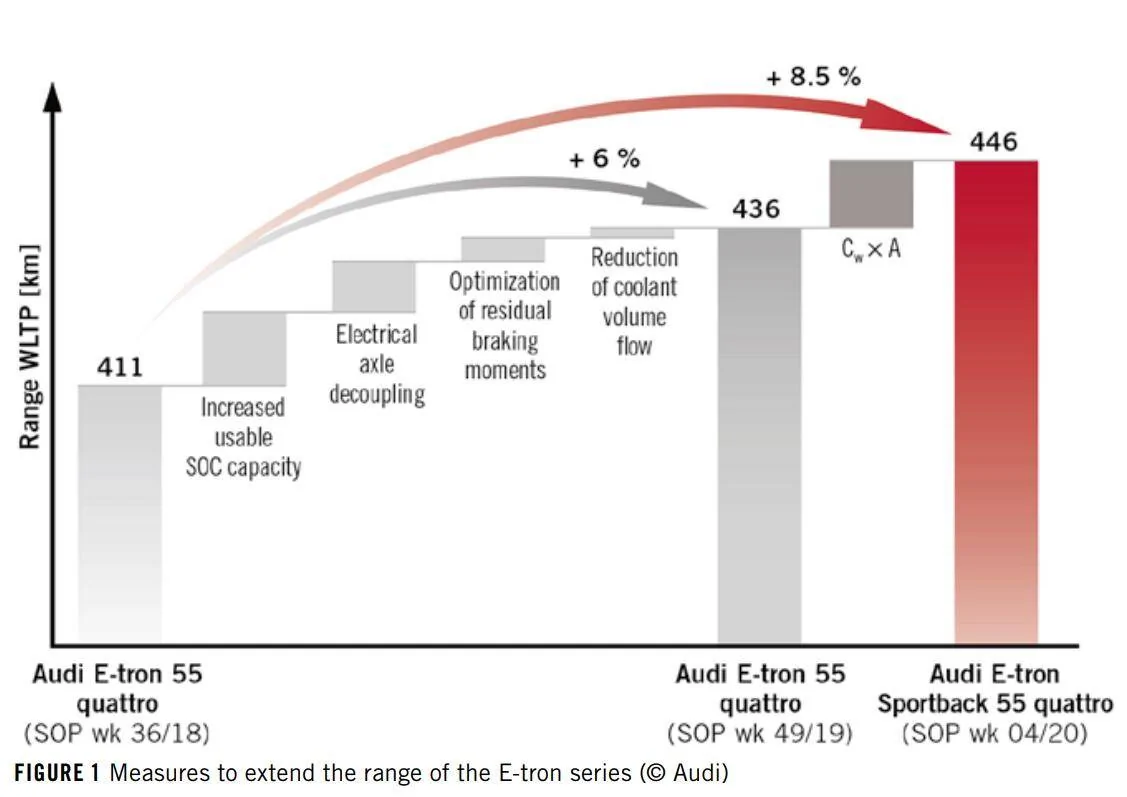
So Audi did probably the same last year for the E-tron: but they mention to free up some of the net capacity to gain that high increase of 5% (which is less than Porsche promised and most of it is due to battery net increase)
it's important to note that Audi Etron used no PSM in front and rear and has no 2-gearbox.
https://www.audi-mediacenter.com/en...oftware-update-for-20192020-model-years-14346
*before it was 83.6kWhEffective immediately, the software features behind this efficiency enhancement are also available for existing vehicles. Among other improvements, the update expands the usable capacity of the high-voltage battery. As a result, the 95 kWh battery in the Audi e-tron 55 quattro1 delivers more net usable power – 86 kWh* capacity therefore translates into increased range.
So Audi did probably the same last year for the E-tron: but they mention to free up some of the net capacity to gain that high increase of 5% (which is less than Porsche promised and most of it is due to battery net increase)
it's important to note that Audi Etron used no PSM in front and rear and has no 2-gearbox.
for me that makes more sense to optimize coasting on an ASM EV than sacrifice the (on paper) optimal cut of the rear axle for Taycan.In addition to the battery capacity, the new software also optimizes the control of the front electric motor. In normal driving mode, the motor attached to the rear axle is responsible for propulsion. For improved efficiency, the front electric motor is now almost completely disconnected and powered off – and only when more power is needed do both motors come into play. This makes it possible to even more effectively exploit the major advantage of the asynchronous motor concept, i.e., currentless operation without electrical drag losses.
Furthermore, the update also improves cooling. The highly flexible thermal management system, which consists of four separate circuits, regulates the temperature of the high-voltage components even more efficiently. Modifying the control system made it possible to reduce the volume flow rates in the coolant circuit, thus reducing energy consumption. The cooling system is the basis for fast DC charging, long battery life, and consistent driving performance, even under high loads.
Sponsored
Last edited: