Sponsored

Level 2 charging rate with a 50 amp capacity

OP
OP

Briguy

Well-Known Member
First Name
Brian
Joined
Sep 14, 2020
Threads
5
Messages
69
Reaction score
50
Location
Toronto
Vehicles
2020 Taycan4s, 2025 Mercedes SL63 AMG, 1973 911
Country flag
i did have a ‘20 cayenne ev hybrid and got rid of it within a few months because its ev range was at best 22kms and no where near the advertised 50 kms.

great that the new ones charge faster…
Sponsored


ntacus

Member
First Name
Jay
Joined
Feb 1, 2025
Threads
1
Messages
21
Reaction score
7
Location
Washington
Vehicles
2025 Taycan 4S
Country flag
I wonder if the cayenne hybrid will actually charge at 11kW or if it’s just another example of incorrect/unachievable specs.
 

daveo4EV

Well-Known Member
First Name
David
Joined
Jan 28, 2019
Threads
192
Messages
7,003
Reaction score
10,473
Location
Santa Cruz
Vehicles
Cayenne Hybrid, 911(s) GT3/Convertable
Country flag
I wonder if the cayenne hybrid will actually charge at 11kW or if it’s just another example of incorrect/unachievable specs.
it actually does ROFL!

I tested a 2024 hybrid at the dealership using their Porsche Wall charger on its 100 amp circuit - it dutifully ramped up to 48 amps and hummed along - we did this just before i tested my 2024 Macan EV to demonstrate it topped out at 40 amps - so my Macan EV with a 100 kwh battery charged 20% slower than a hybrid with a 21 kwh battery - makes perfect sense!

probably the exact same part in the two vehicles

at the time porsche still claimed the macan EV had an 11 kw OBC - my dealer service manager has no response to my demonstration and said he would escalate to PCNA - a few weeks later the macan site was updated to 9.6 kW OBC - and porsche never explained the discrepancy despite multiple requests to do so!
 
Last edited:

daveo4EV

Well-Known Member
First Name
David
Joined
Jan 28, 2019
Threads
192
Messages
7,003
Reaction score
10,473
Location
Santa Cruz
Vehicles
Cayenne Hybrid, 911(s) GT3/Convertable
Country flag
there is a component on the obc circuit boards that route the 240v AC power

it is this component that fails - in the 22/19.2 kw units the power flow is above spec of the component

a hybrid only taxes this component for 2-3 hours at 11 kw

a full EV taxes this component for up to 8-9 hours at 11 kw

I’m wondering if Porsche is more comfortable burning out this chip 2-3 hours at a time vs 8-
9 hours at time to mitigate/reduce failures

only Porsche internal documents can tell us and we do not have access

Porsches OBC most likely has a design flaw that single phase 240v taxes…so they are reducing the electrical load to reduce potential warranty claims
 

whitex

Well-Known Member
Joined
Jul 30, 2021
Threads
87
Messages
8,196
Reaction score
7,236
Location
WA, USA
Vehicles
2023 Taycan TCT, 2024 Q8 eTron P+
Country flag
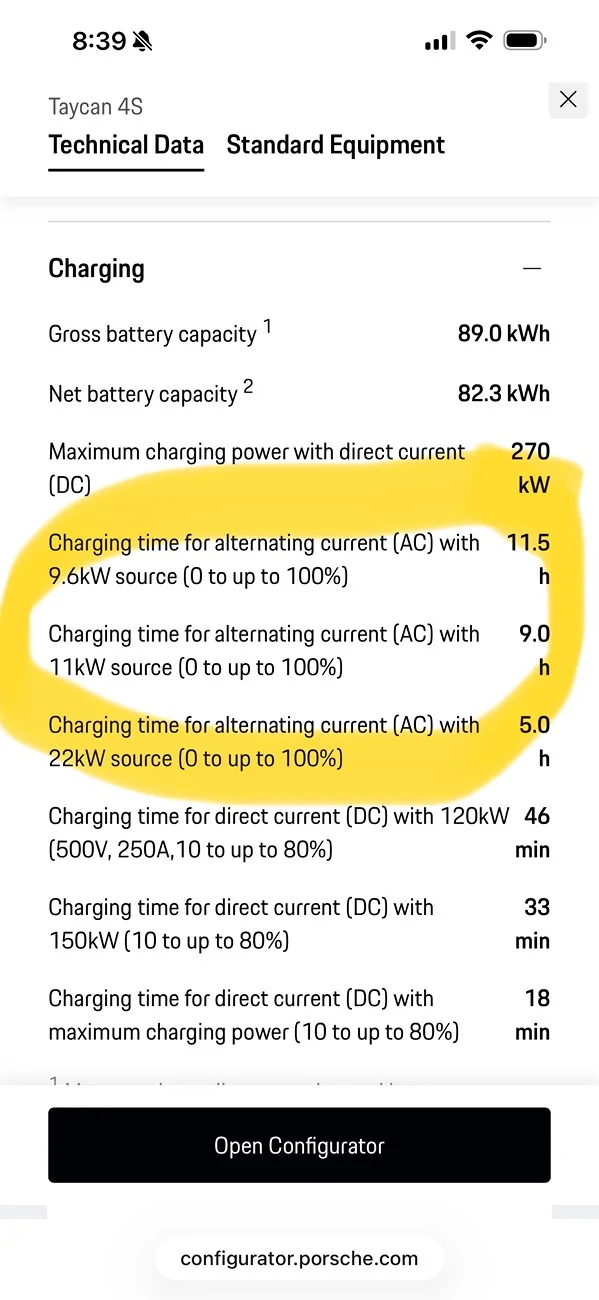
here is an extract from the 2026 Taycan configurator. was the same for the 2025. so charging with over 9.6 kw rate.

IMG_1005.webp
Sadly, this is completely stale information from J1.1. Notice is lists 22kW AC charging, which has never even been offered for J1.2 (2025 or 2026 so far).


whitex

Well-Known Member
Joined
Jul 30, 2021
Threads
87
Messages
8,196
Reaction score
7,236
Location
WA, USA
Vehicles
2023 Taycan TCT, 2024 Q8 eTron P+
Country flag
there is a component on the obc circuit boards that route the 240v AC power

it is this component that fails - in the 22/19.2 kw units the power flow is above spec of the component

a hybrid only taxes this component for 2-3 hours at 11 kw

a full EV taxes this component for up to 8-9 hours at 11 kw

I’m wondering if Porsche is more comfortable burning out this chip 2-3 hours at a time vs 8-
9 hours at time to mitigate/reduce failures

only Porsche internal documents can tell us and we do not have access

Porsches OBC most likely has a design flaw that single phase 240v taxes…so they are reducing the electrical load to reduce potential warranty claims
If it's time charging that taxes or kills the OBC, they should be insisting on highest rates possible, as faster charging would finish sooner. Even going from 11kW to 9.6kW increases the amount of time spent charging. If it's the capacity utilization rate, you'd think 22kW OBC would break less, especially that most people only use them at 50% capacity or less.

Personally I am still not convinced that the 19.2kW OBCs fail more often than 11kW. We do know there was an issue acknowledged by Porsche that applies to 22kW EU 3-phase charging, which was actually that charging at 1 phase (7.3kW) was burning them out, but Porsche hasn't acknowledged any specific 19.2kW issues. All we have is anecdotal reports, as well some confirmation bias. When I wrote here about my 19.2kW dying, someone replied that their 11kW OBC also died and they were waiting for a new one as well. The thread seemed to pick up on "19.2kW are problematic" even though both 19.2kW and 11kW were reported as dead in the same thread.

I think what happened was that there is a steady stream of OBC failures, both 11kW and 22kW, and Porsche decided to streamline the spare part supply chain, to only provide the most commonly ordered OBC. They could have provided all 22kW software de-rated to 9.6kW (you'd think that would fail less than 11kW de-rated to 9.6kW), but that would likely be more expensive, and possibly cause safety issues (should 22kW get enables somehow, the wiring to charging ports is insufficient in 11kW OBC equipped cars).
 
Last edited:

Jonathan S.

Well-Known Member
First Name
Jonathan
Joined
Jan 19, 2023
Threads
43
Messages
2,089
Reaction score
1,908
Location
Amherst MA & Twin Mtn NH
Website
tinyurl.com
Vehicles
'22 4CT, '22 Audi A6 Allroad, '23 BMW i4 M50
Country flag
One little tidbit I've learned is that not all 11kW EV models charge at the same rate, and not all 48a hard-wired units charge at the same rate.
Or at least, my wife's i4 is a bit faster than my Taycan, and our Tesla Universal is a bit faster than our JuiceBox.
Granted, all four combinations are ten-point-something, but the differentials are both consistent and measurable.
 

whitex

Well-Known Member
Joined
Jul 30, 2021
Threads
87
Messages
8,196
Reaction score
7,236
Location
WA, USA
Vehicles
2023 Taycan TCT, 2024 Q8 eTron P+
Country flag
One little tidbit I've learned is that not all 11kW EV models charge at the same rate, and not all 48a hard-wired units charge at the same rate.
Or at least, my wife's i4 is a bit faster than my Taycan, and our Tesla Universal is a bit faster than our JuiceBox.
Granted, all four combinations are ten-point-something, but the differentials are both consistent and measurable.
I am curious, what measurements are you basing the above conclusions on? Power, voltage, current, measures by what (car, evse, other)?


Jonathan S.

Well-Known Member
First Name
Jonathan
Joined
Jan 19, 2023
Threads
43
Messages
2,089
Reaction score
1,908
Location
Amherst MA & Twin Mtn NH
Website
tinyurl.com
Vehicles
'22 4CT, '22 Audi A6 Allroad, '23 BMW i4 M50
Country flag
I am curious, what measurements are you basing the above conclusions on? Power, voltage, current, measures by what (car, evse, other)?
Ah, you’re right - that differential between Taycan and i4 could just be measurement differences between Porsche and BMW.

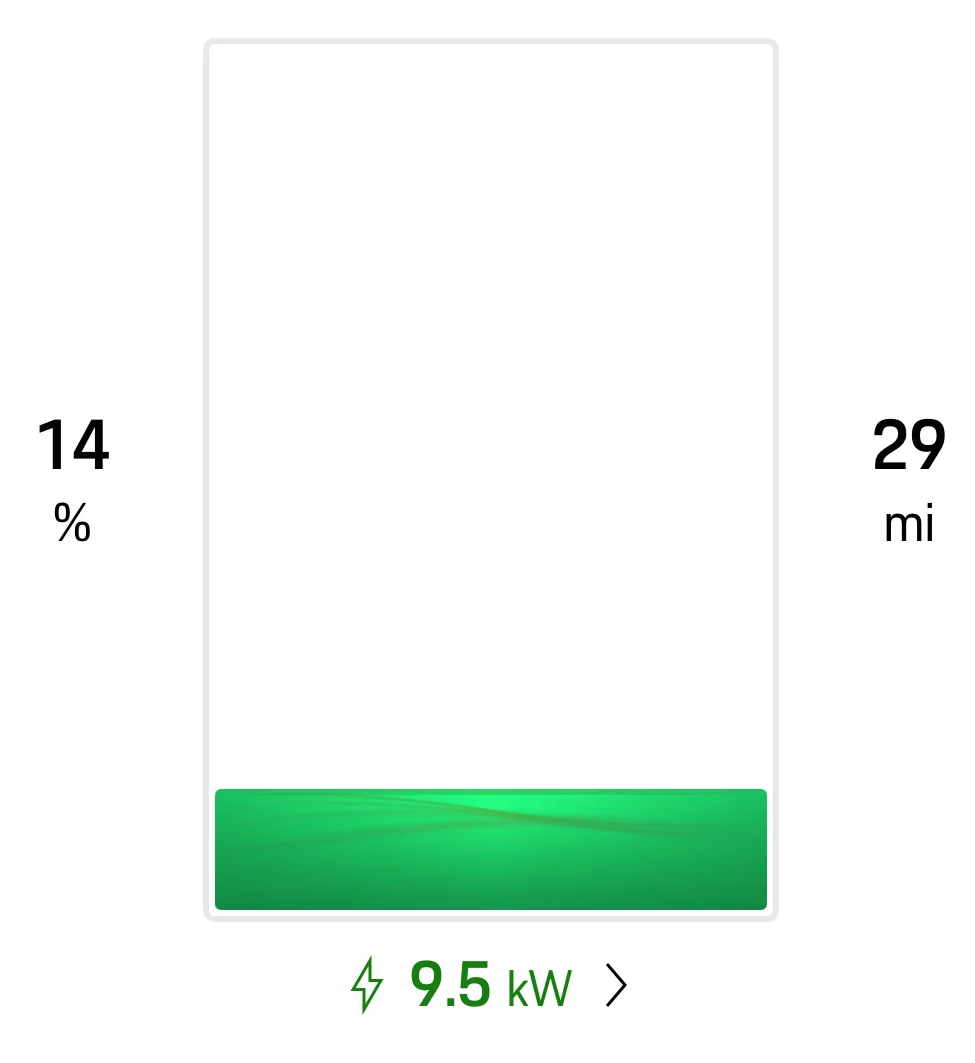
However, the Tesla is consistently faster than the JuiceBox.
Yesterday I posted the Tesla Universal Wall at 10.2kW at 14% SoC. Today on the JuiceBox the Taycan been ranging between 9.7 and 9.5 at similar SoC:


Porsche Taycan Level 2 charging rate with a 50 amp capacity IMG_1241
 
OP
OP

Briguy

Well-Known Member
First Name
Brian
Joined
Sep 14, 2020
Threads
5
Messages
69
Reaction score
50
Location
Toronto
Vehicles
2020 Taycan4s, 2025 Mercedes SL63 AMG, 1973 911
Country flag
Not intending to make an ad for my hardwired chargepoint flex, but at 50 amps , my ‘20 taycan will consistently accept 10.3-10.4 kw, pretty much regardless of the SOC. Alas, its my ‘25 Taycan that appears to be “detuned” to accept only about 9.3-9.4 kw.
 

gtm

Well-Known Member
First Name
George
Joined
Nov 5, 2022
Threads
6
Messages
682
Reaction score
882
Location
Jacksonville, FL
Vehicles
'26 S e-tron GT, '73 Lotus, ('23 GTS sold 10/25)
Country flag
Not intending to make an ad for my hardwired chargepoint flex, but at 50 amps , my ‘20 taycan will consistently accept 10.3-10.4 kw, pretty much regardless of the SOC. Alas, its my ‘25 Taycan that appears to be “detuned” to accept only about 9.3-9.4 kw.
Don't take your '20 in for service. My car consistently charged at 10.4 to 10.6 kW on a 60 amp service with the Tesla Wall Connector. It's been that way since the Taycan was new. The car was just in for a service and suddenly I'm charging at 9kW. Checked the breaker voltage and the Wall Connector settings. Nothing had changed. Dealer claims nothing was done that should have lowered the level 2 charge rate but I am very suspicious. The timing is awfully coincidental. I have the feeling that Porsche is lowering all cars when they wind up in for service. Might be my paranoia but I now charge at 9kW on either of the two Tesla Wall units I have.
 
Last edited:

whitex

Well-Known Member
Joined
Jul 30, 2021
Threads
87
Messages
8,196
Reaction score
7,236
Location
WA, USA
Vehicles
2023 Taycan TCT, 2024 Q8 eTron P+
Country flag
Ah, you’re right - that differential between Taycan and i4 could just be measurement differences between Porsche and BMW.

However, the Tesla is consistently faster than the JuiceBox.
Yesterday I posted the Tesla Universal Wall at 10.2kW at 14% SoC. Today on the JuiceBox the Taycan been ranging between 9.7 and 9.5 at similar SoC:


IMG_1241.webp
There are only 2 things which can make one EVSE "slower" than another for the same car at the same location.
  1. The EVSE is advertising a lower maximum current. This could be due to incorrect setup (though the difference would likely be larger), or it could be due to poor tolerances in control signal generations (e.g. EVSE "thinks" it's setting limit of 48A, but in reality it's sending a signal interpreted as 47A)
  2. Voltage drop. Inside EVSE, or perhaps the wires feeding it, or the connections along the way (or even in the J1772 handle) have higher resistance, causing higher voltage drop at the car, therefore lower power being delivered at the same current (power=voltage*current)
I know Taycans don't show this, not sure if any of your other cars do, but I do know Teslas show both voltage and current. So next time you have access to a Tesla (or another car showing live current/voltage), plug them into each of your EVSEs and note the Power (W), the Voltage (V) and Current (A) for each. If current is lower on JuiceBox, then it's the Juicebox not signaling accurate limit, If the voltage is lower JuiceBox, then you have either longer wiring, thinner wiring, poorer connections, or JuiceBox pcb+relays inside has higher resistance. If it's higher voltage drop, I'd investigate a little further to see where if there may be a developing connection problem somewhere.
 

whitex

Well-Known Member
Joined
Jul 30, 2021
Threads
87
Messages
8,196
Reaction score
7,236
Location
WA, USA
Vehicles
2023 Taycan TCT, 2024 Q8 eTron P+
Country flag
Don't take your '20 in for service. My car consistently charged at 10.4 to 10.6 kW on a 60 amp service with the Tesla Wall Connector. It's been that way since the Taycan was new. The car was just in for a service and suddenly I'm charging at 9kW. Checked the breaker voltage and the Wall Connector settings. Nothing had changed. Dealer claims nothing was done that should have lowered the level 2 charge rate but I am very suspicious. The timing is awfully coincidental. I have the feeling that Porsche is lowering all cars when they wind up in for service. Might be my paranoia but I now charge at 9kW on either of the two Tesla Wall units I have.
Plug into any charger which can give you current readings (Amps), and see what your car draws (vs. what is available). You might unfortunately be stuck with a 2020, since IIRC 2020's were in fact advertised as equipped 9.6kW OBC, even though they accepted 11kW. Porsche could claim they just fixed a bug which allowed too much current. :( Of course they cannot claim the same on the 19.2kW option they sold (either with the car or post-production retrofit).
 

gtm

Well-Known Member
First Name
George
Joined
Nov 5, 2022
Threads
6
Messages
682
Reaction score
882
Location
Jacksonville, FL
Vehicles
'26 S e-tron GT, '73 Lotus, ('23 GTS sold 10/25)
Country flag
Plug into any charger which can give you current readings (Amps), and see what your car draws (vs. what is available). You might unfortunately be stuck with a 2020, since IIRC 2020's were in fact advertised as equipped 9.6kW OBC, even though they accepted 11kW. Porsche could claim they just fixed a bug which allowed too much current. :( Of course they cannot claim the same on the 19.2kW option they sold (either with the car or post-production retrofit).
My response was to OP and the fact that his 2020 would charge at 10.4kW but might cease to do so if he visits the dealership. My 2023 always used to charge at that rate on both a V2 and V3 Tesla Wall Connector. Since my dealer visit the car charges at 8.8kW (9.6kW from the wall) with either connector in either garage. The Tesla Wall Connector is close to a dumb extension cord. Set it for a 60 amp breaker and done. It's the car that is limiting the charge rate and I'm pretty convinced Porsche did something at the last service visit. Per @daveo4EV a couple of posts back:

"it's only recently that Porsche seems to be "enforcing" a 9.6 kW max limit for North American EV's.
in some cases on vehicle's that previously demonstrated a higher max charging limit"

I have no proof of what Porsche might have done but this suddenly lowered max limit doesn't pass the sniff test. Attempting to "protect" a marginal component is what it seems like.
 

ntacus

Member
First Name
Jay
Joined
Feb 1, 2025
Threads
1
Messages
21
Reaction score
7
Location
Washington
Vehicles
2025 Taycan 4S
Country flag
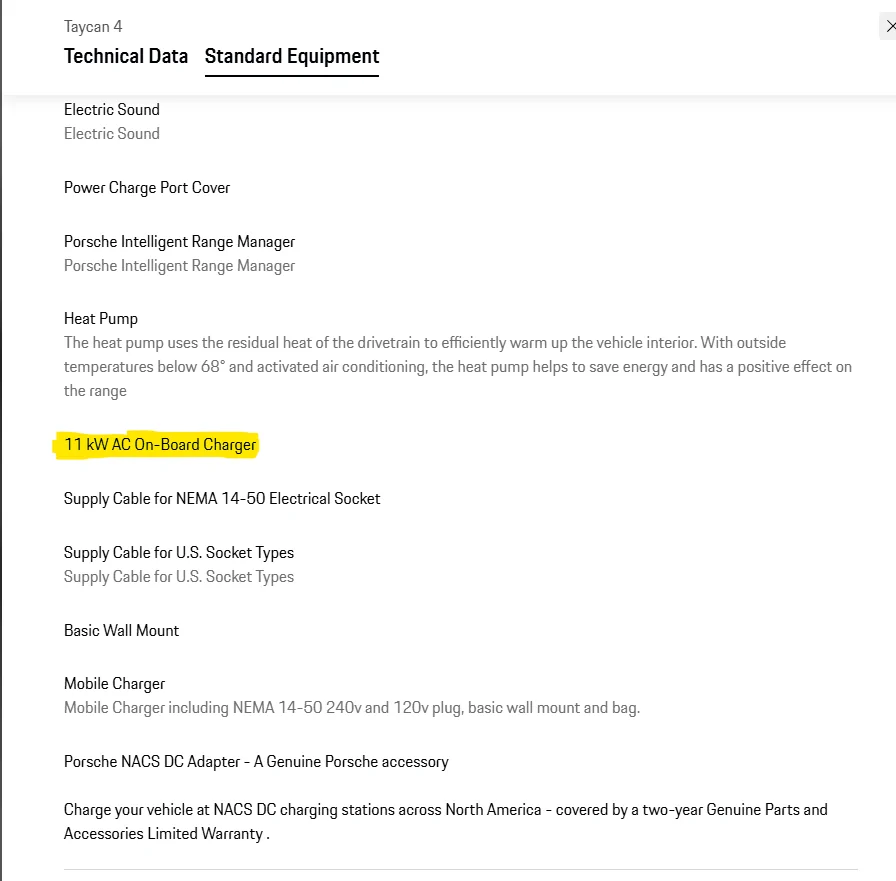
Porsche's website continues to list the 11kW onboard AC charger as standard equipment in the build configuration for the Taycan.

Porsche Taycan Level 2 charging rate with a 50 amp capacity Screenshot 2025-09-25 073820
Sponsored


Top