
Sponsored
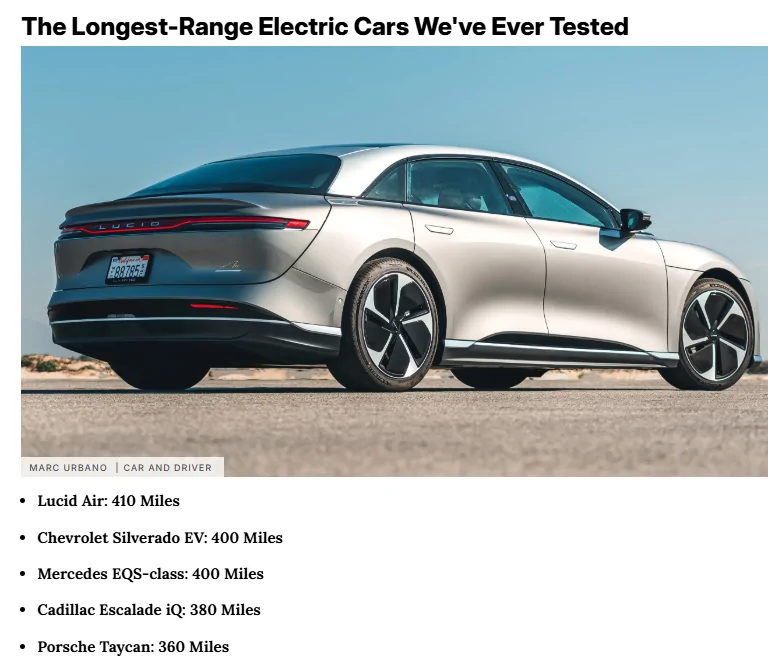
"The Longest-Range Electric Cars We've Ever Tested" - article
69Mach390
Well-Known Member
- Joined
- Nov 14, 2025
- Threads
- 10
- Messages
- 916
- Reaction score
- 637
- Location
- Florida
- Vehicles
- 24 Taycan 4S

I get that EV owners are obsessed with range, but is that really the metric that matters in the real world?
Is it that impressive if you have a long range just by putting in a ridiculously expensive and heavy battery?
Gas cars don’t do it this way- just put a 30 gallon tank in a Honda Civic. Instead it’s about efficiency- miles/gallon.
Efficiency should matter for EVs as well as cost and charging speed.
I would rather have a lower range if it recharges quickly, weighs less, costs less, performs better etc.
Is it that impressive if you have a long range just by putting in a ridiculously expensive and heavy battery?
Gas cars don’t do it this way- just put a 30 gallon tank in a Honda Civic. Instead it’s about efficiency- miles/gallon.
Efficiency should matter for EVs as well as cost and charging speed.
I would rather have a lower range if it recharges quickly, weighs less, costs less, performs better etc.
joowon213
Member
- First Name
- Joowon
- Joined
- Sep 12, 2025
- Threads
- 0
- Messages
- 12
- Reaction score
- 8
- Location
- USA
- Vehicles
- Taycan Turbo
The new ix3 and ix5 will be the top EV seller. 550+ range with 450kw charging speed. I have 2026 bmw ix60 getting average 420miles when it's fully charged. I love my Taycan but BMW makes better EV than Porsche.
PorscheTaycan
Well-Known Member
- Joined
- Nov 23, 2025
- Threads
- 9
- Messages
- 251
- Reaction score
- 215
- Location
- Australia
- Vehicles
- Porsche Taycan MY22

But Porsche makes a better "sports" EV though... yes? Because if it's just EV, I would say Tesla makes the best EVs (having been a long-term ex-Tesla driver).I love my Taycan but BMW makes better EV than Porsche.
Scandinavian
Well-Known Member
- First Name
- Peter
- Joined
- Nov 3, 2019
- Threads
- 52
- Messages
- 3,907
- Reaction score
- 3,552
- Location
- France
- Vehicles
- Taycan T, Aston Martin DB9, Porsche 996 C4 Cab, i4

The Norwegian guys have just tested EV’s on a summertrip and compared the actual range achieved vs WLTP. They also tested charging performance at some of the best High Power chargers (truck chargers).I get that EV owners are obsessed with range, but is that really the metric that matters in the real world?
Is it that impressive if you have a long range just by putting in a ridiculously expensive and heavy battery?
Gas cars don’t do it this way- just put a 30 gallon tank in a Honda Civic. Instead it’s about efficiency- miles/gallon.
Efficiency should matter for EVs as well as cost and charging speed.
I would rather have a lower range if it recharges quickly, weighs less, costs less, performs better etc.
Norway of course have a speed limit on their roads which helps EV’s a lot, but it is also quite varying in altitude .
Use Google translate for the text, but most graphs are self explanatory !
https://www.naf.no/elbil/elprix
In Norway thet are blessed with so many charging stations that can deliver the necessary power, but even Norway have difficulties now in keeping up with the Chinese cars monster charging capabilities!
Fun TC Driving
Well-Known Member
- First Name
- John
- Joined
- Aug 21, 2023
- Threads
- 33
- Messages
- 468
- Reaction score
- 396
- Location
- Pacific Northwest
- Vehicles
- 2024 Macan EV Turbo, 2023 C8 Z06
EV batteries if owner property treated last and last. From July 6th Wall St Journal article:
”Richard Symons recently took his five-year-old Tesla Model 3 on a 260-mile road trip across England without having to stop for a charge.
A new electric vehicle could make the trip no-problem. But Symons’s car—which he has affectionately nicknamed “Miles”—has logged 247,000 miles and is still up for frequent long-distance drives.
Symons, the owner of a U.K.-based used-car sales company that specializes in EVs, has found that the batteries that power these cars continue to perform well even after several hundred thousand miles. This has come as a welcome surprise to him and other EV enthusiasts.
“They are proving themselves to be exceptionally reliable,” Symons said.
After five years on the road, the average EV will still be able to drive up to 95% of its original range, according to Recurrent, a data-science company that provides a battery-monitoring tool for EVs—better than many in the auto industry expected.
Improvements in car batteries’ chemical contents, battery-management systems and thermal regulation have been the difference in making batteries last longer and cost less, Nguyen-Tien said. Battery prices have fallen more than 90% since 2010, according to a BloombergNEF report from late last year.
But industry analysts don’t expect the U.S. slowdown on EVs to last forever. The share of new EVs sold is expected to nearly double to 11% of new-car sales in the U.S. by 2030, according to industry consulting firm AlixPartners.
Globally, EVs already make up 15% of new-car sales and are expected to form nearly a quarter of the global market by 2030, according to AlixPartners.
EV advocates like Ken Yannacci, a market analyst and founder of an EV-ownership and gear website, hope that a clearer picture of exactly how long car batteries can last will help them catch on in the U.S.
“As EVs get a reputation for having that battery longevity, that’s definitely gonna help,” he said.”
More of the article at WSJ.com
.
”Richard Symons recently took his five-year-old Tesla Model 3 on a 260-mile road trip across England without having to stop for a charge.
A new electric vehicle could make the trip no-problem. But Symons’s car—which he has affectionately nicknamed “Miles”—has logged 247,000 miles and is still up for frequent long-distance drives.
Symons, the owner of a U.K.-based used-car sales company that specializes in EVs, has found that the batteries that power these cars continue to perform well even after several hundred thousand miles. This has come as a welcome surprise to him and other EV enthusiasts.
“They are proving themselves to be exceptionally reliable,” Symons said.
After five years on the road, the average EV will still be able to drive up to 95% of its original range, according to Recurrent, a data-science company that provides a battery-monitoring tool for EVs—better than many in the auto industry expected.
Improvements in car batteries’ chemical contents, battery-management systems and thermal regulation have been the difference in making batteries last longer and cost less, Nguyen-Tien said. Battery prices have fallen more than 90% since 2010, according to a BloombergNEF report from late last year.
But industry analysts don’t expect the U.S. slowdown on EVs to last forever. The share of new EVs sold is expected to nearly double to 11% of new-car sales in the U.S. by 2030, according to industry consulting firm AlixPartners.
Globally, EVs already make up 15% of new-car sales and are expected to form nearly a quarter of the global market by 2030, according to AlixPartners.
EV advocates like Ken Yannacci, a market analyst and founder of an EV-ownership and gear website, hope that a clearer picture of exactly how long car batteries can last will help them catch on in the U.S.
“As EVs get a reputation for having that battery longevity, that’s definitely gonna help,” he said.”
More of the article at WSJ.com
.
Gkwan
Well-Known Member
- First Name
- Stéphane
- Joined
- Nov 28, 2025
- Threads
- 6
- Messages
- 262
- Reaction score
- 144
- Location
- France
- Vehicles
- Taycan Turbo (June 2020)
After driving my T Turbo for 8 days in the small roads of Aveyron (France) the answer is "YES", no doubt lol.But Porsche makes a better "sports" EV though... yes? Because if it's just EV, I would say Tesla makes the best EVs (having been a long-term ex-Tesla driver).
And BMW's iX3 is still more sporty than Mercedes's GLC EV
69Mach390
Well-Known Member
- Joined
- Nov 14, 2025
- Threads
- 10
- Messages
- 916
- Reaction score
- 637
- Location
- Florida
- Vehicles
- 24 Taycan 4S
Yeah, any car properly maintained can last a long time. But in the case of EVs if anything goes bad with the HV battery out of warranty the car goes to the garbage dump.EV batteries if owner property treated last and last. From July 6th Wall St Journal article:
”Richard Symons recently took his five-year-old Tesla Model 3 on a 260-mile road trip across England without having to stop for a charge.
A new electric vehicle could make the trip no-problem. But Symons’s car—which he has affectionately nicknamed “Miles”—has logged 247,000 miles and is still up for frequent long-distance drives.
Symons, the owner of a U.K.-based used-car sales company that specializes in EVs, has found that the batteries that power these cars continue to perform well even after several hundred thousand miles. This has come as a welcome surprise to him and other EV enthusiasts.
“They are proving themselves to be exceptionally reliable,” Symons said.
After five years on the road, the average EV will still be able to drive up to 95% of its original range, according to Recurrent, a data-science company that provides a battery-monitoring tool for EVs—better than many in the auto industry expected.
Improvements in car batteries’ chemical contents, battery-management systems and thermal regulation have been the difference in making batteries last longer and cost less, Nguyen-Tien said. Battery prices have fallen more than 90% since 2010, according to a BloombergNEF report from late last year.
But industry analysts don’t expect the U.S. slowdown on EVs to last forever. The share of new EVs sold is expected to nearly double to 11% of new-car sales in the U.S. by 2030, according to industry consulting firm AlixPartners.
Globally, EVs already make up 15% of new-car sales and are expected to form nearly a quarter of the global market by 2030, according to AlixPartners.
EV advocates like Ken Yannacci, a market analyst and founder of an EV-ownership and gear website, hope that a clearer picture of exactly how long car batteries can last will help them catch on in the U.S.
“As EVs get a reputation for having that battery longevity, that’s definitely gonna help,” he said.”
More of the article at WSJ.com
.
There is good reason a 100k+ mile out of warranty Tesla Model S only costs about $10k used.
Rob Scott
Active Member
- First Name
- Rob
- Joined
- Apr 22, 2025
- Threads
- 1
- Messages
- 40
- Reaction score
- 36
- Location
- Naples, Florida
- Vehicles
- 2021 Porsche Taycan Base Model
Not sure I agree with your police work there. Those two new models have a lot to prove before we can declare them “better” in my humble opinion.The new ix3 and ix5 will be the top EV seller. 550+ range with 450kw charging speed. I have 2026 bmw ix60 getting average 420miles when it's fully charged. I love my Taycan but BMW makes better EV than Porsche.
CAGCTG
Well-Known Member
- First Name
- Stephen
- Joined
- Jan 26, 2023
- Threads
- 4
- Messages
- 66
- Reaction score
- 37
- Location
- Solana Beach
- Vehicles
- 2016 GTS, 1997 Carrera, 2023 Taycan GTS
My ‘23 GTS is a superb car, and I’ve had no issues (except car-play is slow to start). But, at 90% charge, I see ~220 mi range, meaning that at most I can go 200 mi on a trip between charges. For the trips we do, it would be sooo much better if we could get a solid 300 miles. We often go from N Co. San Diego to Mammoth lakes, and there is a station at about 260 miles (Coso Junction at 4000 ft elevation). So one stop, instead of 2-3 given the spacing of stations in the eastern sierra. So, I am considering a trade.
What is the real world usable range of a new Taycan, rear wheel, 4S, and GTS? Would owners care to enlighten me?
What is the real world usable range of a new Taycan, rear wheel, 4S, and GTS? Would owners care to enlighten me?
Shug
Well-Known Member
- First Name
- Harry
- Joined
- Oct 2, 2024
- Threads
- 5
- Messages
- 264
- Reaction score
- 98
- Location
- Manchester
- Vehicles
- Taycan 4S, Cayenne Turbo, Cayman

The latest breakthrough in EV battery technology is called Silicon Anode.
If you had this technology in your Taycan, it would double the range.
The weight per kWh is 1.9 kg to 2.8 kg per kWh, roughly 2/3rds the weight of current battery technology, so EV's are going to get a whole lot more exciting as these technologies come to market.
If you had this technology in your Taycan, it would double the range.
The weight per kWh is 1.9 kg to 2.8 kg per kWh, roughly 2/3rds the weight of current battery technology, so EV's are going to get a whole lot more exciting as these technologies come to market.
CAGCTG
Well-Known Member
- First Name
- Stephen
- Joined
- Jan 26, 2023
- Threads
- 4
- Messages
- 66
- Reaction score
- 37
- Location
- Solana Beach
- Vehicles
- 2016 GTS, 1997 Carrera, 2023 Taycan GTS
So you are saying, wait.The latest breakthrough in EV battery technology is called Silicon Anode.
If you had this technology in your Taycan, it would double the range.
The weight per kWh is 1.9 kg to 2.8 kg per kWh, roughly 2/3rds the weight of current battery technology, so EV's are going to get a whole lot more exciting as these technologies come to market.
Shug
Well-Known Member
- First Name
- Harry
- Joined
- Oct 2, 2024
- Threads
- 5
- Messages
- 264
- Reaction score
- 98
- Location
- Manchester
- Vehicles
- Taycan 4S, Cayenne Turbo, Cayman
Nothing to wait for CAGCTG, the Taycan is a fabulous car and deserves to be enjoyed now, there will always be worthwhile innovations in the pipeline.
I have a well sorted 1200 + BHP Nissan R35 GTR, the Taycan beats it in every way except outright pace that can only be safely achieved on a track.
I am happy to forgive the real-world range of 180 miles at 75MPH
I have a well sorted 1200 + BHP Nissan R35 GTR, the Taycan beats it in every way except outright pace that can only be safely achieved on a track.
I am happy to forgive the real-world range of 180 miles at 75MPH

Jonathan S.
Well-Known Member
- First Name
- Jonathan
- Joined
- Jan 19, 2023
- Threads
- 43
- Messages
- 2,126
- Reaction score
- 1,934
- Location
- Amherst MA & Twin Mtn NH
- Website
- tinyurl.com
- Vehicles
- '22 4CT, '22 Audi A6 Allroad, '23 BMW i4 M50
Agreed -- but they might very well prove their worth.Not sure I agree with your police work there. Those two new models have a lot to prove before we can declare them “better” in my humble opinion.
Our household's i4 M50 (now M60) definitely does not handle as well as our 4CT (with RAS & PTV+), but it is nevertheless *really* good ... and the initial reviews of the iX3 sound even better ...
... upgrade the reviewed iX3 50 xDrive model to the upcoming iX3 M60 with a more sophisticated suspension, then upgrade it even further to the quad-motor iXM3 (or whatever it will be called), and give the i3 sedan the same treatment, especially for the wagon "Touring" version (coming to the U.S., please pretty please!) -- well, we'll see!
SoccerMan94043
Well-Known Member
- Joined
- Nov 24, 2025
- Threads
- 26
- Messages
- 745
- Reaction score
- 496
- Location
- San Jose
- Vehicles
- 2025 Taycan GTS
This highly depends on how you drive, but my range would look something like this, when the car is newish in the relatively perfect weather and not much elevation:My ‘23 GTS is a superb car, and I’ve had no issues (except car-play is slow to start). But, at 90% charge, I see ~220 mi range, meaning that at most I can go 200 mi on a trip between charges. For the trips we do, it would be sooo much better if we could get a solid 300 miles. We often go from N Co. San Diego to Mammoth lakes, and there is a station at about 260 miles (Coso Junction at 4000 ft elevation). So one stop, instead of 2-3 given the spacing of stations in the eastern sierra. So, I am considering a trade.
What is the real world usable range of a new Taycan, rear wheel, 4S, and GTS? Would owners care to enlighten me?
1) Base: ~320 miles
2) 4S, GTS, Turbo: ~285 miles
With the different motor for the Turbo S/GT (I think), I assume it would be lower. Also, with you dealing with elevation change, I suspect it would be lower than that.
Sponsored
Similar threads
- Replies
- 2
- Views
- 2,254

- Replies
- 1
- Views
- 11,034

- Replies
- 7
- Views
- 7,808
- Replies
- 1
- Views
- 2,011