Sponsored

Porsche Mobile Charger Plus with PLC Adapter

OP
OP
DerekS

DerekS

Well-Known Member
First Name
Derek
Joined
May 25, 2021
Threads
119
Messages
3,213
Reaction score
5,530
Location
Los Gatos, CA
Vehicles
2025 Taycan GTS
Country flag

ciaranob

Well-Known Member
Joined
Jul 3, 2021
Threads
83
Messages
3,547
Reaction score
2,639
Location
Houston, TX
Vehicles
CT4S 2022 Mini Cooper S 2024 Electric in 2025/6
Country flag
Yes, I used the pairing button on the receiving end after powering up the charger.

Note: the charger is only "online" when plugged into the car, so make sure that is done also.

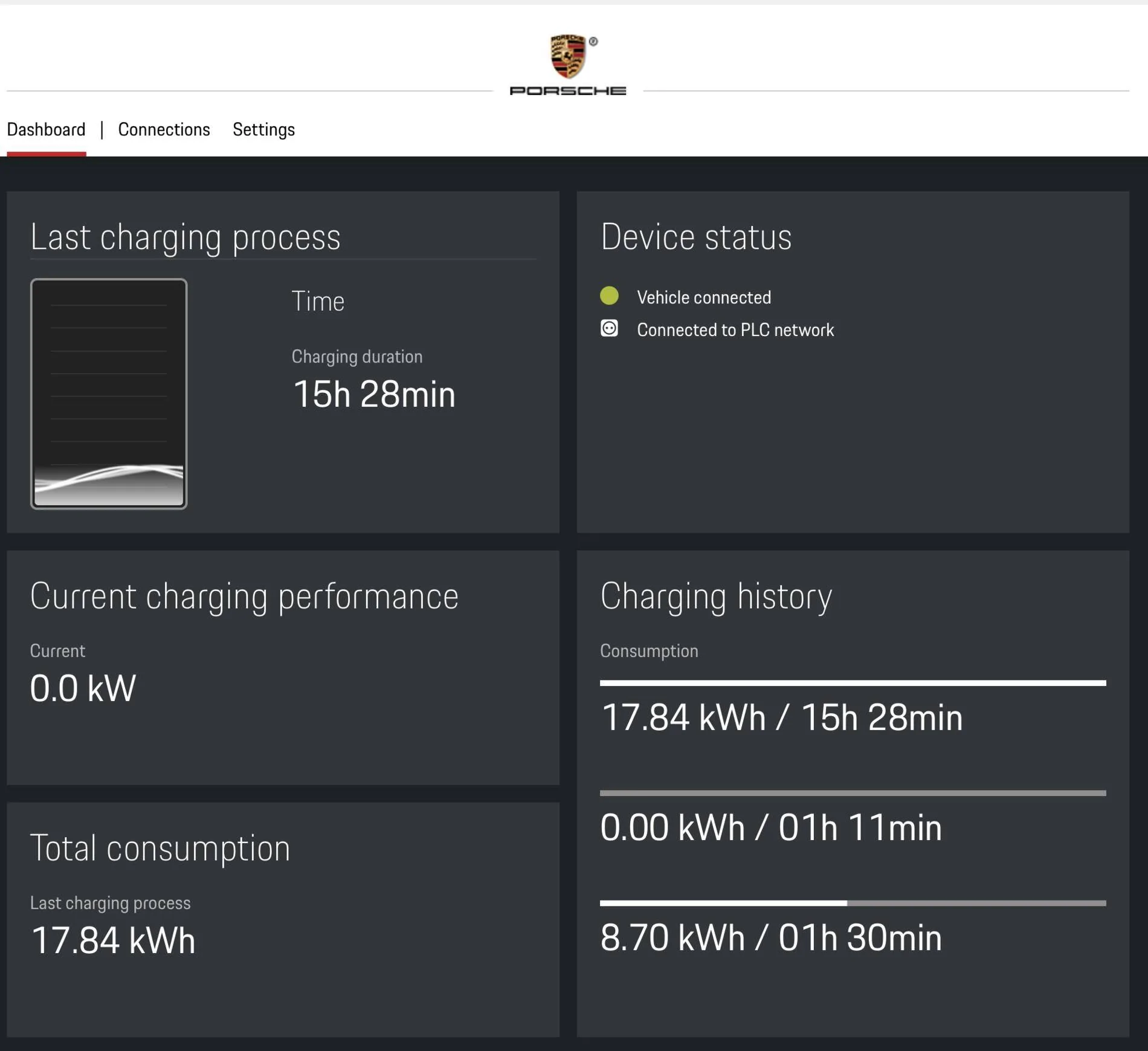
It's not super useful but I do like pulling the charge values off and putting them into a spreadsheet to see what I am spending on "fuel."

Last month was < $25 :)

Screen Shot 2021-09-05 at 6.27.29 PM.webp
My ChargePoint HomeFlex gives me this data std which is nice - not PLC related but on my home WiFi network.
 

refazi

Well-Known Member
First Name
Refael
Joined
Mar 28, 2020
Threads
6
Messages
509
Reaction score
270
Location
San Francisco, CA
Vehicles
2025 Taycan Turbo S, 2025 Taycan CT 4, 2024 Audi e-tron RS GT
Country flag
There is a pair button on mine, you press it for 2 seconds and it was able to sync with the charger.


satchurator

Well-Known Member
Joined
Mar 22, 2021
Threads
45
Messages
742
Reaction score
714
Location
Massachussets, USA
Vehicles
MY22 CT4
Country flag
I doubt there is any intentional filtering in L2 chargers to prevent Ethernet over Powerlines to pass through the relays.
I wonder if the J-1772 comms and CCS / ISO 15118 require the adjacent networks to be air-gapped?
Auto manufacturers are not known for cybersecurity prowess. Maybe it’s better if EVs’ charging systems aren’t connected to networks run by mortals. Imagine malware bricking your EV…
 

whitex

Well-Known Member
Joined
Jul 30, 2021
Threads
87
Messages
8,196
Reaction score
7,236
Location
WA, USA
Vehicles
2023 Taycan TCT, 2024 Q8 eTron P+
Country flag
I wonder if the J-1772 comms and CCS / ISO 15118 require the adjacent networks to be air-gapped?
Auto manufacturers are not known for cybersecurity prowess. Maybe it’s better if EVs’ charging systems aren’t connected to networks run by mortals. Imagine malware bricking your EV…
I don't have a copy of the ISA15118, so not sure, but I would not be surprised if there was no such requirement. I do believe the session between the car and charger is authenticated though, but I am not sure whether it's only charger authenticating the car or mutual authentication.

That said, modern cars are already connecting to mortal ran networks via bluetooth, wifi, or cellular. Heck, some cars allow users to web browse, meaning connect to arbitrary address on live internet. With web browsers in the car, it's not that difficult to get people to click, for example show them an ad (or even put up a physical poster) when at a charger "To get FREE charging, please visit some_site_url_here from your car browser. Once the user clicks, use known browser vulnerabilities to get into the car. That's just one attack vector example.
 

satchurator

Well-Known Member
Joined
Mar 22, 2021
Threads
45
Messages
742
Reaction score
714
Location
Massachussets, USA
Vehicles
MY22 CT4
Country flag
I don't have a copy of the ISA15118, so not sure, but I would not be surprised if there was no such requirement. I do believe the session between the car and charger is authenticated though, but I am not sure whether it's only charger authenticating the car or mutual authentication.

That said, modern cars are already connecting to mortal ran networks via bluetooth, wifi, or cellular. Heck, some cars allow users to web browse, meaning connect to arbitrary address on live internet. With web browsers in the car, it's not that difficult to get people to click, for example show them an ad (or even put up a physical poster) when at a charger "To get FREE charging, please visit some_site_url_here from your car browser. Once the user clicks, use known browser vulnerabilities to get into the car. That's just one attack vector example.
I’m not an automotive engineer, but as I understand it, the networking for modern cars’ core systems, whether CANBus or ethernet, is partitioned separately from those for infotainment and UI. So, similar to the PMCC, the presence of multiple network interfaces doesn’t imply they are interconnected for unbounded IP routing. Connecting to the Taycan’s wifi hotspot doesn’t mean you can then ping the battery control unit.

Imagine a building that has two completely separate ethernet networks. Device 1 on network 1 has a proprietary/non-IP-based connector to device 2 on network 2. The owner can interact with a user interface on device 1 and control/read/write in a limited way to device 2, however they can’t ping/ssh into device 2 from network 1. If network 1 and device 1 are compromised by malware, the attack surface is limited to the mischief that device 1 can enact over that proprietary interface to device 2.

… this is how I understand idealized modern car network topology to be. Would be great to hear from some card-carrying auto engineers on this.

Interesting point on authentication.
The PMCC and PWCC ship without any authentication by default, and when enabled, it’s limited to a passcode on the EVSE, plus the ability to limit which cars can charge (by PCID/VIN). The only Level 3 authentication I’m aware of is PnC’s use of PKI / chain of trust on certificate signing. But you are correct that even if your Taycan is authenticated to Electrify America’s / Ionity’s / whoever’s charging network during a PnC session, your car’s charging comms interface is still exposed to any risks carried through EA’s / Ionity’s network.


JustWatching

Well-Known Member
Joined
Jan 31, 2022
Threads
10
Messages
199
Reaction score
286
Location
USA
Vehicles
Taycan 4S (April '22)
Country flag
Progress...got the PLC to connect...uhm, where is the letter with the login info?


Top