Sponsored

Taycan Problem - potential catastrophic tire failure

OP
OP
Vim Schrotnock

Vim Schrotnock

Well-Known Member
First Name
Vim
Joined
Oct 20, 2018
Threads
37
Messages
1,269
Reaction score
1,886
Location
Cincinnati
Vehicles
GTB1 Race Cayman, Taycan Turbo S
Country flag
So - does anyone have a guess as to why this is happening, and what to do to resolve it? I believe we have established it's not the camber setting.
Sponsored

 

SoccerMan94043

Well-Known Member
Joined
Nov 24, 2025
Threads
25
Messages
686
Reaction score
452
Location
San Jose
Vehicles
2025 Taycan GTS
Country flag
At 5:30 in this video a Porsche representative says there is no camber adjustments and it's not needed; the air springs take care of things automatically.

Since I saw the video earlier in the thread of someone actually adjusting said camber (I think), I suppose this is old information or wrong. I guess FYI.

 
Last edited:

acull2000

Well-Known Member
Joined
Sep 17, 2024
Threads
0
Messages
56
Reaction score
21
Location
Warwickshire
Vehicles
Taycan GTS
Country flag
Officially only front toe adjustable:
https://www.taycanforum.com/forum/t...l-catastrophic-tire-failure.16788/post-488060
Magnitude of front camber is a factor of how it all bolts up (and Porsche show they got this wrong in the early days and had to introduce slotted bolts in the BiW to compensate for this). As I understand, the front camber can only be balanced between left and right:

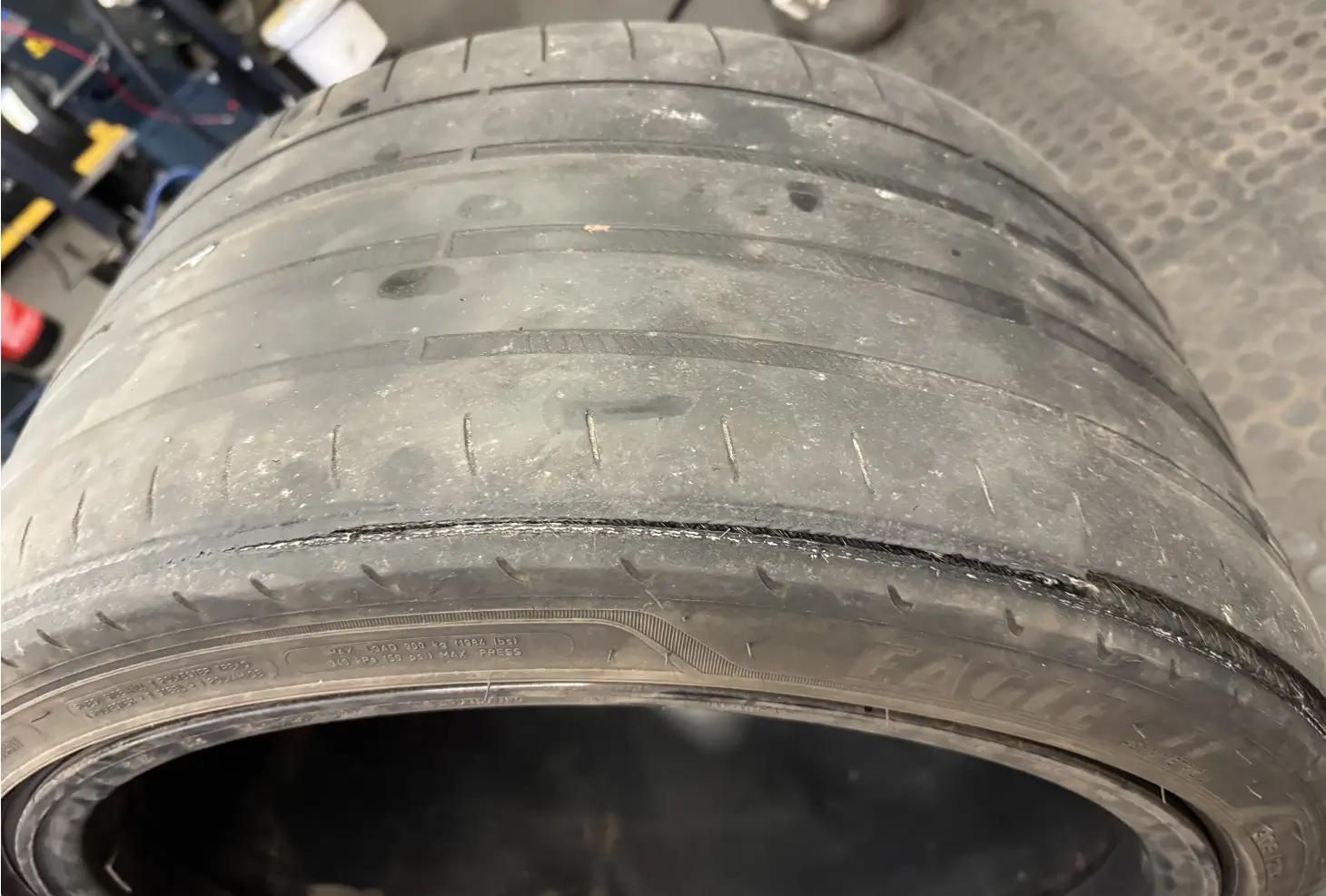
Rear toe and camber can be adjusted. But my take off today shows a tyre wear indicating positive camber setting (yuck) but still exhibiting the problem.


I am getting more convinced the tyre sidewall simply gets 'mashed', especially at pressures below recommended. Weight, camber, torque, regen etc all factors that increase this.

Anyone with a decent go-pro setup (and some time on their hands) would be able to confirm this by driving around in different heights/ pressures/ modes etc - the shoulder that's getting well worn is quite 'far' around the tyre edge so it should be obvious when it's wearing in this manner that quickly gets to cords/ wires.
 
OP
OP
Vim Schrotnock

Vim Schrotnock

Well-Known Member
First Name
Vim
Joined
Oct 20, 2018
Threads
37
Messages
1,269
Reaction score
1,886
Location
Cincinnati
Vehicles
GTB1 Race Cayman, Taycan Turbo S
Country flag
I'm going to throw this out there - it's an interesting possibility. What if we're not looking at a shoulder wear problem, but a separation of the tread/sidewall due to excessive stress?
 

acull2000

Well-Known Member
Joined
Sep 17, 2024
Threads
0
Messages
56
Reaction score
21
Location
Warwickshire
Vehicles
Taycan GTS
Country flag
I'm going to rule that out since there's always wear (externally) in a similar pattern around the shoulder, before the separation occurs. Even if it's not uniform, the wear always seems to be a precursor to the separation (eg from other tyre today):
Porsche Taycan Taycan Problem - potential catastrophic tire failure 1767131938441-4l


Jasper4S

Well-Known Member
First Name
Jasper
Joined
Oct 5, 2022
Threads
27
Messages
1,467
Reaction score
2,140
Location
Netherlands
Vehicles
Taycan 4s ST, Jeep Avenger EV, KTM Duke 790
Country flag
Are all tires from the same brand? All same rims? Or at least same inch? J1.1 only? Same MY? Do you all have the saloon, CT or ST?

In order to speculate we need to write down the facts.

so far we know
- it is not RAS
- it is not Sport Plus or Range mode (lowered)
 

Jonathan S.

Well-Known Member
First Name
Jonathan
Joined
Jan 19, 2023
Threads
43
Messages
2,089
Reaction score
1,908
Location
Amherst MA & Twin Mtn NH
Website
tinyurl.com
Vehicles
'22 4CT, '22 Audi A6 Allroad, '23 BMW i4 M50
Country flag
Many BMW i4 owners report the same problem. But no option for RWS or adjustable height suspension on the i4.
(And we haven’t had that problem on our i4 either.)
 

Fish Fingers

Well-Known Member
Joined
Feb 20, 2021
Threads
50
Messages
2,528
Reaction score
3,279
Location
UK
Vehicles
Sold
Country flag
Are all tires from the same brand? All same rims? Or at least same inch? J1.1 only? Same MY? Do you all have the saloon, CT or ST?

In order to speculate we need to write down the facts.

so far we know
- it is not RAS
- it is not Sport Plus or Range mode (lowered)
From memory........
I think variations of; wheel size and alloy style, tyre brand, model year, model (4s etc), RAS (or not), climate/location have been affected.

Even driving style, as some (like me) rarely had the chance to drive the car aggressively. Never tracked.

Uncertain on any J1.2 affected or model variant (saloon/ST/CT).

As mentioned above, its not uniquely Taycan either, as I've also seen similar on the i4 forum, although less common.

Im no expert! but my suspicion is low tyre pressure......combined with all that weight and torque, puts too much stress on that inner tyrewall (especially on low chassis setting).
In effect the whole weight of the car is concentrated on that inner edge of the rear tyres when accelerating (more so when under-inflated).
 
Last edited:


Jasper4S

Well-Known Member
First Name
Jasper
Joined
Oct 5, 2022
Threads
27
Messages
1,467
Reaction score
2,140
Location
Netherlands
Vehicles
Taycan 4s ST, Jeep Avenger EV, KTM Duke 790
Country flag
Maybe I’m missing something, but I’m genuinely confused. Most of us run NF0-approved tires, which are specifically homologated by Porsche for the Taycan. We’re repeatedly told these are required to avoid warranty discussions or coverage issues.

Now Porsche is reportedly denying warranty claims even when NF0 tires are fitted. If that’s true, what exactly is the point of insisting on NF0 tires in the first place?

"Other brand have it too" is not a valid argument as other tire brand have tires too. And somehow those are not good enough according to Porsche
 

cityhpper

Well-Known Member
First Name
Johan
Joined
Feb 4, 2022
Threads
3
Messages
214
Reaction score
257
Location
Agder
Vehicles
22 GTS ST, 22 CT4 (sold).
Country flag
On my first Taycan (2022 CT4), I went through all the available rim/tyre sizes: 19", 20" and 21".

The 19" rims came with Hankook summer tyres - over about 11 000 kms (6800 miles) I could hardly notice any wear at all. Then went to a set of 20" rims and the Michelin Pilot Sport 4 tyres. Over two summers they began to show clear signs of inner wall wear, but only on the rear tyres. I recon I put about 16 000 kms (10 000 miles) on them. Tyre pressures were as recommended by the PCM and always according to full load settings.

Then changed to a set of 21" rims and Hankook iON tyres. I drove about 14 000 kms (8700 miles) on these. Pressure at (PCM full load+0,1 bar), and slight signs of inner wall wear - but less than on the PS4.

Car driven in Normal mode but due to much motorway driving, automatically goes into lowered level.

These are purely my own observations, but my conclusions so far is:

1. Tyres are different, and the NF0-ones are not necessarily superior to others when it comes to inner wall wear.
2. Stay on the higher side of PCM recommended tyre pressures, then align according to how the car drives and individual use case (climate, road surface quality, spirited driving style, etc.). I'm fine with slightly over-inflated tyres.
3. For the rear axel, toe settings might play a bigger role than camber...
 

SoccerMan94043

Well-Known Member
Joined
Nov 24, 2025
Threads
25
Messages
686
Reaction score
452
Location
San Jose
Vehicles
2025 Taycan GTS
Country flag
looks like there has been some change for me (2025 GTS, 21" RS Spyder Wheel, Pirelli P Zero R):

According to the document trail, it was (for "summer tire", partial load ): 37 Front / 41 Back

It's now(for "summer tire", partial load ):: 41 Front / 42 Back

I just received my car from the dealer last week and they are indeed set to 41/42.

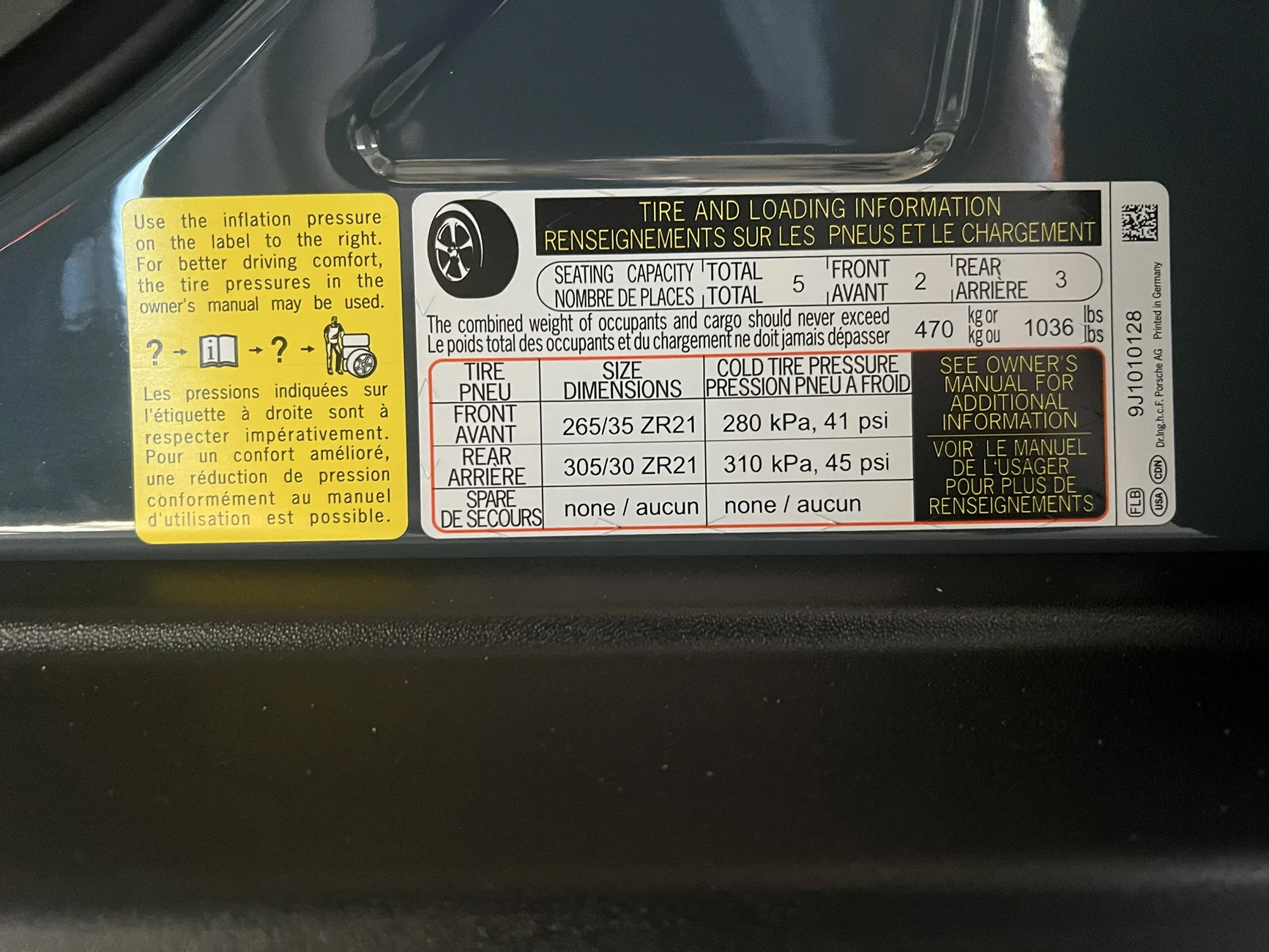
Also, the tag on my car says this:

doorjamcard.webp
Looks like I read that wrong... the updated data says, for Summer Tires/UHP: 37/39 partial load and 41/44 full load (same as the door jam sticker). I'm currently at 41/42 for some reason only known to Porsche Scottsdale.
 

acull2000

Well-Known Member
Joined
Sep 17, 2024
Threads
0
Messages
56
Reaction score
21
Location
Warwickshire
Vehicles
Taycan GTS
Country flag
A short while ago I noticed the load rating of the 21" tyres (101 104) are lower than the 19" (103 108) or 20" (103 108 or 101 105). This got me looking up:
- 101 rating (front) is good for 825kg
- 104 (rear) is good for 900kg
Clearly 3,450kg is collectively high enough for the static Taycan GVWR of 2,850kg.

However it got me thinking, that if you had a 2-up car (2,350+ 2 x 75kg) at say 2,500kg, it wouldn't take a whole lot of weight transfer to one side to exceed the tyre load rating. Eg if you went round a decent corner it would only take transferring 500kg of load from the left side of the car to the right, and the right hand tyres would be subject to 1750kg, exceeding one or both ratings.

I become suspicious of the effects that occasionally exceeding the (static) load rating would have. Thinking about it - the tyre sidewall deflects every revolution causing heat build up and significant energy in the sidewall. If the sidewall deflection is excessive (due to exceeding the load rating at that pressure), then it's anyone's guess what structural damage is being done to the sidewall (even down to delamination of the layers). I do wonder whether excessive sidewall deflection explains the inner shoulder wear we are seeing (and not the tyre physically touching/wearing on the road as I first thought - this would at least explain the incredulous angle of rubber wear on the inner shoulder).

For this reason I now understand the importance of the "XL" (extra load construction)/ "EV approved" tyre constructions (meaning they are designed not specifically with higher load ratings, but with a reinforced construction that is more robust to this kind of abuse, and will fail gracefully as I recently experienced with my two otherwise badly delaminated rears).

Further to this, I learnt the maximum load rating 101=825kg and 104=900kg are only true at the ETRTO reference pressure (42PSI for XL tyres). So if you inflate to the standard Porsche PSI (37/39psi in my case), the tyre load capability is lower (down to 725kg front, 835kg rear, or 3,125kg collectively). You don't have to get very low (eg 30/32 psi) until your tyre load capability is lower than the static laden condition (never mind weight trasnfer)! This raised my suspicion that we are really at the boundary of tyre capability, possibly exceeding it, and that tyre pressure is a fundamental fix to this issue.

When I reviewed the Porsche tyre TSBs, I noticed the statements:
"The tire pressure [...] is specified for cold tires [...]. The tire pressures must never be lower than the specified values". As such we should keep pressures firmly above this (rather than seeing it as a target / nominal).

I use my car in a variety of temperatures and load conditions (usually family+luggage or solo) so also chose to set to the fully laden pressures (cold) 41/45psi all the time, so as I don't have to pump up the tyres when people get it. Whilst this is artificially high (and sacrifices comfort), it's inline with Porsche guidance, respects Goodyear's maximum (cold) inflation pressure written as 50PSI on the tyre, and can be easily backed off if I see the centre of the tyre tread wearing.

Hopefully this will stop (or reduce) the inner shoulder wear going forwards 🤞
 
Last edited:

SoccerMan94043

Well-Known Member
Joined
Nov 24, 2025
Threads
25
Messages
686
Reaction score
452
Location
San Jose
Vehicles
2025 Taycan GTS
Country flag
A short while ago I noticed the load rating of the 21" tyres (101 104) are lower than the 19" (103 108) or 20" (103 108 or 101 105). This got me looking up:
- 101 rating (front) is good for 825kg
- 104 (rear) is good for 900kg
Clearly 3,450kg is collectively high enough for the static Taycan GVWR of 2,850kg.

However it got me thinking, that if you had a 2-up car (2,350+ 2 x 75kg) at say 2,500kg, it wouldn't take a whole lot of weight transfer to one side to exceed the tyre load rating. Eg if you went round a decent corner it would only take transferring 500kg of load from the left side of the car to the right, and the right hand tyres would be subject to 1750kg, exceeding one or both ratings.

I become suspicious of the effects that occasionally exceeding the (static) load rating would have. Thinking about it - the tyre sidewall deflects every revolution causing heat build up and significant energy in the sidewall. If the sidewall deflection is excessive (due to exceeding the load rating at that pressure), then it's anyone's guess what structural damage is being done to the sidewall (even down to delamination of the layers). I do wonder whether excessive sidewall deflection explains the inner shoulder wear we are seeing (and not the tyre physically touching/wearing on the road as I first thought - this would at least explain the incredulous angle of rubber wear on the inner shoulder).

For this reason I now understand the importance of the "XL" (extra load construction)/ "EV approved" tyre constructions (meaning they are designed not specifically with higher load ratings, but with a reinforced construction that is more robust to this kind of abuse, and will fail gracefully as I recently experienced with my two otherwise badly delaminated rears).

Further to this, I learnt the maximum load rating 101=825kg and 104=900kg are only true at the ETRTO reference pressure (42PSI for XL tyres). So if you inflate to the standard Porsche PSI (37/39psi in my case), the tyre load capability is lower (down to 725kg front, 835kg rear, or 3,125kg collectively). You don't have to get very low (eg 30/32 psi) until your tyre load capability is lower than the static laden condition (never mind weight trasnfer)! This raised my suspicion that we are really at the boundary of tyre capability, possibly exceeding it, and that tyre pressure is a fundamental fix to this issue.

When I reviewed the Porsche tyre TSBs, I noticed the statements:
"The tire pressure [...] is specified for cold tires [...]. The tire pressures must never be lower than the specified values". As such we should keep pressures firmly above this (rather than seeing it as a target / nominal).

I use my car in a variety of temperatures and load conditions (usually family+luggage or solo) so also chose to set to the fully laden pressures (cold) 41/45psi all the time, so as I don't have to pump up the tyres when people get it. Whilst this is artificially high (and sacrifices comfort), it's inline with Porsche guidance, respects Goodyear's maximum (cold) inflation pressure written as 50PSI on the tyre, and can be easily backed off if I see the centre of the tyre tread wearing.

Hopefully this will stop (or reduce) the inner shoulder wear going forwards 🤞
I was doing the same thing until a few weeks ago when I had my car in for a tire replacement and they returned it 37 front and 38 back :\

I ended up deciding to split the difference and as of that evening I'm now running 39 front and 41 back. They read 40 to 41 front and 42 in back pretty quickly after driving off however.
 

Longy_UK

Well-Known Member
Joined
Mar 18, 2024
Threads
5
Messages
194
Reaction score
276
Location
Uk
Vehicles
'24 Taycan GTS ST
Country flag
I have just experienced the same wear on Bridgestone Asymmetric 3 NF0's. Car is a GTS.

BUT - I have had the fronts on for circa 17,000miles and the rears for circa 19,000miles. This is a 2tonne+ 600Bhp car; I see that tyre wear and ultimate giving up as acceptable.

To put this is perspective my C8 RS6 would eat a set of Pirellis in about 15,000miles. Thats a car of similar weight and performance.

I have read a few instances on this thread of people complaining about wear after 20k?? These cars are not 190bhp fwd diesels. The tyres are fighting for their life from the moment they are fitted.

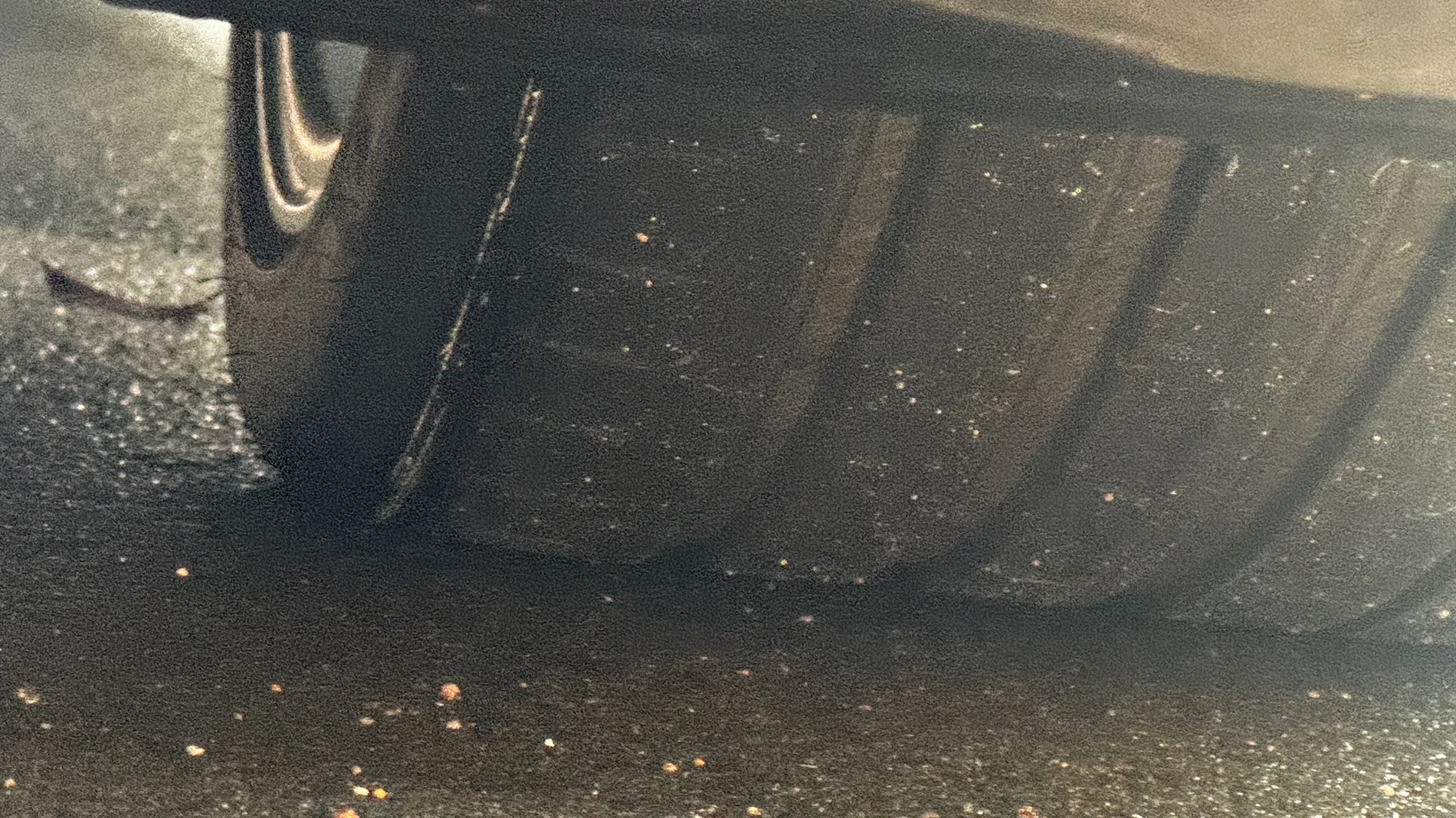
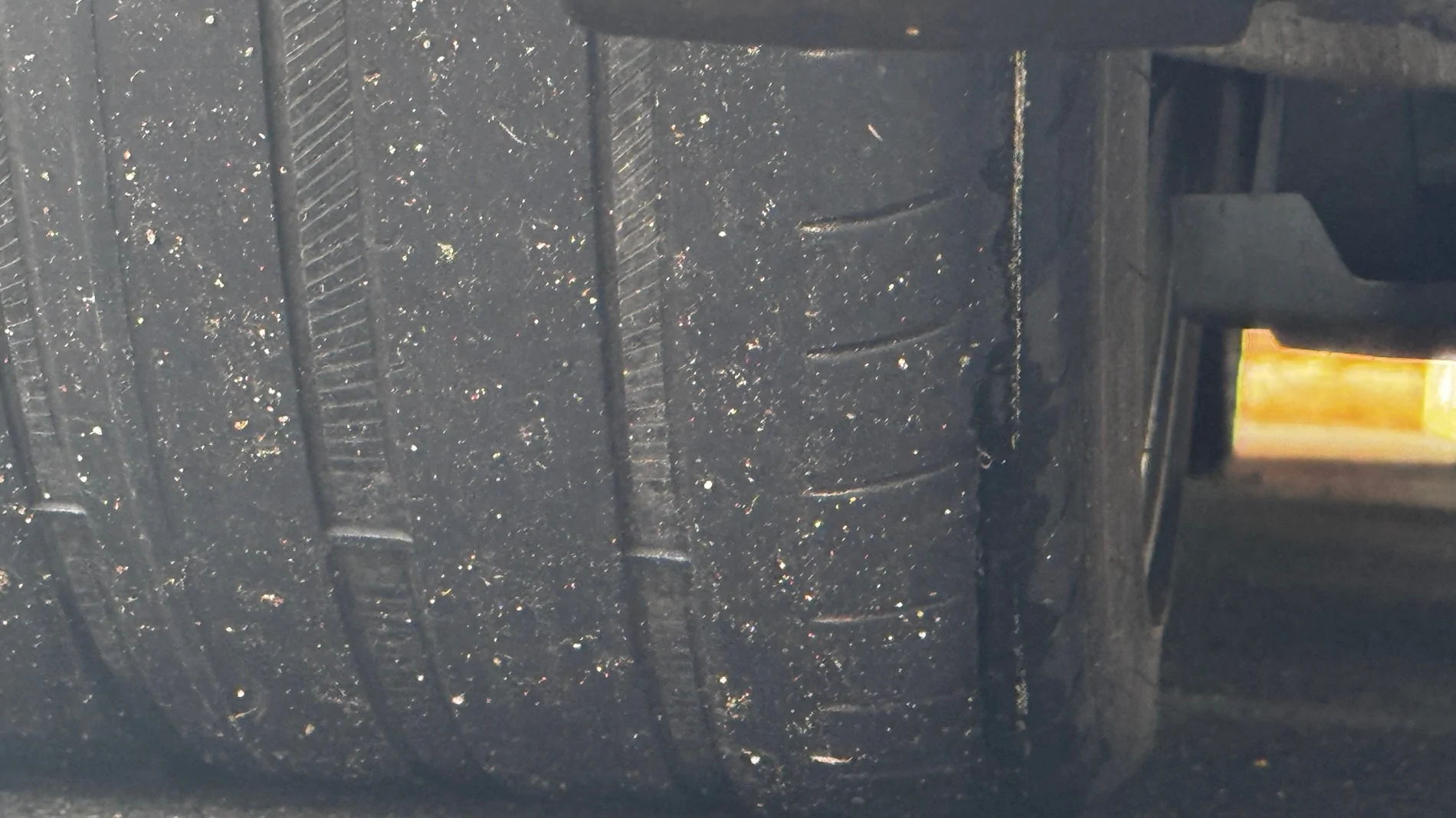
Heres how mine looked.

Porsche Taycan Taycan Problem - potential catastrophic tire failure IMG_9943

Front.


Porsche Taycan Taycan Problem - potential catastrophic tire failure IMG_9944

Rear.

As i say - given my experience of performance cars I feel this is actually good for the use.

Cheers.
Sponsored


Top